

Learning how to choose a furniture manufacturer in China is not a matter of finding the best-looking catalogue or the lowest unit price. It is a controlled decision about whether a named supplier can make a defined product, with approved materials and workmanship, on an achievable schedule, under documented quality and change controls.
For a B2B buyer, the most useful question is therefore not “Is this factory good?” It is: “What evidence shows that this supplier can meet the requirements of this product, this order, this destination and this risk level?”
That approach aligns with NIST’s supplier-selection guidance, which asks manufacturers to assess capability, quality systems, capacity, people, equipment, maintenance, logistics and total cost—not price alone. It also aligns with the OECD’s risk-based due-diligence framework, which treats due diligence as an ongoing cycle of identifying risks, taking action, tracking outcomes and communicating how issues are addressed.
This guide turns that principle into 15 practical evaluation dimensions for buyers comparing furniture manufacturers in China. It explains what to verify, what evidence to request, how to control samples and revisions, and when a gap should pause the order.
Key Takeaways
- Verify the legal entity, operating site, payment beneficiary and actual production role before paying a deposit.
- Compare suppliers against one controlled product specification; otherwise price and lead-time comparisons areunreliable.
- Treat a sample as a production reference only when its version, materials, finish, structure, hardware and packagingdecisions are identifiable.
- Ask for order-specific records, not generic certificates or showroom photographs.
- Match inspection, testing and documentation to the product, intended use, destination and customer contract.
- Start with a risk-controlled order, then expand volume only after quality, delivery and communication evidence supports it.
What Does “How to Choose a Furniture Manufacturer in China” Mean for a B2B Furniture Buyer?
Choosing a China furniture manufacturer means deciding whether a supplier is suitable for a particular commercial program. A retailer may prioritize repeat-order finish consistency. A brand may require drawing control, confidentiality and OEM engineering. A hotel project may emphasize installation interfaces, documentation and milestone control. An event-rental buyer may value durability, replacement availability, storage efficiency and rapid replenishment.
These buyers may all source “furniture,” but they should not use the same scorecard. Supplier approval must begin with the intended use, foreseeable failure modes and the consequences of late delivery, nonconforming materials or product damage.
Scope and Buyer Decision
The decision should answer five questions:
- Is the supplier the legal and operating entity it claims to be?
- Can it make the specified product and control any outsourced processes?
- Can it reproduce the approved result in mass production?
- Can it provide usable evidence for quality, delivery, packaging and applicable requirements?
- Can it support repeat orders, changes and corrective action over time?
Start by checking the registered business name, address, responsible contacts and payment details. The U.S. International Trade Administration recommends due diligence before concluding an international agreement and notes that a background review may cover general business information, key officials, references, financial or credit information and reputation. Its company and partner risk guidance also warns that a poor choice can create financial, legal and reputational consequences.
For a potential Chinese supplier, compare the entity named on the business license, quotation, contract, invoice and payment request. Then connect that entity to the actual production location, equipment, staff, current work and finished inventory. The detailed factory-verification process should be completed before a high-risk deposit or bulk order, while the broader manufacturer-evaluation framework should test product fit, technical capability and commercial reliability.
In MrsWoods’ procurement practice, a change to the receiving bank account is treated as a fresh verification event: the team rechecks the business license, contact path and invoice information, then routes the change for appropriate commercial or financial review. This is a practical control, not a guarantee against fraud, and buyers should define their own approval authority.
What This Article Does Not Cover
This article does not replace legal advice, a product-specific test plan, an independent audit or the importer’s compliance responsibilities. Requirements vary by product type, materials, intended use, destination, sales channel and contract.
A storage cabinet sold in the United States, for example, may fall within a specific safety rule, whereas a dining chair, hospitality table or rental bar stool will follow different requirements. The correct sequence is to identify the exact product and market first, then define the applicable tests, labels, declarations and records.
Map the 15 Supplier-Evaluation Dimensions
The 15 dimensions work as a decision system, not as a list of links. Each one answers a different risk question, and the evidence should appear at the stage where the buyer needs it.
Separate Identity, Reliability and Capacity
Identity asks who is contracting, producing and receiving payment. Reliability asks whether the supplier follows agreed specifications and closes problems. Capacity asks whether its people, equipment, materials and workload can support the proposed order.
Capacity should be checked against the actual process route and current workload, not a headline monthly-output claim. NIST’s guidance specifically recommends reviewing where the buyer fits within the supplier’s capacity, as well as staffing, equipment, maintenance and logistics. A practical factory-capacity review should therefore examine bottlenecks, subcontracting and order-specific planning. Evidence of quality consistency should then show whether material, construction, colour, finish and workmanship remain controlled across a batch and subsequent orders.
Communication is evidence too. A supplier that answers technical questions clearly, identifies document versions, reports exceptions early and names decision owners is easier to control than one that only promises a delivery date. The supplier-communication checklist should cover technical queries, progress evidence, change approval and escalation. These records also become part of the evidence used to judge a long-term furniture supplier after the first order.
Buyer Acceptance Criteria
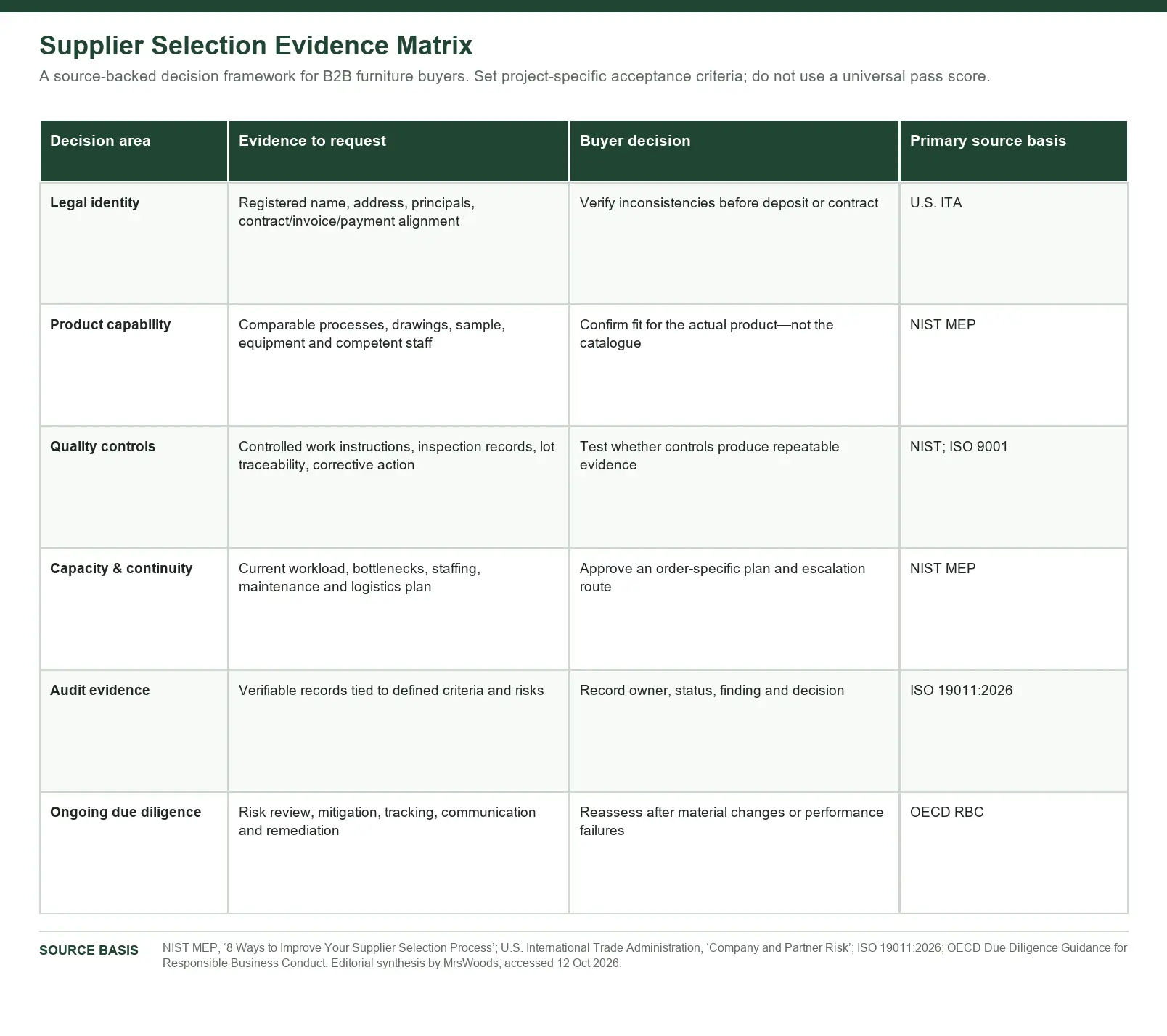
Before comparing candidates, define what counts as sufficient evidence. ISO 19011:2026 describes an evidence-based and risk-based approach to auditing management systems, and it recognizes that audit criteria may include requirements from standards, contracts, policies or regulations. The ISO 19011:2026 overview is useful here as a method for planning and documenting an audit; it is not, by itself, a furniture-factory certification.
The matrix below converts authoritative guidance into buyer actions. It deliberately avoids a universal pass score: acceptance limits must be set for the actual product and order
Define Materials, Quality and Sample Approval Gates
Supplier comparison becomes unreliable when each quotation assumes a different product. Create one controlled specification covering dimensions, construction, materials, visible surfaces, finish, hardware, performance, packaging and documentation. Then use that same reference for quotation, sample approval, production and inspection.
Materials and Product Definition
Descriptions such as “oak,” “marble,” “high-density foam” or “export packaging” are not complete specifications. For wood furniture, identify which components are solid wood, where veneer is used, the substrate, visible surfaces, edge treatment, colour reference and finish. For upholstery, define fabric reference, composition where required, colour, sewing details, filling or foam requirements, hardware and approved appearance. Stone, metal and mixed-material products need the same level of clarity.
Moisture is especially important in wood and wood-based products. ASTM D4442 states that moisture content is one of the most important variables affecting the properties of wood and wood-based materials, and the USDA Forest Products Laboratory explains how moisture changes can cause dimensional change. These sources support measuring and controlling moisture where it is relevant; they do not create one universal moisture limit for every species, construction, destination and service environment. The buyer should set the applicable criterion with technical input and record the method used.
The detailed furniture material specification should connect drawings and bills of materials to inspection points. Buyers can use ASTM D4442’s moisture-content methods and the USDA Wood Handbook chapter on moisture and dimensional change as technical references when building a suitable wood-control plan.
Turn the Sample into a Controlled Reference
A sample is useful only if the approved attributes are identifiable. Review dimensions, materials, structure, load-bearing connections, stability, colour, sheen, texture, workmanship, hardware, moving parts, assembly and packaging. Retain the drawings, material references, photographs and written confirmation that establish the approved version.
MrsWoods’ practical sample review uses the same categories that later guide production checks: dimension, material, structure, surface, function and packaging. The exact approval route can vary by project—email, marked drawing, sample record or customer system—so the article does not impose a universal signature format. The control objective is that the current approved reference can be identified and retrieved.
The furniture sample approval process explains how to establish that reference. When a design, material, colour, finish, structure, hardware or packaging item changes, assess its effect before production continues. ISO 10007 provides guidance on configuration management across a product or service life cycle; applying that principle through a controlled revision record helps prevent an obsolete drawing or sample from remaining in use.
Compare MOQ, Quotations and Lead Time on the Same Basis
MOQ, price and lead time are linked. Material supplier minimums, tooling, setup, printed packaging, special finishes and SKU fragmentation can all affect the commercial result. MrsWoods’ standard starting MOQ is 10 pieces per style, but feasibility, unit price and schedule still depend on the actual material, finish, packaging and SKU mix. Buyers should confirm the current project basis before treating any MOQ as fixed.
The furniture MOQ guide explains these cost drivers. When reviewing prices, compare factory quotations against the same drawing, materials, construction, finish, hardware, packaging, quantity, inspection, testing, trade term and payment basis. The ICC’s official Incoterms® 2020 checklist confirms that the 11 rules allocate transport obligations, costs and risks between buyer and seller; the named rule and place should therefore be explicit rather than implied.
Lead time must also start from a defined event. Sample development and mass production use different clocks. Material approval, final drawings, deposit, sample confirmation, production, inspection, packaging and shipment preparation should appear as separate milestones. The furniture manufacturing lead-time framework helps buyers identify dependencies instead of relying on one unsupported delivery promise.
Use Risk-Based Quality Gates
Quality control should begin before final inspection. Incoming materials, first article, work in progress, finished products and packaging each answer different questions. The furniture quality-control process should define what is checked, by whom, against which version and what happens when the result fails.
If sampling is used, the buyer must specify the lot, inspection level, sampling plan, defect categories and acceptance criteria. ISO 28590 introduces the ISO 2859 family of attribute-sampling standards, but it does not justify choosing an arbitrary AQL or applying one plan to every defect. Critical product-safety or regulatory characteristics may require a different control than cosmetic workmanship.
The control-gate table below shows where evidence should be created from supplier approval through shipment.
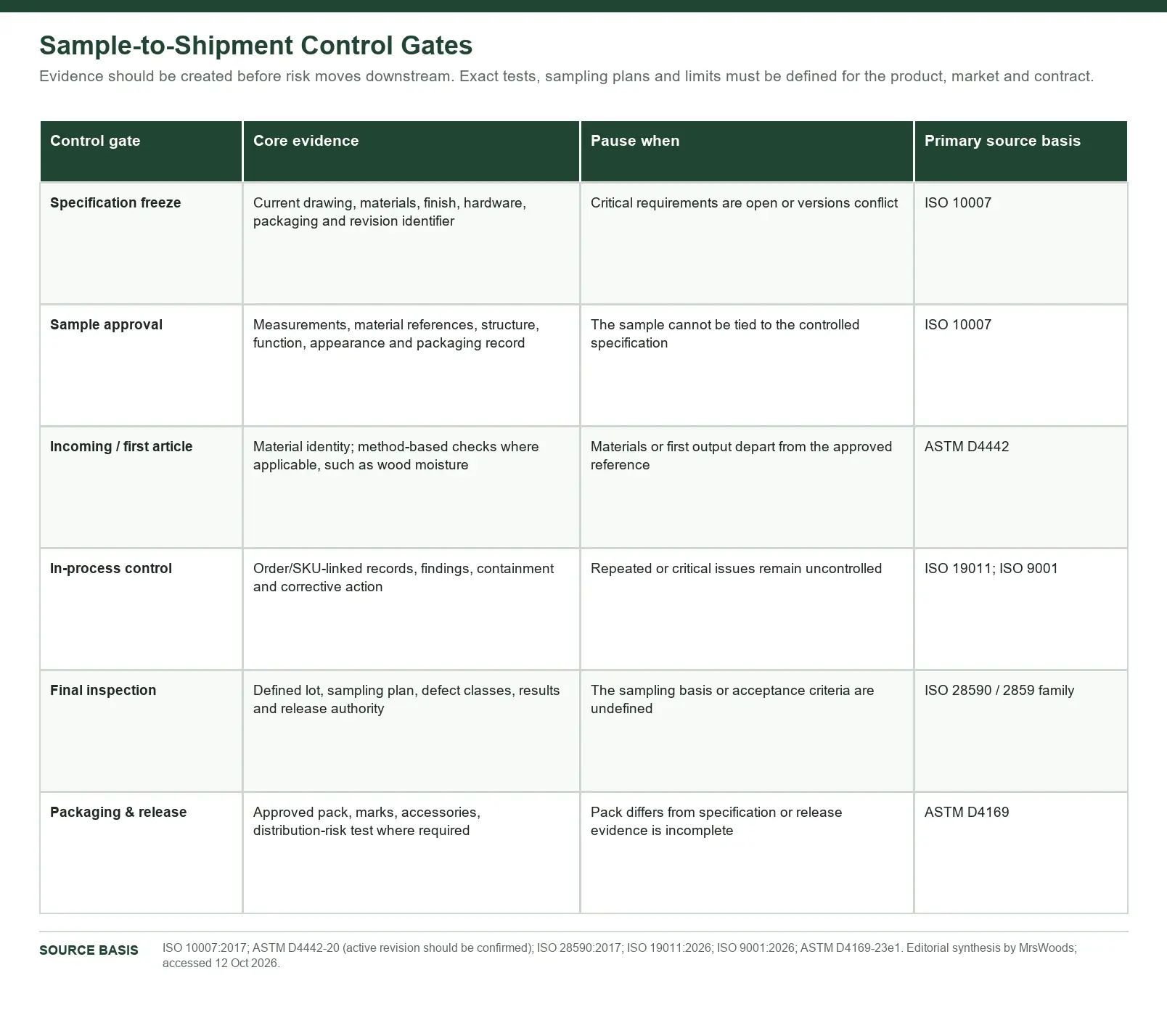
The ISO 28590 overview is the authoritative starting point for understanding the attribute-sampling family. The project’s quality professional should select and document any actual sampling plan.
For a new supplier, MrsWoods’ procurement practice generally uses an approved sample before mass production, then controls exposure through an appropriate first order. Orders can be allocated according to supplier strengths, with later volume increases based on quality, on-time delivery and communication evidence. This is a risk-control approach rather than a promise that every project follows an identical sequence.
Verify Packaging, Compliance and Long-Term Fit
A product that passes appearance inspection can still fail during distribution or after entering the market. Packaging and compliance therefore belong in supplier selection, not after production is complete.
Packaging Must Match the Distribution Risk
Define the outer carton, internal protection, corner protection, securing method, hardware pack, assembly instructions, labels, carton marks and customer-specific requirements. Consider the distinct risks of stone, glass, metal, finished wood, upholstery and protruding components. Knock-down construction may improve container utilization, but it can add connection, missing-hardware and assembly risks.
ASTM D4169 provides a uniform laboratory basis for evaluating whether shipping units can withstand anticipated distribution hazards. It states that the test sequence should represent the intended distribution environment; it does not mean every furniture shipment requires the same cycle or level. Use the ASTM D4169 packaging-performance reference when developing an appropriate test plan, and use the furniture export-packaging checklist to translate the plan into materials, protection, labels and loading controls.
MrsWoods’ packaging checks can cover the outer carton, liners, corner protection, internal fixation, labels, carton marks and any agreed test or customer requirement. Packaging approval is coordinated among quality, business and customer roles as applicable to the project; it is not treated as a generic “export standard” without a written specification.
Compliance Is Product- and Market-Specific
Ask five questions: What is the exact product? What materials and intended use apply? Where will it be imported and sold? Which legal or customer requirements apply? Does each report or declaration match the current product, material, model, method and scope?
The U.S. Consumer Product Safety Commission’s mandatory standards and business-guidance index illustrates why generic “furniture compliance” claims are unsafe: certain products, including in-scope clothing storage units, have specific rules. A report for another model, material or product category should not be accepted merely because it belongs to the same supplier.
The furniture compliance requirements guide explains how product, material, use, destination, testing, documents and labels interact. The importer or appointed specialist should confirm the current legal obligations before ordering and again when the product, material, process or market changes.
Turn Findings into a Weighted Shortlist
Classify each criterion as mandatory, risk-adjusted or commercial preference. Legal identity, payment verification, critical product safety, material accuracy and confirmed market requirements usually belong in the mandatory group. A limited history with one finish may be manageable through added sampling or inspection. A wider catalogue may be useful, but it should not outweigh evidence for the actual product.
Do not hide uncertainty inside a total score. Record the evidence, owner, status and decision reason. If one mandatory item fails, a high average score should not make the supplier approvable.
Escalation or Approval Gate
Pause the process when:
- the contracting entity, invoice entity and payment beneficiary do not align;
- factory evidence cannot be connected to the stated site or current order;
- a material, structure, finish, hardware item or process differs from the controlled specification;
- the sample and final drawing conflict;
- capacity or delivery claims lack an order-specific plan;
- a required report does not match the product or scope;
- repeated defects remain open without cause, containment and corrective action.
The response may be a renewed identity check, site visit, revised sample, independent test, third-party inspection, smaller first order, corrective action or rejection. The action should be proportional to the risk and documented
What Evidence, Records and Approvals Should Buyers Require?
A good supplier file lets another qualified team member reconstruct what was required, approved, changed and released.
Required Records
Depending on the project, retain:
- supplier identity, operating-site and contact information;
- quotation, contract or purchase order and payment instructions;
- controlled drawings, specifications and bill of materials;
- material, colour, finish, fabric, stone and hardware references;
- sample evidence and approval record;
- packaging and labelling specification;
- change requests, impact review and revised versions;
- order-specific progress records;
- inspection findings, nonconformities and corrective actions;
- applicable reports, declarations and destination documents;
- packing list and shipment-release records.
A photograph without an order or product reference has limited evidential value. A drawing without a version can be confused with an obsolete file. A certificate without a valid scope does not prove that the current product or process is covered.
ISO’s publication on supplier confidence explains that an ISO 9001 claim may be supported in different ways, including supplier declaration, customer assessment or third-party certification. Even a valid certificate should be checked for issuer, accreditation where relevant, validity and scope. The current ISO 9001:2026 overview describes the quality-management-system requirements, while ISO’s supplier-confidence guidance explains the distinction between first-, second- and third-party evidence.
Named Owners and Revision Control
Assign an owner to each approval. Product or design teams may approve appearance and function. Procurement may own supplier and commercial records. Quality may define inspection and release. Logistics may approve packing and shipment data. The importer or appointed specialist should own market-specific compliance decisions.
The supplier should also identify who owns sales, engineering, production, quality and shipment coordination. When a change affects cost, stock, process, schedule, quality or compliance evidence, update the controlled documents and obtain the required project approval before implementation.
MrsWoods’ specification-freeze practice brings the final drawing, material, colour, finish, packaging and marks into one controlled reference. A proposed change is reviewed for its effect on cost, inventory, process, timing, delivery and quality, then the relevant documents are updated. This is the kind of traceability buyers should require from any serious supplier.
What Red Flags and Common Mistakes Should Buyers Avoid?
Most furniture sourcing from China problems are visible as evidence gaps before they become shipment problems.
Evidence Gaps
Treat these as warning signs:
- registered, contractual, invoicing or payment names conflict without a verified explanation;
- the supplier shows finished-product photographs but no traceable process or site evidence;
- materials are described only with marketing terms;
- the quotation omits packaging, testing, tooling, hardware or required records;
- the sample differs from the current drawing or material reference;
- production begins while critical requirements remain open;
- progress updates contain promises but no order-specific status;
- a material, finish, hardware item or process changes without approval;
- recurring defects are closed without a documented cause and action;
- delivery dates move repeatedly without a revised milestone plan.
Another mistake is choosing among furniture suppliers from China solely from a marketplace profile, showroom or
certificate file. These can help identify candidates, but none proves that the current order is controlled.
When to Pause, Recheck or Reject
Pause when missing information can materially affect payment security, product safety, quality, cost, schedule or compliance.
Recheck when the supplier changes an entity, account, production site, material, design, process, report or delivery plan.
Reject when a critical inconsistency cannot be resolved, evidence appears unreliable, necessary controls are refused or repeated failures make the residual risk unacceptable.
The result should be product- and order-specific. A supplier may be capable in one category but unsuitable for another material combination, tolerance, order size or delivery window.
How Can MrsWoods Support This Stage of the Sourcing Process?
MrsWoods supports B2B furniture buyers including brands, retailers, wholesalers, rental companies, design companies and hospitality or commercial-project clients. Its confirmed positioning is mid- to high-end furniture supply, customization, wholesale, OEM and ODM, supported by product development, supply-chain coordination, quality checking, packaging and export services.
Confirmed Capability and Project Fit
In an OEM project, the buyer may provide drawings, specifications, materials and brand requirements. In an ODM project, MrsWoods can support product design and development when the buyer does not begin with a complete production package. The correct route depends on how mature the product information is; the OEM and ODM capability guide explains the difference in development, engineering and approval responsibilities.
MrsWoods can work across wood, marble, metal, woven materials, upholstery and other combinations. Its confirmed quality support includes comprehensive pre-shipment checking and cooperation with customer-appointed third-party inspection when required. These statements describe available support; the exact inspection plan, test scope, tolerance, lead time and capacity must still be confirmed for the specific project.
The MrsWoods sourcing and custom-development services connect requirement definition, supplier coordination, sampling, production follow-up, quality checking, packaging and export preparation. Buyers should provide the product category, destination, expected quantity, customization needs and available technical information so the highest-risk questions can be addressed first.
Facts to Confirm Before Ordering
Always reconfirm current capacity, lead time, material availability, tolerances, testing, certification, destination requirements and the project’s approval route. These can change by product, quantity, supplier and production period, so they should not be inferred from a previous order.
Frequently Asked Questions
What is the best way to choose a furniture manufacturer in China?
Use a controlled product specification and a risk-based evidence plan. Verify the entity and production role, then evaluate materials, sample control, quality, capacity, communication, packaging, delivery and applicable market requirements against the same criteria.
What evidence should a B2B buyer request?
Request evidence connected to the actual supplier, product and order: company details, controlled drawings, material references, samples, production records, inspection findings, packaging specifications, revision history and relevant reports. Check scope and validity rather than collecting documents without context.
Does ISO 9001 certification prove that the furniture will meet the specification?
No. A valid, relevant ISO 9001 certificate can support confidence in a supplier’s quality management system, but it does not replace product specifications, sample approval, inspection, testing or order-specific evidence.
Should every furniture order use the same AQL?
No. Sampling plans and acceptance criteria should reflect the lot, defect type, risk, contract and applicable requirements. Critical characteristics may need controls beyond routine attribute sampling.
When should a buyer use an independent audit, test or inspection?
Use independent support when internal verification is insufficient for a material risk, when the customer or market requires it, or when the supplier, product or prior performance justifies added assurance.
How can MrsWoods support the selection process?
MrsWoods can support requirement clarification, OEM/ODM development, material and finish coordination, sampling, supplier coordination, production follow-up, pre-shipment checking, packaging and export preparation. Project-specific capability and requirements must be confirmed before ordering.
Conclusion
The most reliable furniture supplier China decision is not automatically the lowest quotation or the largest factory. It is the supplier that can connect a controlled requirement to verifiable capability, an approved sample, repeatable production evidence and a documented release decision.
Use the 15 dimensions throughout this guide to build a shortlist, not merely a score. Verify identity before payment. Compare quotations on one specification. Control materials and revisions. Match quality, packaging and compliance evidence to the actual product. Then increase commitment only when performance supports it. To discuss an OEM, ODM, sourcing or custom furniture project, contact the MrsWoods team with your product category, target market, expected quantity and current technical information.
