
Successful custom oak furniture development depends on much more than changing a size or stain. The buyer and manufacturer must agree on the development model, product brief, materials, construction, ownership, sample baseline, quality evidence, packaging and commercial terms before mass production begins.
For brands, retailers, wholesalers and project buyers, the first decision is whether the project is OEM, ODM, a modification of an existing product or a hybrid. These labels are used differently across the furniture industry, so the contract and approval records matter more than the acronym alone.
This guide explains how to structure a custom oak furniture manufacturing project from initial concept to repeatable supply, and how to keep creative freedom connected to cost, quality and market requirements.
Key Takeaways
- Define OEM and ODM responsibilities in writing; do not assume the same terms mean the same work at every supplier.
- A useful development brief connects the intended customer and market with dimensions, materials, construction, finish, testing, packaging and target quantities.
- An experienced custom oak furniture manufacturer should turn ideas into revision-controlled drawings, samples and a production specification.
- MOQ, development cost and lead time depend on the complete product route, including material minimums, tooling, finish, hardware, testing and packaging.
- The approved sample is strongest when supported by drawings, a bill of materials, finish references, packaging details and signed deviations.
- Design ownership, confidentiality, branding rights, Incoterms and change approval should be settled before the project becomes commercially sensitive.
Understand the Difference Between OEM and ODM Furniture
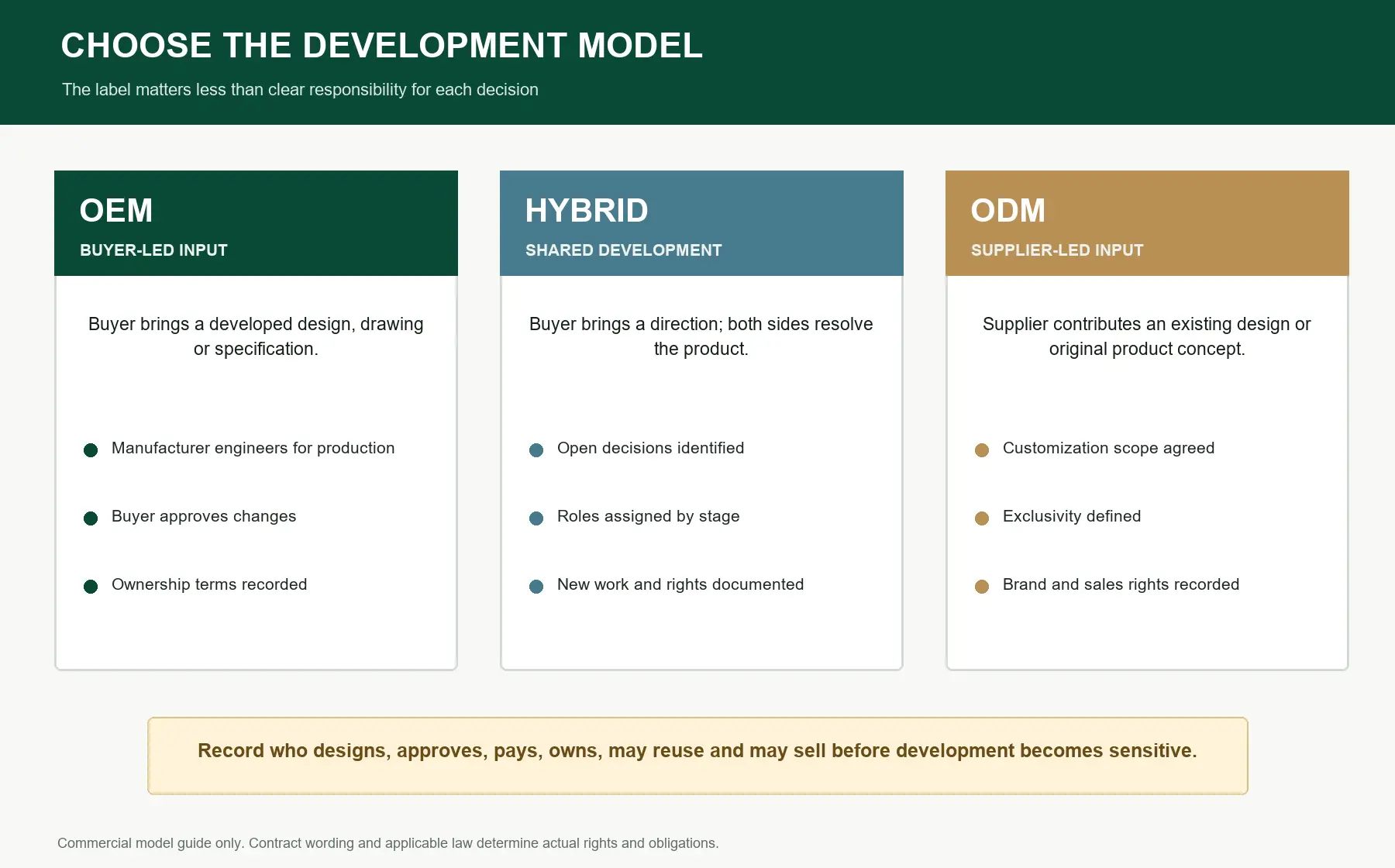
In a typical OEM project, the buyer provides the design, drawing or technical specification and the manufacturer develops or produces the item against that input. An OEM furniture manufacturer may still contribute engineering, material and production advice, but the buyer generally brings the product direction.
In a typical ODM project, the supplier contributes more of the original product concept or offers an existing design that can be selected, adapted and branded for the buyer. An ODM furniture manufacturer may support proportions, construction, material combinations, finishes and collection coordination.
Real projects often sit between these definitions. A buyer may bring a reference image but no drawing. A supplier may propose a construction, while the buyer controls dimensions, finish and branding. An existing product may be modified extensively enough to require a new sample and test plan.
Define Responsibilities Instead of Debating Labels
Before development begins, record:
- who supplies the initial concept and drawings;
- who creates production drawings and technical revisions;
- who selects or approves materials and hardware;
- who pays for samples, tooling and tests;
- who owns newly created design work;
- whether the supplier may show, reuse or sell the design;
- what constitutes final approval;
- how changes are requested and authorized.
For oak furniture OEM, this record prevents a buyer-provided concept from changing quietly during engineering. For oak furniture ODM, it clarifies which supplier design may be customized, where exclusivity applies and whether the same base product remains available to other customers.
The supplier-evaluation framework in how to choose an oak furniture manufacturer is useful before sharing commercially sensitive design files. Once a partner is selected, the project needs a more detailed development agreement.
Build a Complete Custom Furniture Development Brief
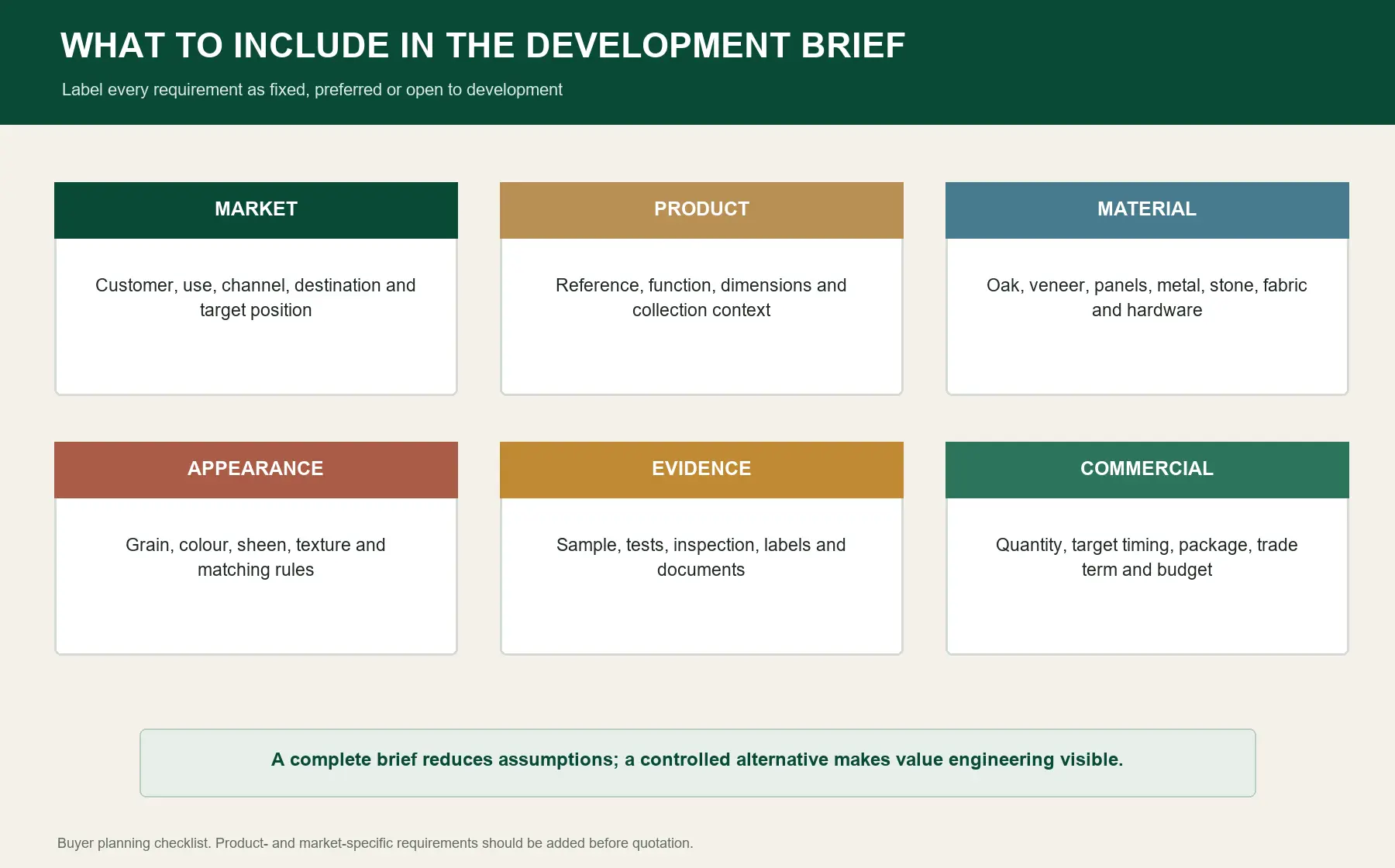
A strong brief explains the business reason for the product as well as its appearance. A manufacturer cannot make sound trade-offs without knowing the intended user, sales channel, market position, quantity and destination.
An OEM oak furniture manufacturer should normally receive enough information to define the following areas.
Commercial and Market Context
- target customer and price position;
- retail, wholesale, hospitality or project use;
- destination country or region;
- expected launch quantity and repeat-order pattern;
- required launch date and decision deadlines;
- whether the item belongs to a coordinated collection.
Product and Technical Inputs
- reference images, sketches, CAD files or dimensions;
- intended function and use environment;
- fixed dimensions and dimensions open to adjustment;
- oak species or visual direction;
- solid wood, veneer, engineered panel and mixed-material preferences;
- finish color, sheen and tactile target;
- hardware, upholstery, stone or metal requirements;
- assembly, labeling and packaging expectations;
- applicable tests, regulations and buyer protocols.
Use Target Cost Carefully
A target cost can help the custom furniture supplier propose an achievable route, but it should not replace the specification. If the number is fixed while materials, construction and quality remain vague, quotations may become impossible to compare.
Ask the supplier to identify value-engineering proposals explicitly. A thinner component, alternate substrate, revised joint, different hardware or simplified package may be reasonable, but it should be evaluated as a controlled option rather than hidden inside the price.
MrsWoods accepts development input from drawings, reference images, specifications or a collection direction. Its furniture customization and branding services connect those inputs with material selection, sampling, production follow-up, quality control and export support.
Specify Oak Materials, Construction and Finish
The phrase “oak furniture” is not a complete material specification. A design may combine solid oak, oak veneer, engineered panels, metal, stone, glass, cane or upholstery. Each component should be identified by function and appearance.
The comparison of solid oak vs oak veneer furniture explains why both constructions can belong in a well-engineered product. Solid wood can add structural or tactile value in legs, rails and exposed edges, while a balanced veneered panel can suit broad cabinet or tabletop surfaces.
For every visible and structural component, define:
- material and commercial species group;
- solid, veneer, panel or composite construction;
- grain direction and veneer matching;
- thickness and critical dimensions;
- sapwood, knot and natural-variation policy;
- moisture and storage requirements;
- joint, fastener and hardware system;
- finish build, color reference and acceptable range;
- surfaces that must match across a collection.
Treat Finish as a System
Color names are not precise enough for bulk production. “Natural oak” can look different according to board selection, sanding, stain, pigment, sealer, topcoat, sheen and lighting. The guide to oak furniture finishes explains why surface preparation and approval references matter.
Approve a physical finish panel whenever color and texture are commercially important. Record the substrate, preparation and coating system used for that panel. For a collection, review relevant materials together so wood, metal, stone and upholstery form one intentional palette.
Engineer the Product, Not Only the Appearance
Dimensions and proportions can affect wood movement, joint loading, hardware clearance, packing volume and stability. A visually faithful copy of a reference image may still require technical changes.
Use oak furniture construction principles when reviewing large solid-wood surfaces, grain direction, joints and mixed-material connections. An engineering proposal should explain the reason for any change and preserve the design intent wherever possible.
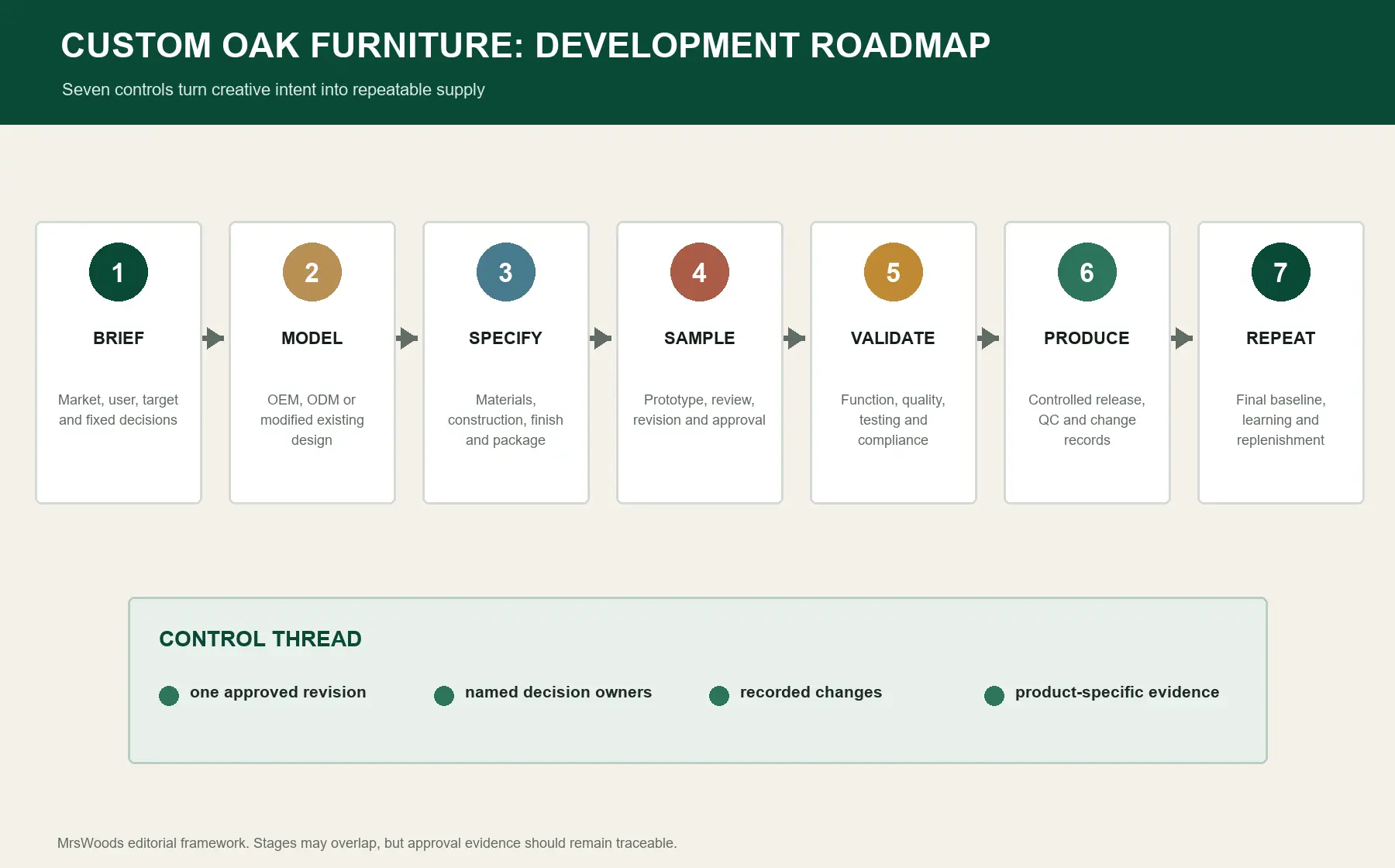
Move From Drawing to an Approved Sample
The sample stage converts assumptions into evidence. It should test the proposed appearance, dimensions, structure, function, assembly and package before the production quantity makes changes expensive.
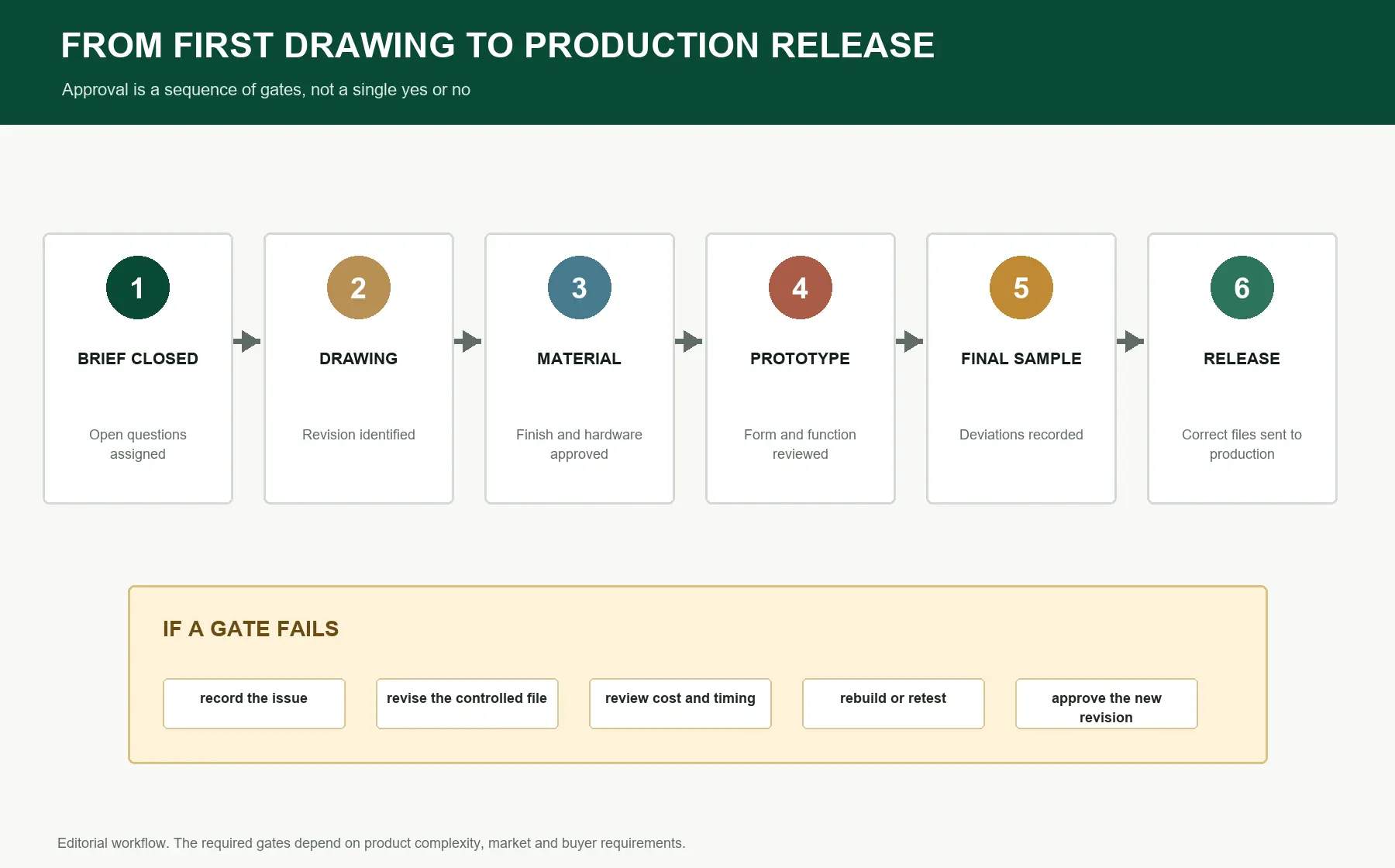
A practical sequence for OEM and ODM furniture manufacturing is:
- confirm the development brief and open questions;
- issue a numbered drawing or specification revision;
- approve materials, hardware and finish references;
- build and internally review the prototype;
- send the sample, video or inspection record for buyer review;
- record every requested revision;
- approve the final sample and supporting documents;
- release the correct revision to production.
Build an Approval Pack
The physical sample is important, but hidden construction and later revisions may not be visible. Support it with:
- signed or digitally approved drawings;
- component-level bill of materials;
- finish panel and tolerance notes;
- hardware and upholstery references;
- functional and dimensional checklist;
- packaging specification and assembly instructions;
- required test plan and reports;
- approved deviations;
- dated photographs of critical details.
The stages in the oak furniture manufacturing process show why the approval baseline must reach material preparation, machining, assembly, sanding, finishing, inspection and packing rather than remain with the sales team.
Do Not Approve With Silence
If the buyer does not comment on one area, that should not automatically mean the area is approved. Close the sample review with a written list of accepted points, changes, unresolved decisions and the next revision. Production should start only when both sides know which version is controlling.
Plan MOQ, Development Cost and Lead Time
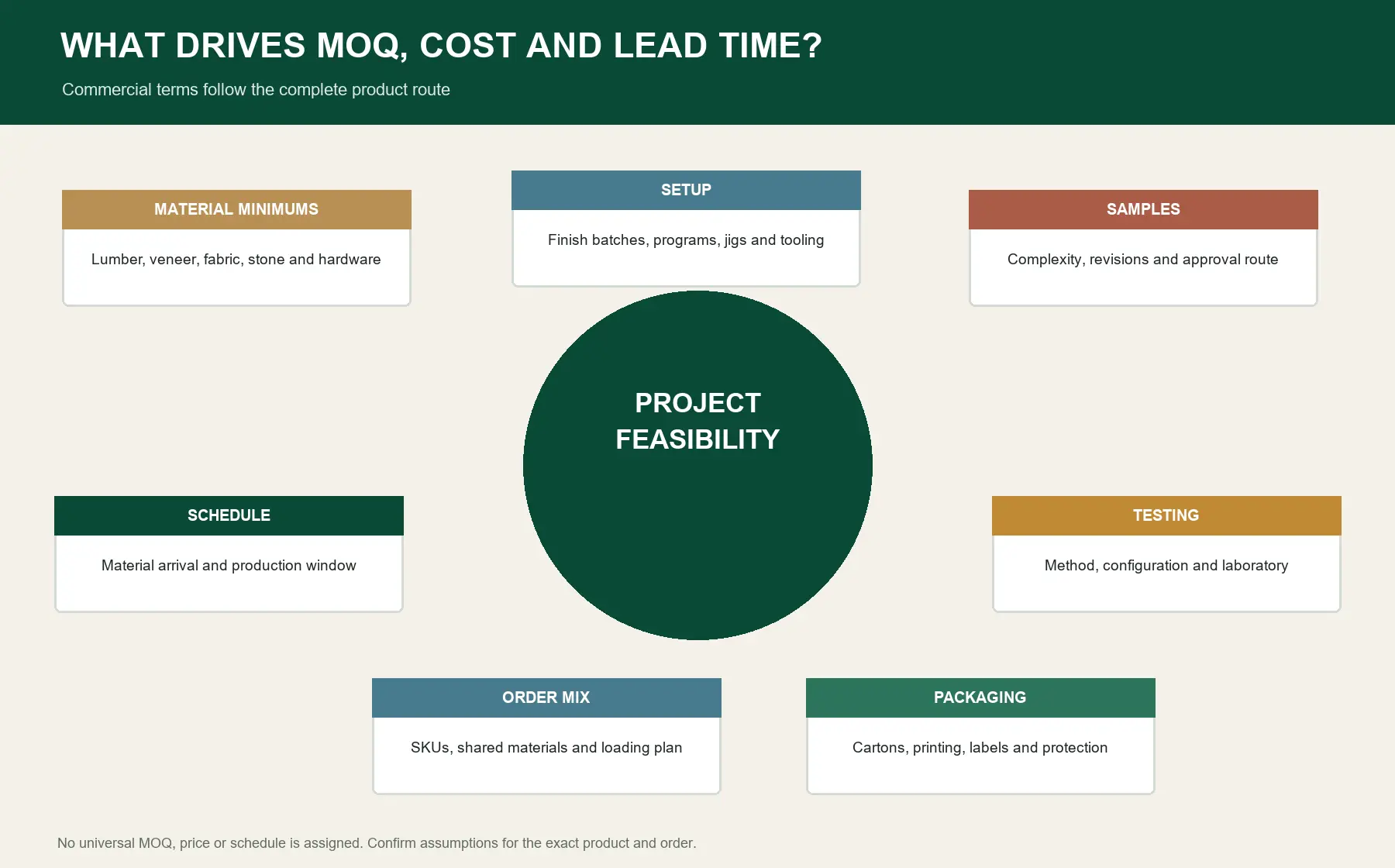
There is no responsible universal MOQ for all custom oak furniture. The practical quantity depends on the product, manufacturing route and purchasing plan.
Important drivers include:
- lumber, veneer, panel, fabric, stone and hardware minimums;
- finish mixing and production setup;
- CNC programming, jigs, moulds or tooling;
- sample complexity and number of revisions;
- specialist subcontract processes;
- testing and certification scope;
- custom labels, cartons and printed instructions;
- factory scheduling and container utilization;
- whether several SKUs share materials and finishes.
Separate One-Time and Recurring Costs
Ask the quotation to distinguish development charges from unit pricing where relevant. One-time costs may include design work, sample labor, tooling, testing, photography or custom packaging setup. Recurring costs may include materials, labor, packaging, inspection and freight-related services.
This separation helps a private label furniture manufacturer and buyer discuss how costs behave at launch, replenishment and larger volume. It also prevents a low unit price from hiding a large set of excluded development tasks.
Define When Lead Time Starts
“Lead time” can mean the period after deposit, after drawing approval, after sample approval, after materials arrive or after all packaging files are released. Record separate estimates for development, sampling, testing, bulk production and shipment preparation, together with the decision or payment that starts each stage.
MrsWoods uses project-based MOQ planning rather than presenting one minimum for every category. A smaller launch, mixed collection or large repeat program can therefore be reviewed against its actual materials, processes and loading plan. Feasibility remains product-specific and should be confirmed in the quotation.
Control Quality, Compliance and Production Changes
Quality control begins before production. The product specification should identify what will be checked, when it will be checked, who records the result and what happens when a requirement is not met.
The current ISO 9001 quality management standard provides a recognized framework for organizations to meet customer expectations, control processes and continually improve. A management-system certificate can support supplier qualification, but it does not prove that one custom product passed its applicable tests or matches its approved sample.
For the order itself, use a control plan that can include incoming-material checks, first-piece approval, in-process checks, finish comparison, function review, packing validation and finished-goods inspection. The article on oak furniture quality testing explains why inspection and laboratory testing answer different questions.
Match Compliance to the Exact Product and Market
Furniture requirements are category- and market-specific. The U.S. CPSC Business Guidance Library separates guidance for categories such as clothing storage units, upholstered furniture, bunk beds and children’s folding chairs. That structure illustrates why “export standard” is not a sufficient compliance instruction.
For commercial and institutional furniture, BIFMA’s standards descriptions show that tables, storage units, seating and other products have different performance methods and scopes. Confirm the relevant edition, configuration, laboratory competence and acceptance requirement before ordering a test.
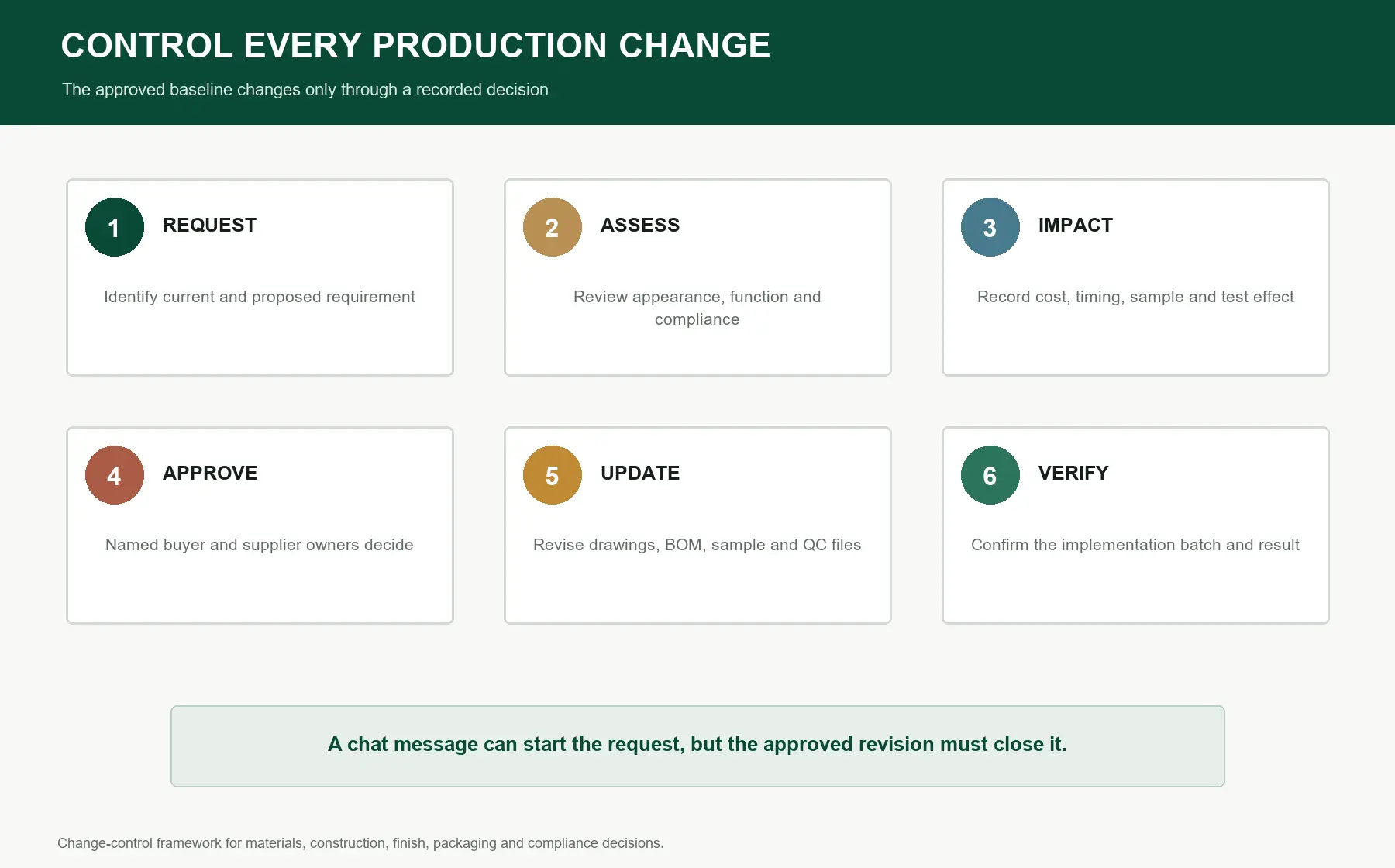
Use Formal Change Control
Material shortages, engineering findings or test results may require changes. Every proposed change should identify:
- the current and proposed specification;
- the reason for the change;
- effect on appearance, function and compliance;
- cost and schedule effect;
- new sample or test required;
- responsible approver;
- implementation batch.
Protect Designs, Branding and Commercial Terms
Product design, technical know-how, drawings, brand assets and packaging files do not all carry the same rights. Ownership may also depend on contracts and applicable law. Set expectations before sharing sensitive work.
The WIPO industrial design guidance explains that industrial-design protection is generally obtained through national or regional applications and is territorial. WIPO also notes that novelty or originality requirements may make filing timing important before public disclosure.
This article is not legal advice. Buyers should obtain advice for the countries, rights and commercial arrangement involved. Operationally, the development agreement can address:
- confidentiality and permitted disclosure;
- ownership of buyer-provided and supplier-created materials;
- right to manufacture, sell, display or reuse the design;
- exclusivity by product, territory, customer or period;
- trademark, label and packaging use;
- handling of unused samples and files;
- responsibility for checking third-party rights;
- remedies and dispute process.
Define Delivery Terms Precisely
Use a named place and the correct rule version when agreeing an Incoterm. The ICC explanation of Incoterms 2020 states that the rules allocate selected obligations, costs and transfer of risk between seller and buyer, but they are not a substitute for the sales contract.
The contract or purchase order should still define the goods, approved specification, quantity, price, payment, schedule, inspection, documents, warranty, claims and applicable dispute terms.
Plan Packaging, Logistics and Repeatable Supply
The first approved product is only the beginning of custom oak furniture for retailers and other repeat-order programs. The supply system should preserve the approved design while allowing controlled learning.
Before bulk production, agree on:
- assembled or knock-down configuration;
- carton construction and protective materials;
- corner, edge, hardware and surface protection;
- assembly instructions and tool pack;
- labels, barcodes and private-label presentation;
- package tests appropriate to the route and risk;
- spare parts and replacement process;
- loading orientation and mixed-container plan;
- commercial and compliance documents;
- retention samples and repeat-order references.
Prepare for the Second Order During the First
Keep the final drawing revision, bill of materials, finish reference, approved package, test evidence, inspection findings and corrective actions together. Review what changed during the first order and decide which improvements enter the next controlled revision.
This is where a capable custom furniture supplier creates long-term value. Repeatability does not mean freezing every detail forever. It means changing deliberately, preserving traceability and confirming the commercial effect before implementation.
MrsWoods supports furniture brands, retailers, wholesalers and project buyers across living, dining, bedroom and study categories. Its model combines existing product selection with OEM/ODM development, multi-material coordination, sample review, production follow-up, quality checks, third-party inspection support, export packaging and mixed-container planning.
Buyers can send reference images, drawings, dimensions, material preferences, quantity, destination market and target timing through the MrsWoods custom furniture sourcing form. The team can then confirm the appropriate development route, missing information and next quotation or sampling step.
Frequently Asked Questions
What is the difference between an OEM furniture manufacturer and an ODM furniture manufacturer?
An OEM project usually begins with buyer-controlled designs or specifications, while an ODM project normally includes more supplier-originated design input or an existing supplier design. Actual responsibilities vary, so define design contribution, engineering, ownership, approval and sales rights in writing.
What should I send a custom oak furniture manufacturer?
Send reference images or drawings, dimensions, intended use, destination market, material and finish expectations, quantities, target timing, packaging route and required tests. Mark which details are fixed, preferred or open to value engineering.
How long does custom oak furniture manufacturing take?
There is no universal schedule. Development time depends on the completeness of the brief, drawing work, material sourcing, sample complexity, revision rounds, testing, tooling, finish approval and production planning. Record separate timelines and start triggers for each stage.
Can an OEM oak furniture manufacturer copy a reference image exactly?
A reference image may contain protected design or brand elements, and its visible appearance may not reveal safe construction. Confirm that you have the right to use the material, obtain appropriate legal advice and ask the manufacturer to engineer the product against an approved specification rather than copying blindly.
Can I customize an existing product instead of developing from zero?
Yes. Modifying an existing design can reduce development work, but changes to dimensions, material, structure, finish, hardware or packaging may still require drawings, samples and new testing. Confirm which original and revised rights apply.
Does a private label furniture manufacturer provide branded packaging?
Many suppliers can support labels, cartons, instructions and brand presentation, but the scope, files, minimums, approvals and intellectual-property permissions should be written into the project requirements.
How can I compare oak furniture OEM quotations?
Give each supplier the same revision and ask it to identify materials, construction, finish, hardware, packaging, development charges, testing, MOQ, lead-time trigger and trade term. Compare approved alternatives separately instead of treating unlike quotations as equivalent.
Conclusion
A successful custom oak furniture project turns creative intent into controlled evidence. Define the OEM or ODM model, prepare a complete brief, specify every material and interface, approve a reproducible sample, understand the commercial drivers, control changes and protect the design and delivery terms.
MrsWoods operates as a company and B2B furniture manufacturing partner, not a furniture collection. For buyers seeking OEM and ODM furniture manufacturing, the company can coordinate design input, material and finish options, multi-category development, sampling, production follow-up, quality control and export support around the requirements of each project.
The strongest starting point is concrete: product reference, intended market, dimensions, materials, quantity, timing and the decisions that cannot change. From there, an experienced custom oak furniture manufacturer can turn the brief into drawings, samples, approved production and a repeatable supply program.
