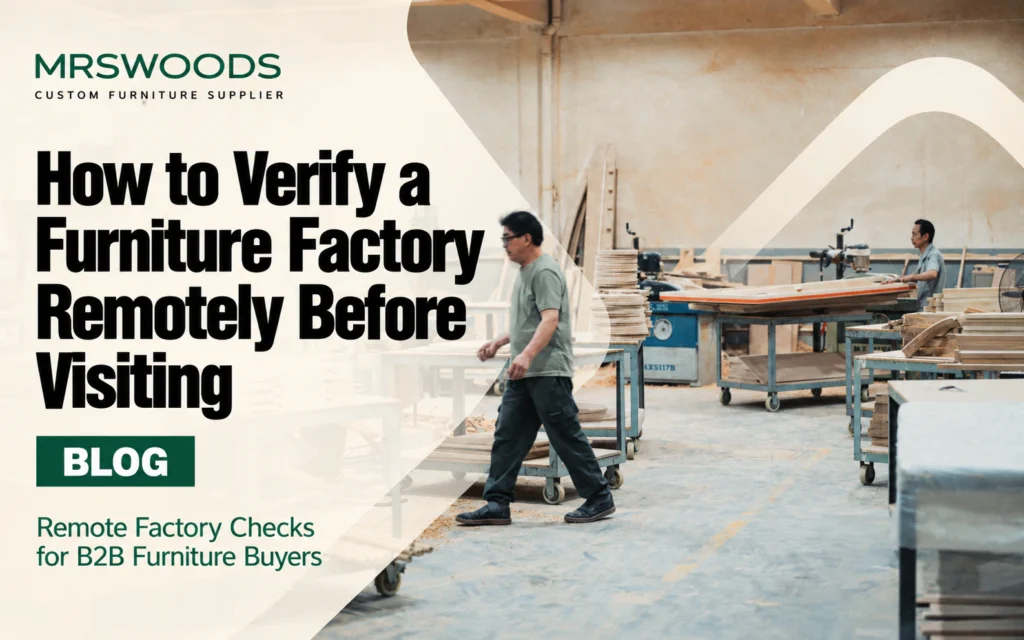
This guide focuses on preparation, live observation and follow-up before a factory visit. It does not repeat legal-entity and payment checks, calculate available capacity or prescribe product tests. For the broader sourcing sequence, use our guide to how to choose a furniture manufacturer in China. The practical steps below are buyer recommendations, not a certification procedure or a report on any particular factory.
Key Takeaways
- Prepare questions about the production arrangement before asking for a live tour.
- Compare the video, staff explanations and records instead of treating any one item as proof.
- Record inaccessible areas and missing evidence as unresolved, not as completed checks.
- Arrange further verification when important questions cannot be answered remotely.
What Can Remote Furniture Factory Verification Establish?
What you can check before visiting
A preliminary review can help you observe a stated location, selected work and the people explaining it. Keep the conclusion specific: you saw a particular activity during a particular session. Connect it to the supplier’s declared role before drawing a broader conclusion.
Someone trying to verify a Chinese factory online should separate business identity from production observation. Our guide to how to verify a furniture manufacturer explains that distinction. Here, start with the location and production relationship already declared, and investigate whether the remote evidence is consistent with them.
What a video call cannot prove on its own
Seeing furniture being assembled does not establish ownership of the building, the seller’s control over every process or spare capacity for your order. Video also does not authenticate the bank account receiving payment. Treat these as separate questions, even when the presenter answers confidently.
The published scope of ISO/IEC TS 17012:2024 on remote auditing methods covers management-system audits and describes remote methods as a supporting tool rather than a replacement for on-site methods. That is a useful boundary for this buyer-side review, not a claim that an informal call meets the standard or verifies a furniture product.
How Should You Plan a Live Factory Video Tour?
Agree on the scope, participants and viewing conditions
Send a short agenda identifying the furniture category, the proposed site, the work you want to understand and the documents needed for discussion. Ask who will guide the camera and who can answer technical questions. Before your order exists, request comparable current work; do not expect the factory to show your unplaced order in production.
For a remote furniture factory audit commissioned from a professional provider, agree the provider’s scope and reporting terms separately. An informal supplier video call should not be labeled an independent audit simply because several people attend it.
Check the connection from the viewing areas, not only the office. Agree what may be recorded, who can access shared files and how confidential designs or customer details will be concealed. If a requested view is restricted, discuss an appropriate alternative before the session.
Follow the relevant production process
Plan a route that connects the stated site with relevant materials, work in progress, assembly, finishing, quality checks and packing, where applicable. Ask which operations take place elsewhere. Do not require every step to be demonstrated in the same building or during the same call.
For an illustrative oak furniture manufacturer review, select a comparable dining-table component and ask where it is machined, assembled and finished. For event seating, choose the relevant chair process instead. These are viewing examples, not MrsWoods customer cases. Never ask a worker to bypass a safety rule or move into an unsafe position for the camera.

Who Should You Speak to During the Remote Check?
Ask technical and production questions beyond sales
A salesperson can organize access, but arrange for the people responsible for technical and production decisions to explain their work. One person may cover several roles in a smaller business. The question is whether the responsibility and explanation are clear, not whether the supplier has four separate departments.
TÜV Rheinland’s remote-audit explanation describes combining digital interviews, document sharing and live observation of processes. Its technical guidance also addresses connectivity, access and data security. Borrowing these methods can structure a buyer’s review; it does not make the supplier or MrsWoods certified or endorsed by TÜV Rheinland.
For OEM furniture manufacturing, ask the technical contact which drawing revision is being discussed and how a production question reaches the person authorized to answer it. Ask the production contact where that instruction is used. Compare the answers without turning the conversation into an examination of unrelated customer designs.
Ask how quality issues are identified and handled
Ask the person responsible for QC to explain one relevant check: what is examined, which reference is used and what happens if the result is unacceptable. Request an appropriately redacted example if available. This is a check on the explanation and available evidence, not a full review of the inspection plan.
Useful follow-up questions include: “Who receives this finding?” and “How would a revised requirement reach this workstation?” If the answer depends on somebody absent, record the question for that person rather than asking sales to guess.
How Do You Cross-Check Video Against Production Records?
Connect what you see to identifiable records
Furniture factory video verification becomes more useful when a selected item can be connected to a reference. Ask the presenter to explain a permitted job reference, drawing or production photograph alongside the item being shown. Record the session date and the supplier’s explanation of the relationship.
For example, a component in an assembly area might be compared with a redacted drawing showing the relevant construction. Ask which visible features connect the two. Keep the conclusion limited to that comparison; it is not material authentication or proof that an entire order conforms.
For a fuller discussion of record types and their limitations, see our guide to furniture factory production evidence. Use that reference to prepare a broader evidence request beyond the selected records discussed during the call.
Record inconsistencies without jumping to conclusions
Use agreed live follow-up requests, such as showing another accessible side of a component or explaining a nearby permitted reference. Compare the response with earlier information. Timestamps, signs and continuous footage provide context, but they are not independent authentication. Do not turn a camera technique into a guarantee against staged or altered evidence.
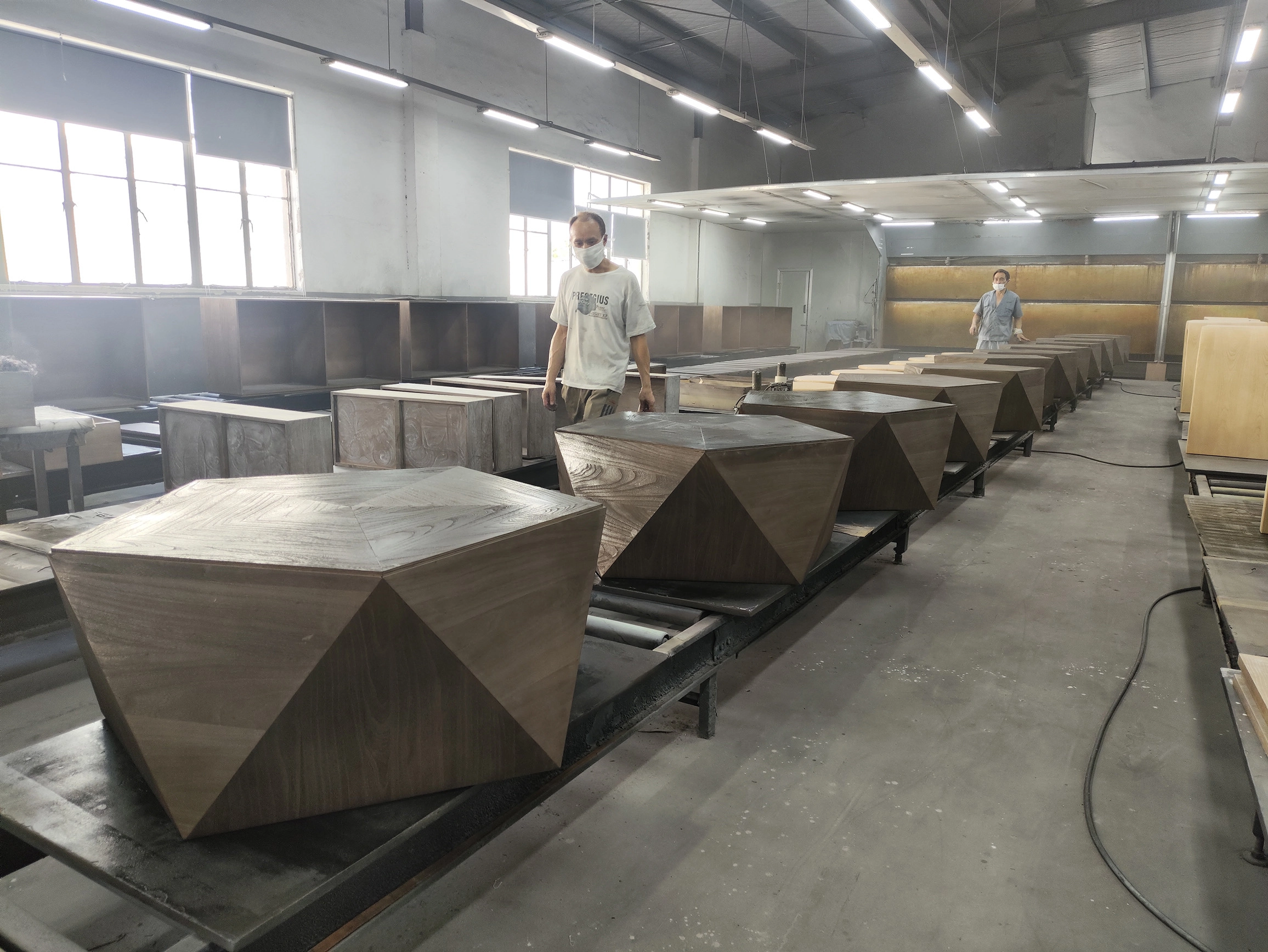
MrsWoods’ procurement team compares production photographs, product markings and finish references with the stated site and the work being shown. It also checks the actual site against supplied photographs and videos. This practice connects the visual review with on-site observation rather than treating images as sufficient proof.
A missing reference can leave a question unanswered without establishing dishonesty. Ask for an explanation or an agreed substitute. Conceal other customers’ names, commercial details and protected designs while retaining enough context to assess the specific claim.
How Should You Record Findings and Follow Up?
Keep a clear record of observations and gaps
Write a finding another buyer could understand without replaying the whole call. Separate the supplier’s statement, your observation and your conclusion. For example: “Assembly was shown at the declared site; finishing was described but not viewed.” This describes a limited observation without approving the unobserved process.
Use a compact record with the question, evidence reference, session date, reviewer, unresolved issue and proposed action. Identify whether a point was observed, explained only, not shown or contradicted by other information. These are working labels, not official audit ratings or a scoring system.
Assign follow-up actions before the next decision
For each important gap, name the contact who will respond, the requested evidence and an agreed follow-up date. Decide whether another remote session could answer the question or whether it needs a different method. File the reply with the original question rather than leaving it in a separate message thread.
Do not close a finding merely because a new photograph arrives. Check whether it answers the recorded question. Likewise, a promising sample or an attractive price should not be used to cancel an unresolved production-site issue.

When Should You Arrange an On-Site Check?
Identify questions that remain unresolved remotely
A visit may be appropriate when the relationship between the seller and site remains unclear, an important operation cannot be observed, or staff explanations conflict with the records. Ask what further evidence would resolve the issue. Repeated refusal of reasonable verification and alternatives deserves a different response from a documented confidentiality restriction.
A weak connection is not proof of fraud. It does, however, limit what you can conclude from that session. Rearrange the call if that is sufficient; use on-site review when the unresolved question requires direct access. Your own purchasing criteria may require a visit even if the remote review raises no obvious problem.
Set the scope of the follow-up visit
Give the reviewer the exact site, disputed claim, relevant product and records already examined. State what needs to be observed or reconciled. If the real question is product safety, material performance or available capacity, commission the appropriate assessment rather than expecting a general site visit to answer everything.
MrsWoods owns several furniture factories, with different products manufactured at different facilities. Before placing bulk production orders, our procurement team visits the relevant factory to review production conditions. These on-site checks remain part of our procurement process; remote viewing is not a substitute. Overseas buyers can contact our team to request a live video factory tour or arrange an in-person visit to our facilities in China.
After identity and production questions have been addressed, separately evaluate a furniture manufacturer before your first order. A remote review or visit does not, on its own, establish future delivery reliability.
Frequently Asked Questions
Can I verify a furniture factory without visiting China?
You can verify a factory without visiting only to the extent that the available evidence supports specific findings. Combine records, live observation and interviews, then identify unanswered questions. You may need an independent on-site reviewer even when you cannot travel yourself.
Is a live video tour enough to prove a supplier owns the factory?
No. It shows access to a location, not ownership or control of every process. Ask how the seller is connected to that site and seek appropriate supporting evidence. Transparent partner production is different from an unsupported ownership claim.
What should I request before a remote factory check?
Request the declared site, relevant production route, responsible participants and agreed supporting records. Confirm viewing permissions and connection arrangements. A virtual audit of a furniture factory should have a defined scope; an informal call should be identified as such.
Does refusing to show another customer’s order mean a supplier is unreliable?
No. Confidentiality may justify redaction or restricted viewing. Agree an alternative that addresses your question without exposing protected information. Record any remaining limitation rather than treating confidentiality as either proof of misconduct or proof of capability.
Can remote verification confirm production capacity or product compliance?
Not by itself. Those conclusions require evidence and assessment appropriate to the order, product and destination. A busy workshop or a test-report image does not settle either question. Keep both outside the conclusion of a preliminary video review.
When should I arrange an independent on-site audit?
Arrange one when your review criteria require it or when important questions need direct observation or specialist judgment. Define the task and reviewer competence in advance. An audit, an order inspection and a product test serve different purposes.
Conclusion and Next Step
The practical aim when you verify a furniture factory remotely is to replace vague impressions with specific observations and questions. Prepare the viewing route, involve the right people, compare selected records and keep the limits of each finding visible. The next decision should follow the evidence, not the polish of the presentation.
A productive session can leave questions open. Identify and follow them up before the relevant commitment. Distinguish seeing production from establishing its suitability for your order. Use further remote checks where they can answer the question, and arrange on-site or specialist work where they cannot. A completed call is not a blanket release for production or payment.
For a project with MrsWoods, explore our OEM, ODM and furniture supply services. Share the product category, drawings or reference images, materials, quantities and target market. These details support discussion of your requirements and the production information needed, without implying an independent assessment of another supplier.
