
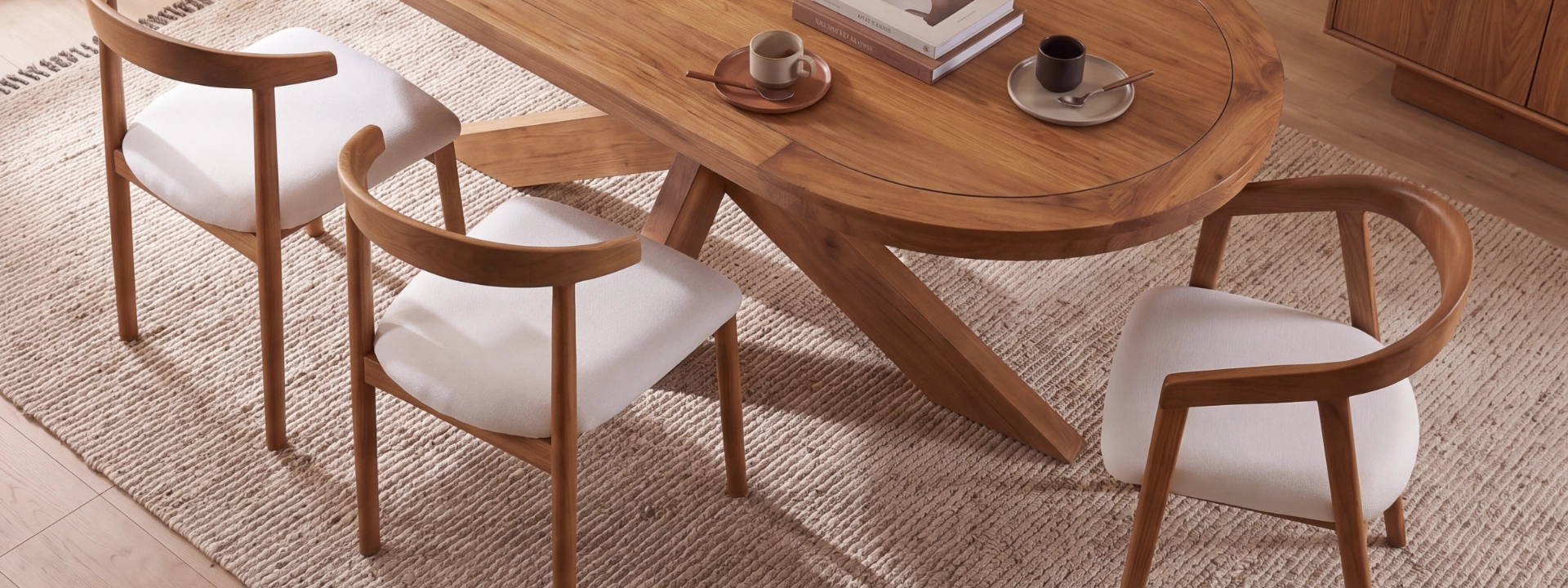

Oak wood is strong, hard-wearing, visually distinctive, and suitable for many types of furniture. Its main disadvantages are its relatively high weight, higher material and processing cost, and natural movement when moisture conditions change.
For furniture buyers, however, the question is not simply whether oak is “good” or “bad.” The final performance of oak furniture also depends on the oak species, lumber quality, moisture control, construction, surface finish, and how the material is used within the product.
Oak has long been used for furniture, flooring, cabinetry, joinery, and other wood products.
Technical data from the USDA Forest Products Laboratory describes oak as a hardwood with useful strength, stiffness, machining, fastening, gluing, and finishing characteristics.
Key Takeaways
- Oak is a strong and relatively heavy hardwood with useful furniture-making properties.
- Its natural grain and finishing flexibility make it suitable for many furniture styles.
- Oak requires controlled drying and moisture management because wood naturally responds to changes in surrounding humidity.
- Solid oak is not automatically better than oak veneer. The right construction depends on the product, structure, appearance, and target price.
- Furniture quality depends on much more than the species name. Moisture, construction, joinery, finishing, and quality control all matter.
Is Oak Wood Good for Furniture?
Yes. Oak is one of the most established hardwoods used in furniture manufacturing because it combines strength, visible grain, machining performance, and finishing flexibility.
But “oak” is not one uniform material.
The oak genus contains many species. In the furniture industry, buyers commonly encounter groups such as white oak and red oak. Their color, grain, pore structure, density, physical properties, and finishing behavior are not identical.
The American Hardwood Export Council’s hardwood species comparison provides separate technical information for American red oak and white oak and allows their physical properties to be compared directly.
That variation matters when specifying furniture.
A dining table, chair frame, cabinet door, or wide sideboard panel does not place the same demands on the material. Good furniture development therefore starts by asking what the wood needs to do, rather than simply specifying “oak.”
Professional furniture manufacturing also looks beyond the species name. Understanding oak wood properties for furniture helps buyers evaluate lumber selection, moisture behavior, grain direction, machining, and whether oak is appropriate for a particular product structure.
What Are the Advantages of Oak Wood?
1. Oak Has Good Strength and Durability
Strength is one of the main reasons oak is widely used in furniture.
Oak is generally associated with relatively high hardness, stiffness, and strength compared with many lighter furniture woods. It also has useful machining, fastening, and finishing characteristics when properly processed.
These material characteristics are documented in the USDA technical reference for oak wood.
These characteristics make oak wood for furniture suitable for products that may experience repeated everyday use, including:
- Dining tables
- Dining chairs
- Coffee tables
- Side tables
- Bed frames
- Cabinets
- Sideboards
- Shelving
- Other casegoods
However, durability should not be treated as a property of the wood species alone.
Even a strong hardwood can perform poorly if it is incorrectly dried, if joints are badly designed, or if a wide solid-wood component is prevented from responding naturally to changes in moisture.
For this reason, furniture manufacturers need to consider material properties together with oak furniture construction, including joinery, grain direction, panel design, and natural wood movement.
2. Oak Has a Distinctive Natural Grain
Oak is also valued for its visual character.
Its visible growth structure and grain give the surface a strong natural identity. Appearance varies by oak species, growing conditions, board selection, and the way the timber is sawn.
White oak and red oak can also present different visual characteristics. Buyers who need to compare their properties can refer to the AHEC hardwood species data.
This natural character allows oak to work across very different furniture styles.
A light finish can preserve a cleaner and more natural appearance. A darker stain can create a more traditional or dramatic effect. Brushing, texturing, staining, or other surface treatments can change the final expression again.
For furniture brands and buyers, this flexibility is useful because one material can support several design directions without losing the character of natural wood.
Oak also combines naturally with other furniture materials. It can be paired with:
- Metal
- Natural or engineered stone
- Marble
- Upholstery
- Rattan
- Glass
- Other wood species
This type of mixed-material development is particularly useful when a collection needs to balance appearance, function, price, and market positioning.
3. Oak Accepts a Wide Range of Finishes
Oak can be finished in many ways.
A clear finish can preserve more of the natural appearance. Stains can adjust the tone while leaving the grain visible. Depending on the design and intended use, oil, lacquer, paint, or other coating systems may also be considered.
Furniture finishing is not only about color.
The USDA Forest Products Laboratory guide to finishing wood explains that finishes can provide the required appearance, protect wood surfaces, and create a surface that is easier to clean.
This distinction matters to furniture buyers.
Two products both described as oak furniture can look very different because of:
- Wood selection
- Grain matching
- Sanding
- Stain formulation
- Coating system
- Gloss level
- Surface texture
- Application consistency
For repeat orders, controlling these variables can be just as important as choosing oak itself. A deeper understanding of oak furniture finishes helps buyers specify color, texture, protection, and production consistency more clearly.
4. Oak Works Across Many Furniture Categories
Oak is not restricted to one furniture category.
Its combination of structural properties and natural appearance means that it can be used both for visible surfaces and for structural components.
Typical applications include:
- Table legs and frames
- Tabletops
- Chair frames
- Cabinet structures
- Drawer fronts
- Shelves
- Doors
- Sideboards
- Bed frames
- Decorative components
Oak veneer expands these options further.
A piece of furniture does not have to be constructed entirely from solid oak to make effective and appropriate use of oak.
In many products, the better solution is to use different material constructions in different areas of the same product.
For example, solid timber may make sense for legs, frames, exposed edges, or other components where solid material provides the required structure or detailing.
Veneered panel construction may be more suitable for large cabinet surfaces or other wide areas where controlled panel construction is useful.
This is why buyers should understand solid oak vs oak veneer furniture before deciding which material construction is appropriate for a product.
What Are the Disadvantages of Oak Wood?
Oak offers many advantages, but it also has limitations. These become especially important when furniture is being developed for commercial production and international shipment.
1. Oak Is Relatively Heavy
Oak is a relatively heavy hardwood.
The exact density varies by species and individual material. American red oak and white oak, for example, have different published physical-property values.
These differences can be reviewed in the American Hardwood Export Council species comparison.
Weight is not necessarily a quality problem.
For a substantial dining table, cabinet, or sideboard, weight may even contribute to the physical feel of the product.
However, it has practical consequences for:
- Factory handling
- Product assembly
- Packaging
- Carton strength
- Container loading
- Freight
- Final-mile delivery
For B2B furniture buyers, these factors should ideally be considered during development rather than after production has been completed.
2. Oak Can Cost More to Buy and Process
Oak furniture is not normally selected when the only objective is to minimize material cost.
Raw material cost can vary according to:
- Oak species
- Grade
- Origin
- Board dimensions
- Availability
- Color requirements
- Grain requirements
- Order volume
Material yield is another important factor.
A design requiring wide, clear boards with tightly controlled grain and color can create very different material usage from a design that allows more natural variation.
Processing also contributes to cost.
Depending on the product, production may include:
- Lumber selection
- Drying
- Cutting
- Machining
- Grain matching
- Joinery
- Sanding
- Staining
- Coating
- Assembly
- Inspection
The most effective way to control cost is therefore not always to replace oak with a cheaper wood.
Better product engineering may produce a stronger balance between appearance, quality, function, and price.
That can involve using solid oak only where it adds structural or visual value, using oak veneer on suitable surfaces, adjusting dimensions, or combining oak with other appropriate materials.
This is why material selection should ideally happen during product development rather than after the design is already fixed.
3. Oak Moves as Moisture Conditions Change
This is one of the most important technical points to understand about oak—and about solid wood generally.
Wood is hygroscopic.
This means that it exchanges moisture with the surrounding environment.
According to the USDA research on moisture relations and physical properties of wood, moisture exchange depends on factors including relative humidity, temperature, and the current amount of water in the wood.
Changes in moisture content can affect dimensional stability and contribute to shrinkage or swelling.
For furniture, poor moisture management can contribute to problems such as:
- Cracking
- Warping
- Opening joints
- Panel movement
- Distorted doors
- Surface problems
- Veneer defects
But this does not mean that oak should be considered an inherently unstable or unsuitable furniture material.
The important issue is control.
Drying, storage, production conditions, grain direction, structural design, and the expected end-use environment all influence how a wooden product performs.
This is particularly important for furniture exported between markets with different climates.
A product manufactured in one humidity environment may eventually be used in another. For international furniture buyers, understanding oak wood moisture content is especially important because production and end-use environments may have very different humidity conditions.
4. Natural Variation Requires Careful Selection
Natural wood is not manufactured to look identical from board to board.
Oak can naturally vary in:
- Grain pattern
- Color
- Growth-ring appearance
- Sapwood and heartwood
- Ray figure
- Knots
- Other natural features
For some furniture collections, this variation is part of the intended appearance.
For other collections, especially repeated retail programs, the buyer may require tighter visual consistency across multiple pieces and production batches.
That means expectations should be defined before mass production.
The specification may need to address:
- Acceptable color range
- Grain direction
- Knot acceptance
- Sapwood allowance
- Board matching
- Veneer matching
- Finish samples
- Production tolerances
Without an agreed standard, one person may consider a feature “natural character,” while another may view the same feature as inconsistency.
For B2B furniture production, the better approach is to define acceptable natural variation before production begins.
What Furniture Is Oak Best Used For?
Oak can be used across many furniture categories, but some products make particularly effective use of its structural and visual characteristics.
Dining Tables and Chairs
Dining furniture needs to balance appearance, structure, proportions, and daily use.
Oak can be used in:
- Tabletops
- Table frames
- Table legs
- Chair frames
- Chair legs
- Visible wooden components
Its pronounced grain also works well where the natural wood surface is intended to form an important part of the design.
Material selection should still be considered together with construction, dimensions, finishing, upholstery, packaging, and the intended market.
Buyers can explore MrsWoods’ dining furniture range for examples of dining-category product development.
Cabinets and Sideboards
Oak works particularly well in casegoods because both solid timber and veneer can be considered within the same product.
Different parts may require different solutions:
- Solid legs
- Solid frames
- Veneered side panels
- Veneered doors
- Solid exposed edges
- Veneered drawer fronts
- Engineered internal panels
Large flat surfaces are a good example of why professional buyers should understand solid oak vs oak veneer furniture rather than treating one option as universally superior.
Coffee Tables and Side Tables
Coffee tables and side tables also work well with oak because their designs often combine several materials.
Oak can be paired with:
- Marble
- Stone
- Metal
- Glass
- Upholstery
- Other wood finishes
This allows designers to create contrasts in texture while retaining the warmth and natural character of wood.
However, the tabletop, base, edge, connection method, and support structure may each require a different material solution.
Bedroom Furniture
Oak can also be used for:
- Bedside tables
- Dressers
- Tallboys
- Bed frames
- Wardrobes
- Bedroom cabinets
In bedroom collections, visual consistency can become especially important because several products may appear together in the same room.
Grain, wood tone, stain color, veneer matching, hardware, and surface finish may therefore need to be controlled across several SKUs rather than evaluated one piece at a time.
Solid Oak or Oak Veneer: Which Is Better?
Neither is automatically better.
Solid oak uses solid timber and can be particularly useful for components such as:
- Legs
- Frames
- Exposed edges
- Turned components
- Structural details
Oak veneer uses a thin layer of real oak applied over a suitable substrate.
It allows a real wood surface to be used across wide panels and other constructions where an engineered panel may provide useful properties.
The USDA technical chapter on wood-based composite materials explains the characteristics of plywood, particleboard, fiberboard, MDF, laminated veneer products, and other bonded wood materials.
The more useful quality question is therefore:
Is the material appropriate for that part of the furniture, and has it been engineered and manufactured correctly?
A high-quality oak furniture piece can legitimately use both solid oak and oak veneer.
For example:
- Solid oak for legs and frames
- Oak veneer for broad cabinet panels
- Solid timber on exposed edges
- Engineered panels where controlled panel construction is useful
Veneer quality itself also depends on several factors:
- Veneer selection
- Substrate selection
- Grain matching
- Adhesive system
- Pressing
- Edge treatment
- Sanding
- Finishing
- Moisture control
A high-quality veneer surface depends on veneer selection, substrate, grain matching, pressing, edge treatment, sanding, finishing, and moisture control. These details are explored further in our guide to oak veneer furniture.
For buyers comparing the two construction methods more broadly, our guide to solid oak vs oak veneer furniture will examine their differences in stability, appearance, weight, cost, and suitable applications.
What Should Buyers Consider When Specifying Oak Furniture?
For professional furniture buyers, writing only “oak” on a product specification is not enough.
A stronger specification should consider several areas.
Oak Species
White oak and red oak are not identical.
The choice should be based on factors such as:
- Desired appearance
- Grain
- Finish
- Structural requirements
- Product category
- Target market
- Availability
- Price position
Buyers can compare published material data through the AHEC hardwood species comparison.
Our detailed comparison of white oak vs red oak furniture will examine how these differences affect furniture design, finishing, and material selection.
Moisture Control
Moisture should be considered in relation to the environment in which the furniture will be produced, stored, transported, and ultimately used.
There is no technically responsible reason to assume that one moisture-content number is universally correct for every product and every market.
The relationship between environmental conditions and wood moisture is explained in the USDA guide to moisture relations and physical properties of wood.
This is particularly important for international orders. Understanding moisture content in oak furniture helps buyers evaluate drying, storage, production conditions, and destination climate more accurately.
Construction
Buyers should understand how the major parts of the furniture are built.
Useful questions include:
- Which parts are solid oak?
- Which parts use oak veneer?
- What substrate sits beneath the veneer?
- How are tabletops constructed?
- What joint systems are used?
- How is natural wood movement accommodated?
- How are stone, metal, or other materials connected?
- Which parts carry structural loads?
These questions often reveal more about product quality than a simple label such as “solid wood furniture.”
A closer look at oak furniture construction can help buyers understand joinery, panel design, wood movement, and structural decisions in greater depth.
Surface Finish
If color and appearance are commercially important, a finish sample should normally be confirmed before bulk production.
Buyers may need to specify:
- Color
- Grain visibility
- Gloss level
- Texture
- Edge treatment
- Surface consistency
- Intended use
Repeat orders create another challenge: the supplier must be able to control these characteristics over time rather than produce one good sample.
More detail on this subject is available in the USDA Forest Products Laboratory guide to wood finishing.
Understanding oak furniture finishes also helps buyers specify color, sheen, surface preparation, protection, and acceptable production variation more clearly.
Quality Control
Material selection is only the beginning.
Quality control should continue through production and final inspection.
For oak furniture, useful inspection points may include:
- Dimensions
- Construction
- Stability
- Joint quality
- Surface finish
- Color
- Grain appearance
- Veneer details
- Hardware
- Function
- Assembly
- Packaging
At MrsWoods, furniture orders are inspected against confirmed requirements before shipment, with quality control covering areas such as materials, construction, finish, function, and packing.
Buyers can learn more about our quality control process on the MrsWoods service page.
The broader lesson is simple:
Oak is a material, not a guarantee of quality.
The final product depends on how the oak is selected, dried, engineered, processed, finished, inspected, and packed.
Buyers who want a practical evaluation framework can also review how to tell if oak furniture is high quality.
FAQ
Is oak wood good for furniture?
Yes. Oak combines strength, visible natural grain, and useful finishing properties, making it suitable for tables, chairs, cabinets, sideboards, bedroom furniture, and many other products.
What are the main disadvantages of oak wood?
Oak is relatively heavy, can involve higher material and processing costs than some alternatives, and requires proper moisture management. Natural variation in grain and color also needs to be managed when consistent production is required.
Does oak furniture crack easily?
Well-designed and properly manufactured oak furniture should not be expected to crack easily. However, wood naturally responds to moisture changes, so unsuitable drying, construction, storage, or major environmental changes can increase the risk of cracking or movement.
The underlying wood-science principles are explained in the USDA research on moisture relations in wood.
Is solid oak better than oak veneer?
Not always. Solid oak and oak veneer have different strengths and applications. High-quality furniture may use both, depending on structure, surface area, design, dimensional requirements, and target cost.
Our guide to solid oak and oak veneer will compare these two material constructions in greater detail.
What is the difference between white oak and red oak?
White oak and red oak differ in appearance, pore structure, physical properties, and other material characteristics. These differences can influence material selection, furniture design, and finishing.
Technical species data is available through the American Hardwood Export Council.
Our dedicated guide to white oak and red oak will examine these differences specifically from a furniture perspective.
What should B2B buyers check when sourcing oak furniture?
Check the oak species, moisture control, solid-wood and veneer construction, joinery, finishing, visual consistency, quality-control process, packaging, and whether the material specification is appropriate for the actual furniture design.
Conclusion
The advantages and disadvantages of oak wood become much clearer when oak is viewed as an engineering and furniture material rather than simply as a “premium hardwood.”
Its strength, natural grain, finishing flexibility, and broad application range explain why it remains widely used in furniture.
At the same time, its relatively high weight, material cost, natural variation, and response to changing moisture conditions require proper material selection and manufacturing control.
For furniture buyers, the most important point is that oak alone does not determine furniture quality.
The final result also depends on:
- Oak species
- Lumber selection
- Oak wood moisture content
- Solid oak vs oak veneer construction
- Joinery
- Grain direction
- Surface finishing
- Quality control
- Packaging
For furniture brands, retailers, wholesalers, and project buyers developing an oak furniture collection, MrsWoods supports material selection, custom development, OEM/ODM, sampling, production coordination, quality control, and export delivery.
