
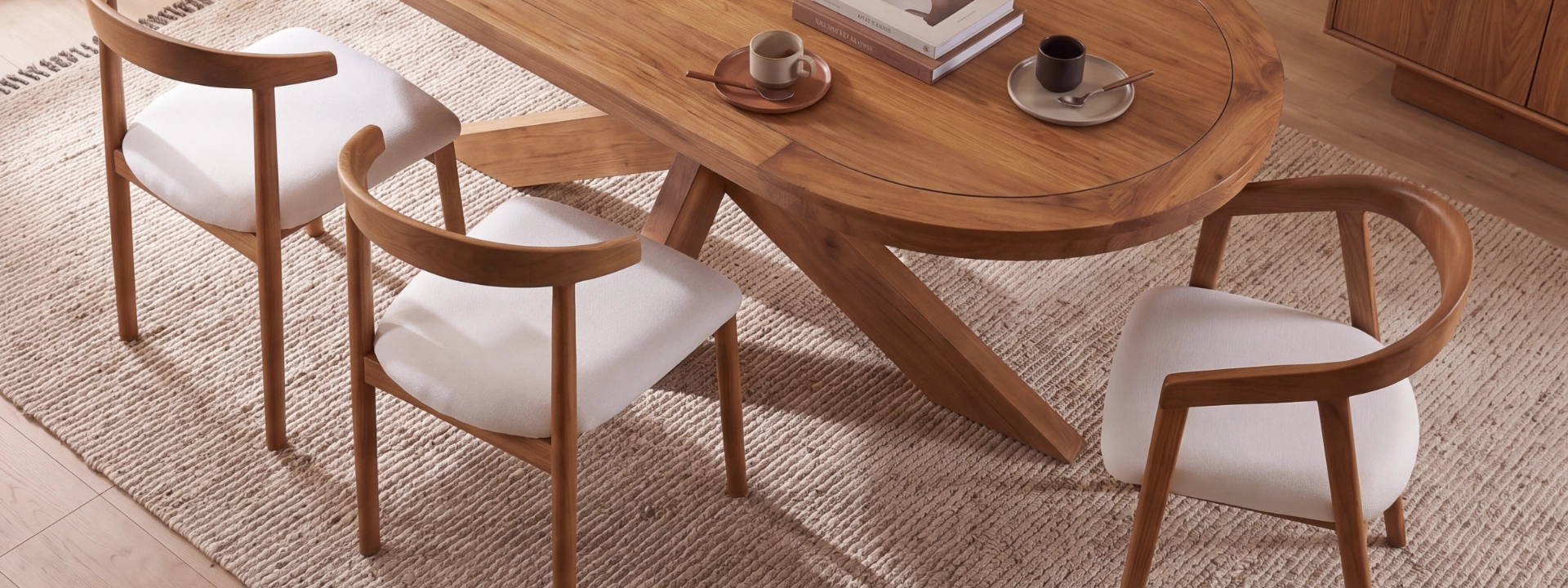

The best oak furniture manufacturer is not simply the factory with the lowest quotation or the largest workshop. It is the supplier that can translate your product brief into a controlled specification, prove its material and manufacturing decisions, reproduce the approved sample, meet destination-market requirements and support the order after shipment.
For furniture brands, retailers, wholesalers and project buyers, supplier selection is therefore an evidence exercise. A polished catalogue is useful, but it does not show how the company manages oak species, veneer construction, drawings, finish tolerances, testing, substitutions, mixed orders or corrective action.
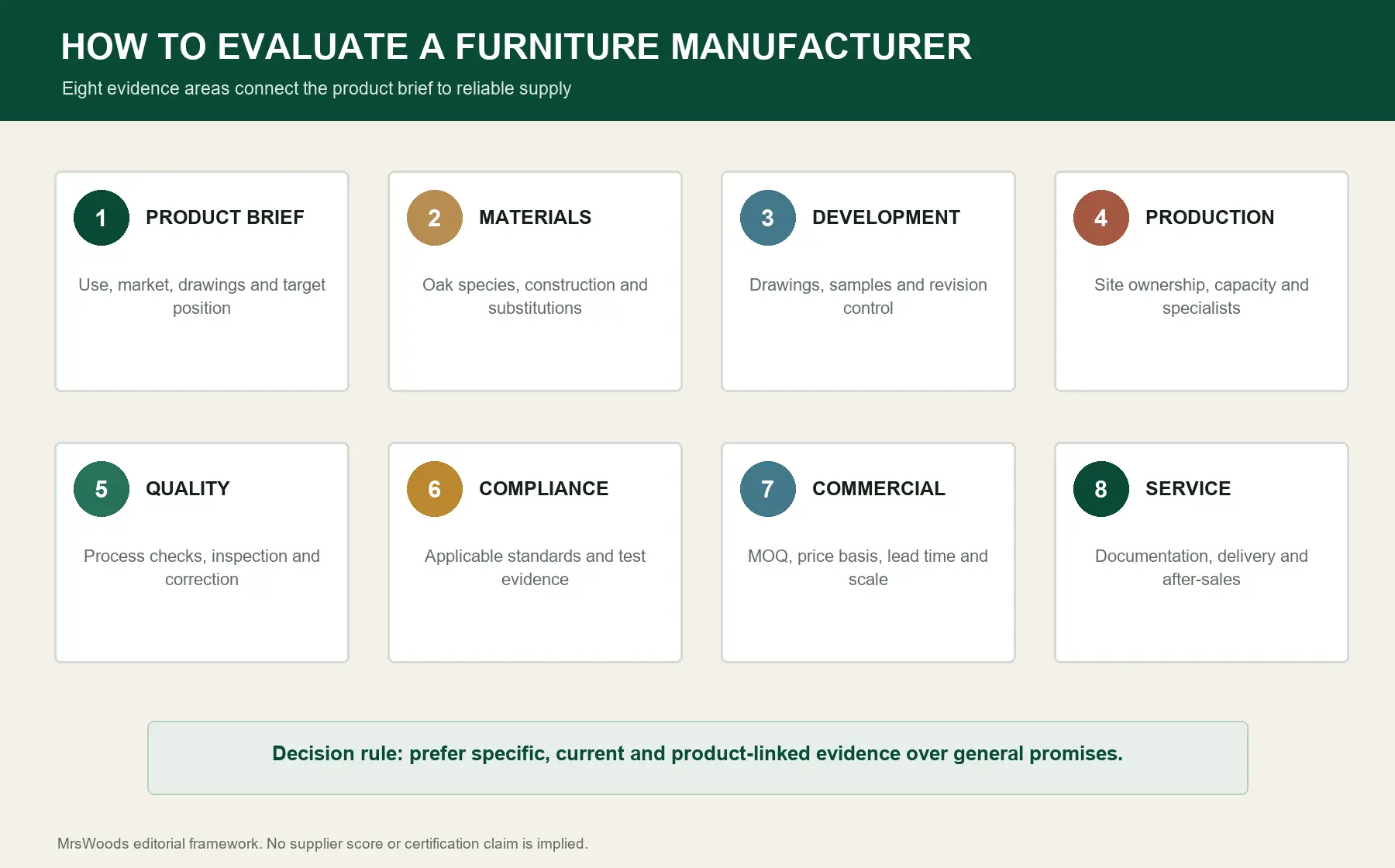
This guide explains how to choose an oak furniture manufacturer through eight practical evaluation areas. It also shows which questions reveal real capability before sampling and mass production begin.
Key Takeaways
- Choose an oak furniture manufacturer against a defined product and market brief, not a generic company presentation.
- Confirm whether quoted components are solid oak, oak veneer, engineered panels or another material before comparing prices.
- A capable custom oak furniture manufacturer should control drawings, materials, samples, revisions and production against one approved baseline.
- Management certificates, social audits, product inspections and laboratory tests answer different questions; none replaces the others.
- MOQ, lead time and capacity should fit the actual purchasing program, including launch quantities, repeat orders and mixed-category requirements.
- Communication quality is operational evidence: decisions, approvals, deviations and corrective actions should remain traceable.
Define the Product and Market Before Comparing Suppliers
A supplier cannot prepare a meaningful proposal from “oak table” or “oak cabinet” alone. The first test of an oak furniture supplier is whether the team asks enough questions to define the item, intended use and commercial route.
A useful sourcing brief normally includes:
- product category and intended use;
- destination market and sales channel;
- drawings, dimensions or reference images;
- expected oak species and visible material language;
- solid wood, veneer and panel preferences;
- finish color, sheen and texture;
- estimated launch and repeat-order quantities;
- target packaging and delivery route;
- required tests, labels and documents;
- fixed requirements and areas open to value engineering.
These inputs prevent false price comparisons. Two suppliers may quote products that look similar in a rendering but use different substrates, joinery, veneer grades, hardware, coatings or packaging.
The material and workmanship checks in how to tell if oak furniture is good quality provide a useful starting point for converting a visual concept into an approval standard.
Normalize the Quotation Basis
Ask every candidate to quote the same specification version. Record inclusions such as tooling, sampling, testing, labels, export packing, spare parts and delivery terms. If a supplier proposes an alternative construction, require it to be identified rather than hidden inside a lower price.
A quotation is comparable only when the scope is comparable.
Verify Oak Material and Construction Knowledge
An experienced solid wood furniture manufacturer should explain where solid wood adds structural or tactile value and where a stable veneered panel may be more suitable. The correct answer depends on the component, dimensions, appearance target, service environment and price position.
Ask the supplier to identify:
- the commercial oak group or species where relevant;
- the material used in each visible and structural component;
- veneer type, matching method and substrate;
- expected natural variation and sapwood policy;
- moisture-control points;
- joint design and grain direction in loaded components;
- finish build and approved color range;
- which substitutions require written approval.
The comparison in solid oak vs oak veneer furniture explains why premium furniture may use both constructions deliberately. A trustworthy supplier should be able to defend the proposed bill of materials without presenting veneer as solid oak or treating every engineered panel as interchangeable.
Look for Component-Level Answers
General phrases such as “premium oak” or “export quality” are too vague. Ask what is used in the legs, rails, top, door fronts, drawer parts, back panels and hidden structural areas. Then ask how the answer will appear in drawings, the bill of materials and inspection records.
This is especially important when evaluating a China oak furniture manufacturer for repeat orders. Material continuity depends on documented approvals and controlled alternatives, not on remembering what the first sample looked like.
Evaluate Product Development and Sample Control
The difference between a catalogue vendor and an OEM oak furniture manufacturer becomes clear during development. A development-capable team should convert references into drawings, material proposals, finish samples, prototypes and a final production specification.
For ODM work, the supplier may also help resolve proportions, construction, materials and manufacturing details. An ODM furniture supplier should still separate the buyer’s approved decisions from suggestions that remain open.
Ask What the “Approved Sample” Actually Controls
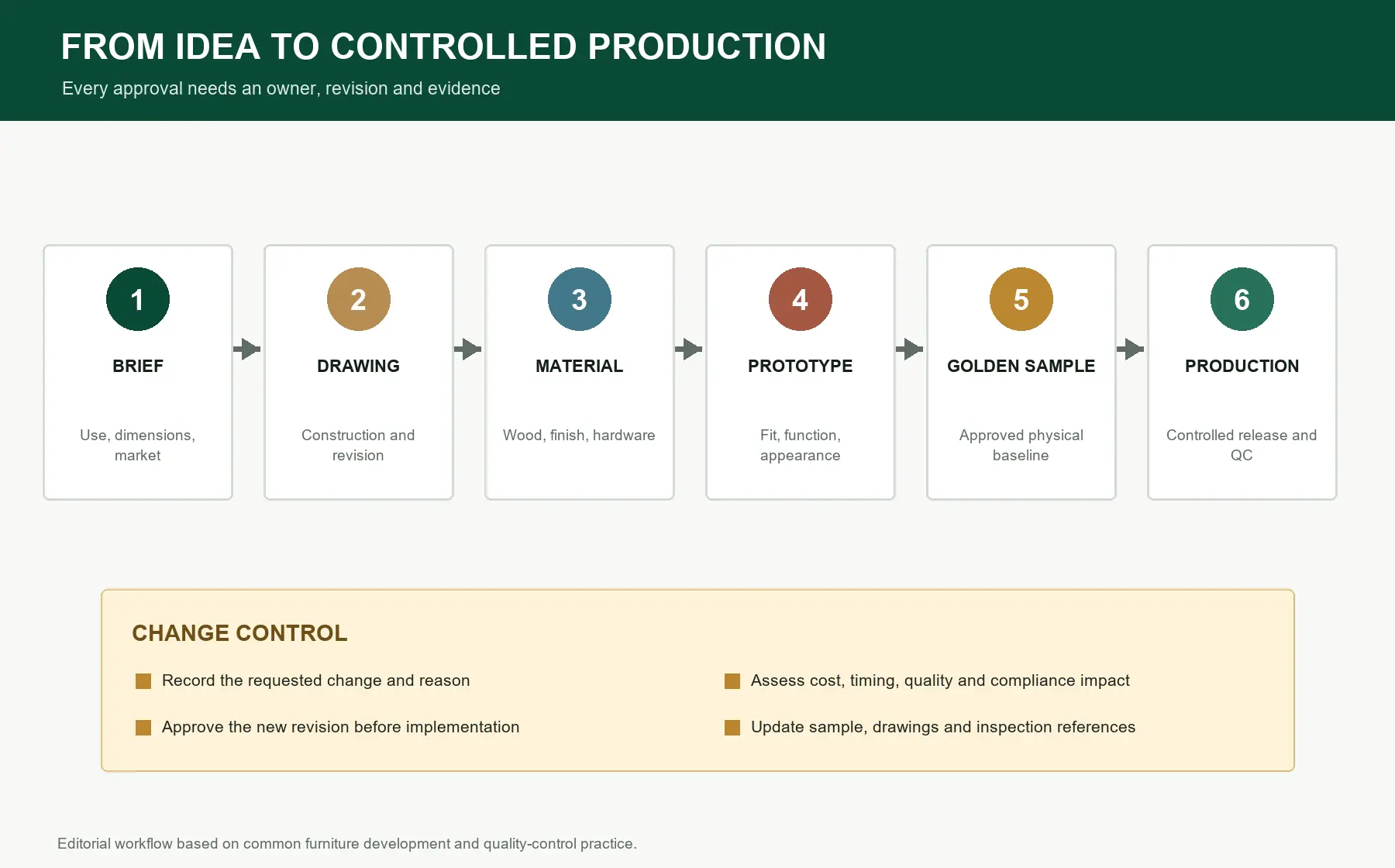
A physical sample may confirm appearance and function, but it cannot record every hidden detail by itself. The approval pack may also need:
- revision-controlled drawings;
- bill of materials;
- finish sample and acceptable range;
- hardware references;
- packaging specification;
- assembly instructions;
- test plan;
- signed deviations and open points.
The production stages in how oak furniture is made show why approvals must connect material preparation, machining, assembly, sanding, finishing, inspection and packing.
Test the Change-Control Process
Ask what happens if the specified hardware is unavailable, veneer color shifts, a panel thickness changes or a packaging test exposes a weakness. A capable supplier should raise the issue, explain the effect, present an alternative and obtain approval before implementation.
Silence is not flexibility. Unrecorded substitution is loss of control.
Review Manufacturing Capacity and Supply Chain Control
Capacity should be evaluated against the order, not as a single promotional number. A large factory may be poorly matched to a small launch program. A small workshop may make an excellent prototype but lack the systems for repeated multi-category orders.
When assessing a China furniture manufacturer, ask:
- which site will make the quoted product;
- which processes are completed there;
- which components or finishes are outsourced;
- who owns the approved specification across suppliers;
- how incoming materials and subcontracted work are checked;
- how peak demand and repeat orders are planned;
- whether mixed-category loading can be coordinated;
- how production status and delays are reported.
A supplier network is not automatically a weakness. Furniture often requires specialized capabilities across solid wood, veneer, metal, upholstery, stone, finishing and packaging. The question is whether one accountable team controls the interfaces.
MrsWoods combines manufacturing resources with design, sourcing, QC and export coordination across furniture categories. Buyers can review the company’s ODM, OEM, sourcing and quality-control services before discussing which resources suit a specific program.
Examine Quality Management, Inspection and Corrective Action
Quality should be visible as a process, not only as a certificate or final inspection. Look for evidence that requirements move from the buyer’s brief into drawings, samples, production checks, finished-goods inspection and corrective action.
The ISO 9001 quality management framework covers planning, documented information, operational control, performance evaluation and improvement. ISO published ISO 9001:2026 in September 2026 and states that certified organizations will transition within the timeframe set by their certification cycle. Buyers should therefore check the full standard reference, legal entity, site, scope, certificate status and transition position rather than accepting a logo alone.
Accredited management-system certificates can be checked through IAF CertSearch certificate verification guidance, which explains how to review status and accredited-standard information.
Separate System Evidence from Product Evidence
An ISO 9001 certificate concerns a management system. It does not prove that one chair passed a stability test or that one cabinet shipment matches the approved finish.
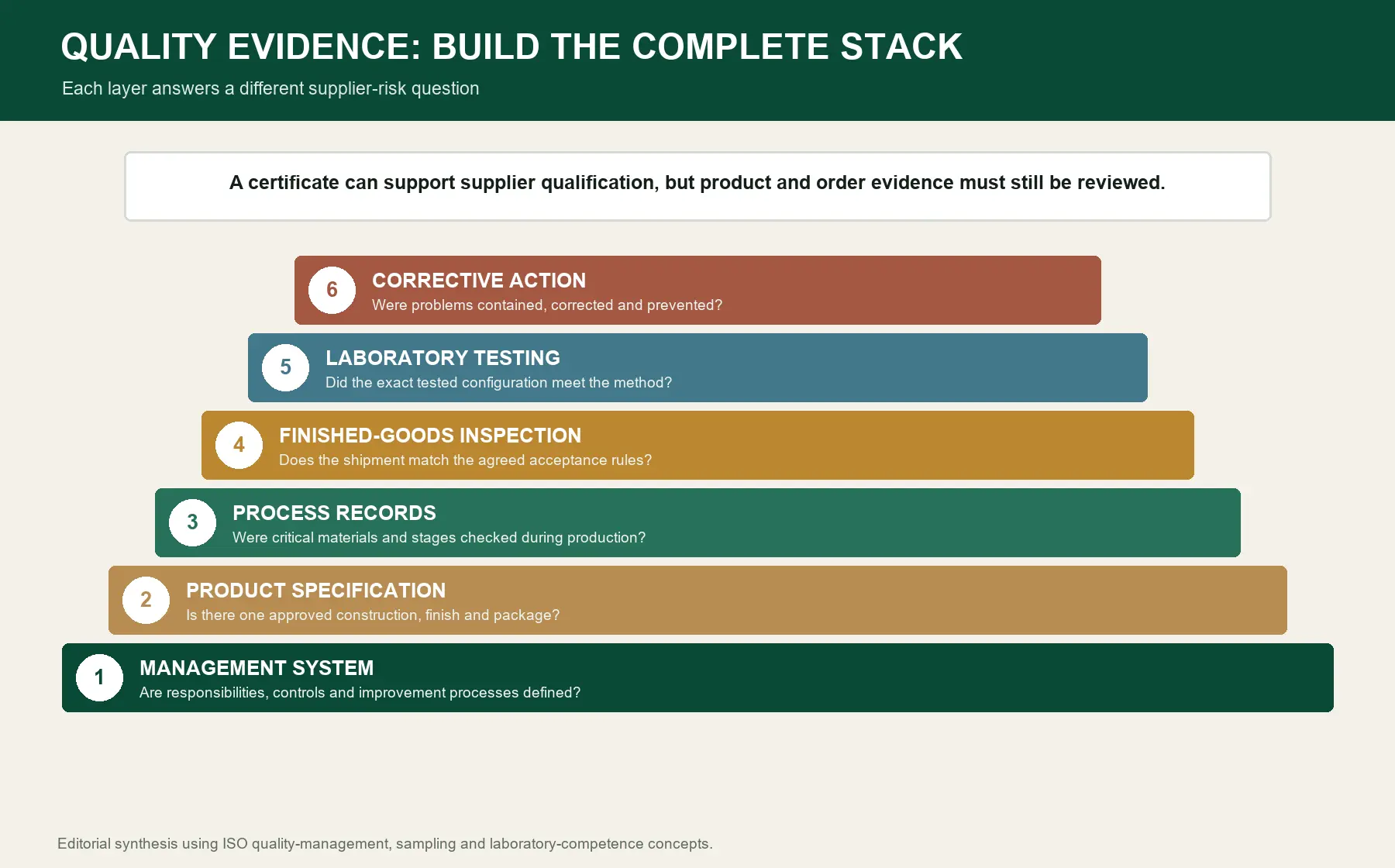
For finished-goods inspection, the buyer and supplier should agree defect categories, sampling method, acceptance rules and reporting format. The current ISO 2859-1:2026 acceptance-sampling standard defines AQL-indexed sampling schemes for lot-by-lot inspection. An AQL reference is incomplete unless the order also defines what counts as critical, major and minor nonconformity.
The distinction between routine inspection and performance testing is explained in oak furniture quality testing. Use that framework to ask which characteristics are checked on the production floor and which require a laboratory or defined test rig.
Confirm Product Testing and Destination-Market Compliance
There is no universal “furniture certificate” covering every table, chair, cabinet and market. Testing must follow product category, intended use, destination, buyer specification and applicable law.
For business and institutional furniture, the BIFMA furniture compliance program identifies category-specific safety and durability standards and explains how buyers can request conformance evidence. A dining chair, lounge chair, desk and storage unit should not be evaluated under one generic test list.
When laboratory evidence is needed, ask whether the facility’s accredited scope includes the relevant method. ISO/IEC 17025 laboratory competence requirements address competence, impartiality and consistent laboratory operation. A laboratory name alone is less useful than a report showing the exact product, method, result, date and tested configuration.
Ask for a Market-Specific Compliance Map
Some rules apply only to defined products. For example, the U.S. Consumer Product Safety Commission’s clothing storage unit business guidance explains the scope, stability requirements, warnings and certification obligations under 16 CFR part 1261 for covered units.
This does not mean every cabinet falls within that rule. It shows why the oak furniture supplier should identify product scope and importer responsibilities before quoting compliance as a generic feature.
Material sourcing evidence is another separate layer. Our guide to sustainable oak furniture sourcing explains how buyers can check certification claims, chain of custody, traceability and composite-wood documentation without confusing them with finished-product performance.
Compare MOQ, Pricing, Lead Time and Scalability
The right wholesale oak furniture supplier should fit both the launch plan and the expected growth path. A low MOQ is valuable only if sampling, tooling, material purchasing and production remain commercially workable. A large stated capacity is valuable only if the supplier can reserve the right resources and maintain the approved standard.
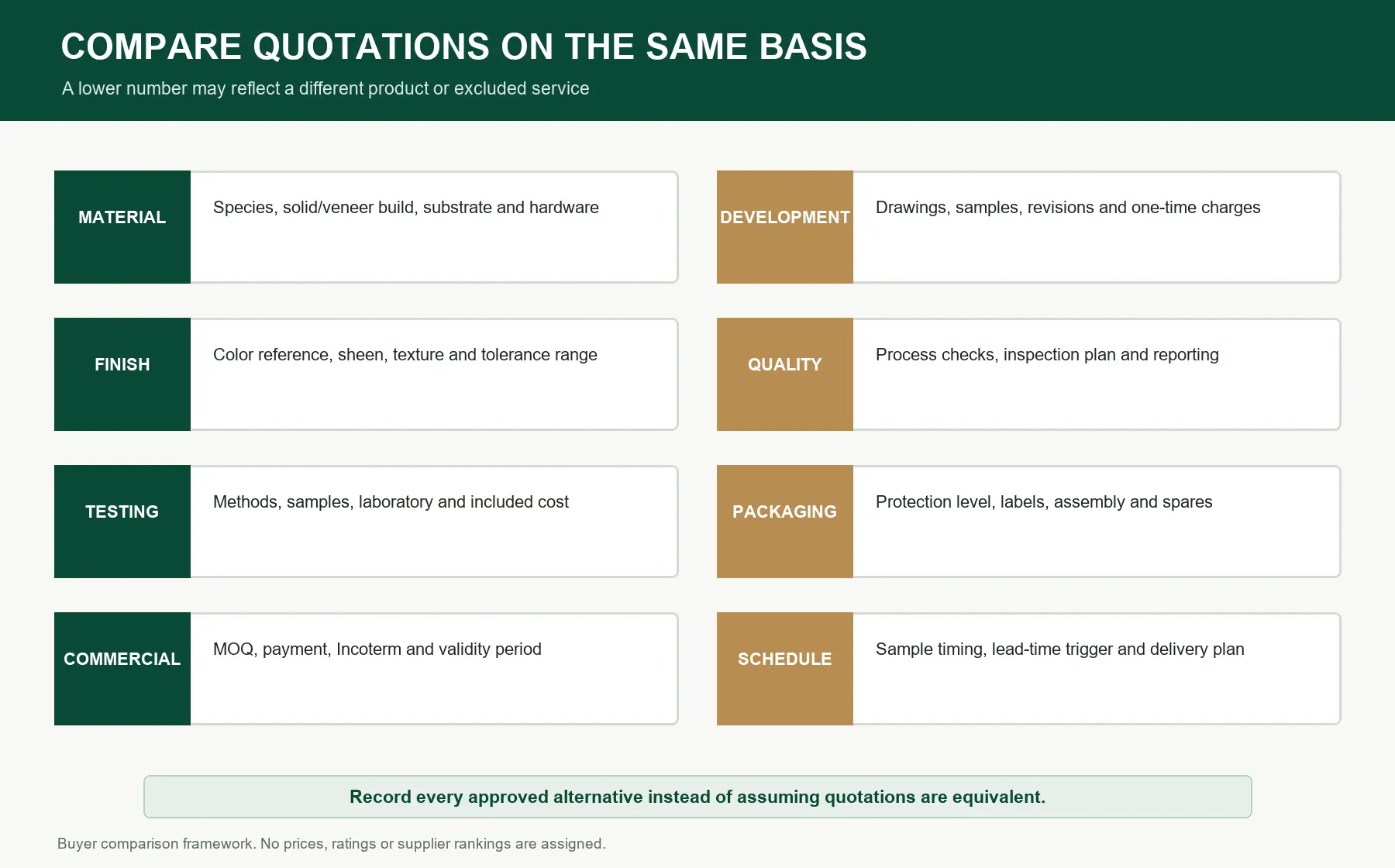
Ask each supplier to separate:
- sample cost and expected revision rounds;
- tooling or one-time development charges;
- product MOQ and color or fabric MOQ;
- material-order constraints;
- testing and inspection costs;
- standard and upgraded packaging;
- production lead time and its starting point;
- Incoterm, loading port and payment terms;
- spare parts, replacements and warranty process;
- conditions for repeat-order pricing.
Test Both Directions of Flexibility
For a launch, ask whether the oak furniture supplier for retailers can support a smaller trial order without silently reducing the specification. For a successful range, ask what changes when the order grows: material reservation, production slots, QC staffing, packaging lines and container planning.
MrsWoods discusses minimum quantities by product and project rather than presenting one MOQ for every furniture category. That approach allows existing designs, modifications and new development to be considered against material, process and order requirements.
Check Communication, Documentation and After-Sales Support
Supplier communication should reduce ambiguity. Look for named ownership of sales, design, production follow-up, QC and shipment coordination. Ask where the latest specification is stored, who can approve a change and how unresolved issues are escalated.
Useful evidence includes:
- meeting notes and decision logs;
- drawing and bill-of-material revisions;
- sample approval records;
- production milestone updates;
- inspection findings and corrective-action closure;
- packing and loading records;
- document lists for the destination market;
- an agreed process for shortages, damage or nonconformity.
Social-compliance evidence can also be relevant to supplier qualification. Sedex’s official SMETA explanation describes SMETA as an on-site social-audit methodology covering labour, health and safety and, depending on scope, environment and business ethics. Sedex also states that SMETA is a continuous-improvement methodology rather than a certification.
That distinction matters. A social audit does not replace furniture QC, and a good pre-shipment inspection does not replace labour due diligence. A serious supplier evaluation keeps each evidence type attached to the risk it addresses.
MrsWoods is a furniture company and B2B manufacturing partner, not a furniture series. Its company background and operating capabilities cover product development, multi-category sourcing, manufacturing follow-up, quality control and export coordination for international buyers.
Questions to Ask an Oak Furniture Manufacturer
Use the following questions during initial qualification and again before the purchase order:
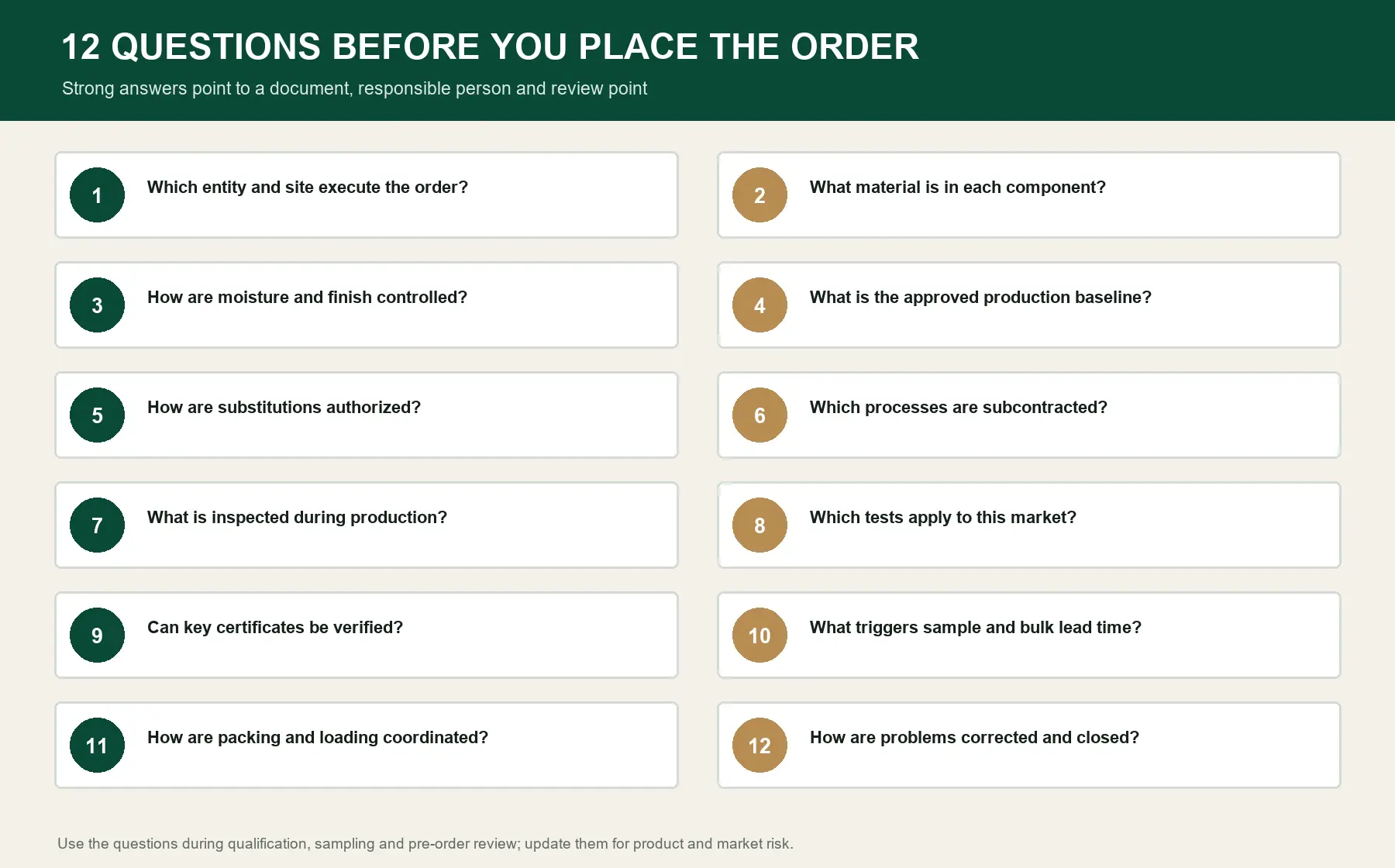
- Which legal entity and production site will execute the order?
- What material is used in every visible and structural component?
- How are oak moisture, grain selection and finish variation controlled?
- What drawings and samples become the production baseline?
- How are material or construction changes approved?
- Which processes are internal and which are subcontracted?
- What inspections occur during production and before shipment?
- Which tests and regulations apply to this product and market?
- Can certificates and laboratory scopes be independently verified?
- What are the MOQ, sample schedule and bulk lead-time assumptions?
- How are mixed categories, packing and container loading coordinated?
- What happens when inspection finds a problem or a customer reports one?
Strong answers should be specific enough to place in the sourcing file. “We always make high quality” is not an operating method.
Frequently Asked Questions
How do I find a reliable oak furniture manufacturer?
Start with a clear product and market brief, then ask candidates for component-level material details, sample-control records, QC evidence, relevant test reports, realistic commercial terms and a defined corrective-action process. Verify important claims independently.
Is a factory audit enough to choose an oak furniture supplier?
No. A factory audit can examine facilities, systems or social conditions within its scope, but it does not prove that your exact product, sample, finish, testing plan and shipment meet the purchase specification.
Should I choose the lowest-priced China oak furniture manufacturer?
Choose the best comparable offer, not automatically the lowest number. Normalize construction, materials, finish, packaging, testing, Incoterms and included services before evaluating price.
What should I send an OEM oak furniture manufacturer for a quotation?
Send drawings or reference images, dimensions, intended use, destination market, material and finish expectations, estimated quantity, packaging route, target timing and required tests or documents. Identify fixed and flexible details.
Can a custom oak furniture manufacturer support a small launch order?
Possibly, but feasibility depends on the product, material minimums, tooling, finish, development work and production route. Discuss launch quantities and repeat-order plans together rather than assuming one universal MOQ.
What is the difference between an oak furniture manufacturer and an oak furniture supplier?
A manufacturer directly operates production processes. A supplier may manufacture, coordinate specialized factories or combine both models. Buyers should identify who controls each process and who remains accountable for the approved order.
Conclusion
Choosing an oak furniture manufacturer is a controlled comparison of evidence. Define the product first, verify materials and construction, test the development process, review production ownership, separate management systems from product proof, confirm market requirements and align the commercial plan.
MrsWoods supports brands, retailers, wholesalers and project buyers with existing product selection, OEM/ODM development, material and finish coordination, sampling, production follow-up, quality control, third-party inspection support, export packing and mixed-container planning. The practical scope, MOQ, testing and documentation are confirmed for each product and order.
Buyers can send drawings, reference images, dimensions, material preferences, quantity, destination and target timing through the MrsWoods sourcing request page. That information gives the team a concrete basis for proposing the next development and quotation steps.
