
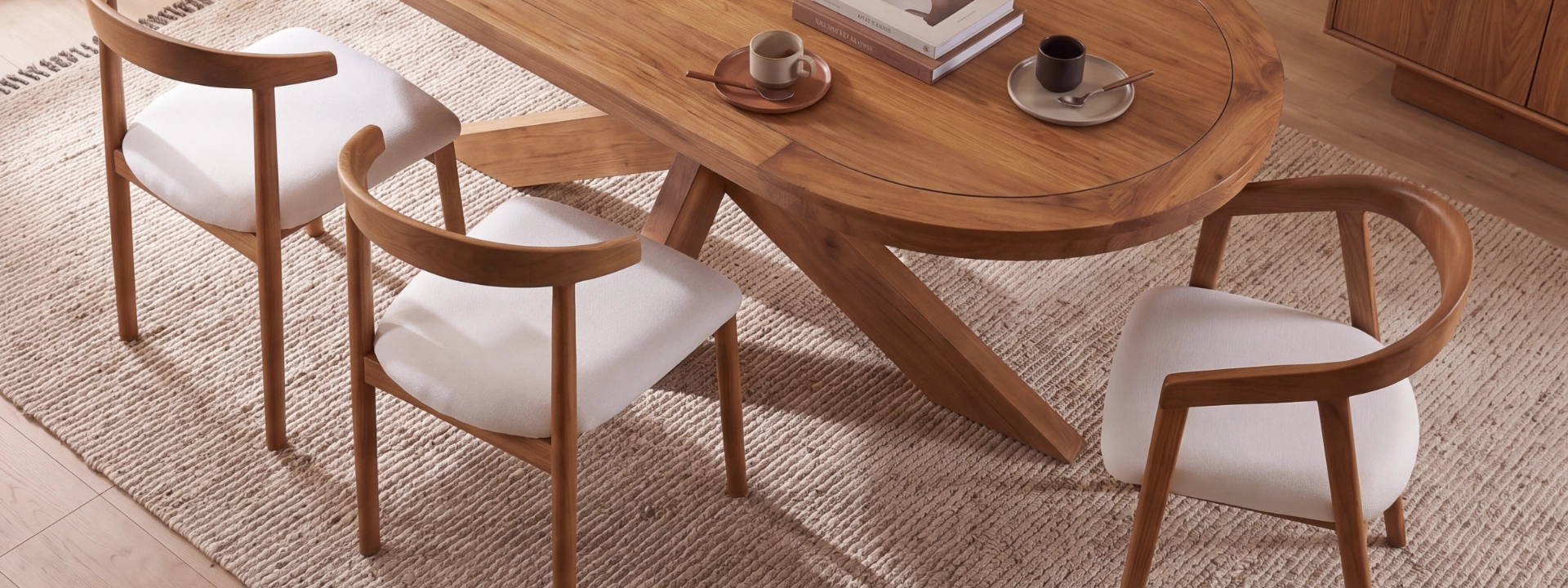

High quality oak furniture has more than attractive grain. A well-made piece uses the specified materials, sound construction, controlled moisture, consistent finishing, reliable fittings and inspection criteria suited to its intended use.
You cannot confirm all of that from a product photo or the word “oak” on a quotation. A buyer needs to examine the sample, agree on measurable requirements and check whether production matches the approved version. This guide turns the material and manufacturing topics in our earlier articles into an actionable oak furniture buying guide for brands, retailers and project buyers.
It also gives buyers a practical basis for questioning an oak furniture manufacturer or oak furniture supplier about materials, approvals and QC. It does not assume that solid wood is always better than veneer, that a premium lumber grade guarantees a sound chair, or that one finish suits every market.
Key Takeaways
- A material description should identify where solid oak, oak veneer and any engineered core are used, rather than calling the whole item simply “oak.”
- Lumber grade describes the raw board; finished furniture quality also depends on design, joints, moisture, finish and assembly.
- Approve visible appearance and hidden construction separately, using drawings, physical samples and agreed acceptance criteria.
- A pre-shipment inspection should compare the actual order with the approved sample and specification, including packaging and labels.
- Ask for test reports or compliance documents only where the product, destination market and claimed standard make them relevant.
What Actually Defines Oak Furniture Quality?
The best starting question is not “Is this oak?” but “Does this product meet a defined specification for its intended use?” A domestic sideboard, a hotel dining chair and a frequently moved event table face different demands. Their materials and checks should reflect those differences.
Judge quality at three levels. Material quality covers species or commercial group, solid and veneered parts, core materials and acceptable natural variation. Construction quality covers component dimensions, joints, movement allowances, hardware and stability. Production quality covers how closely repeat units match the approved sample, including finish, function and packing.
A good sample is evidence of what a supplier can make once. It does not, by itself, show that every order unit will match. Before production, define critical-to-quality points: the characteristics that would lead you to accept, rework or reject a product. Keep the approved drawings, material schedule, finish sample and packaging specification together so each inspection uses the same reference.
This article is a buyer’s decision framework, not a replacement for product-specific engineering or laboratory testing. Where a retailer or project requires a formal performance claim, identify the correct test method and request a report for the relevant product configuration.
Check What “Oak” Means
“Oak furniture” can refer to a solid-wood frame, a veneered panel on a wood-based core, or a combination. A decorative oak-look surface is different again. None of these descriptions automatically proves or disproves quality; the problem is an unclear specification.
Ask for a component-by-component material schedule. A dining table may use solid oak legs and rails with a veneered top. A cabinet may combine solid edging, oak-veneered doors and a compliant engineered core. The quotation and sample should name those parts consistently. The Decorative Hardwoods Association’s veneer overview explains that wood veneer is a thin sheet of real wood that can be selected and matched for a surface.
If a panel contains hardwood plywood, MDF or particleboard for the U.S. market, check the applicable documentation. The U.S. EPA’s composite wood rule covers specified composite wood products and finished goods containing them. It is not a general certificate for all furniture, and a natural oak veneer does not remove the need to verify a regulated core.
For a deeper material comparison, the separate guide to solid oak vs oak veneer furniture explains where each construction makes sense. Here the buyer’s task is simpler: verify that every visible and hidden part matches what was quoted.
Assess Wood Selection
Look across several pieces, not only the most attractive sample. Does the approved appearance allow sapwood, knots, mineral streaks, filled defects or strong color variation? These may be acceptable design features, but their location and frequency need agreement. On prominent cabinet fronts, ask how grain direction and adjacent boards or veneers will be arranged.
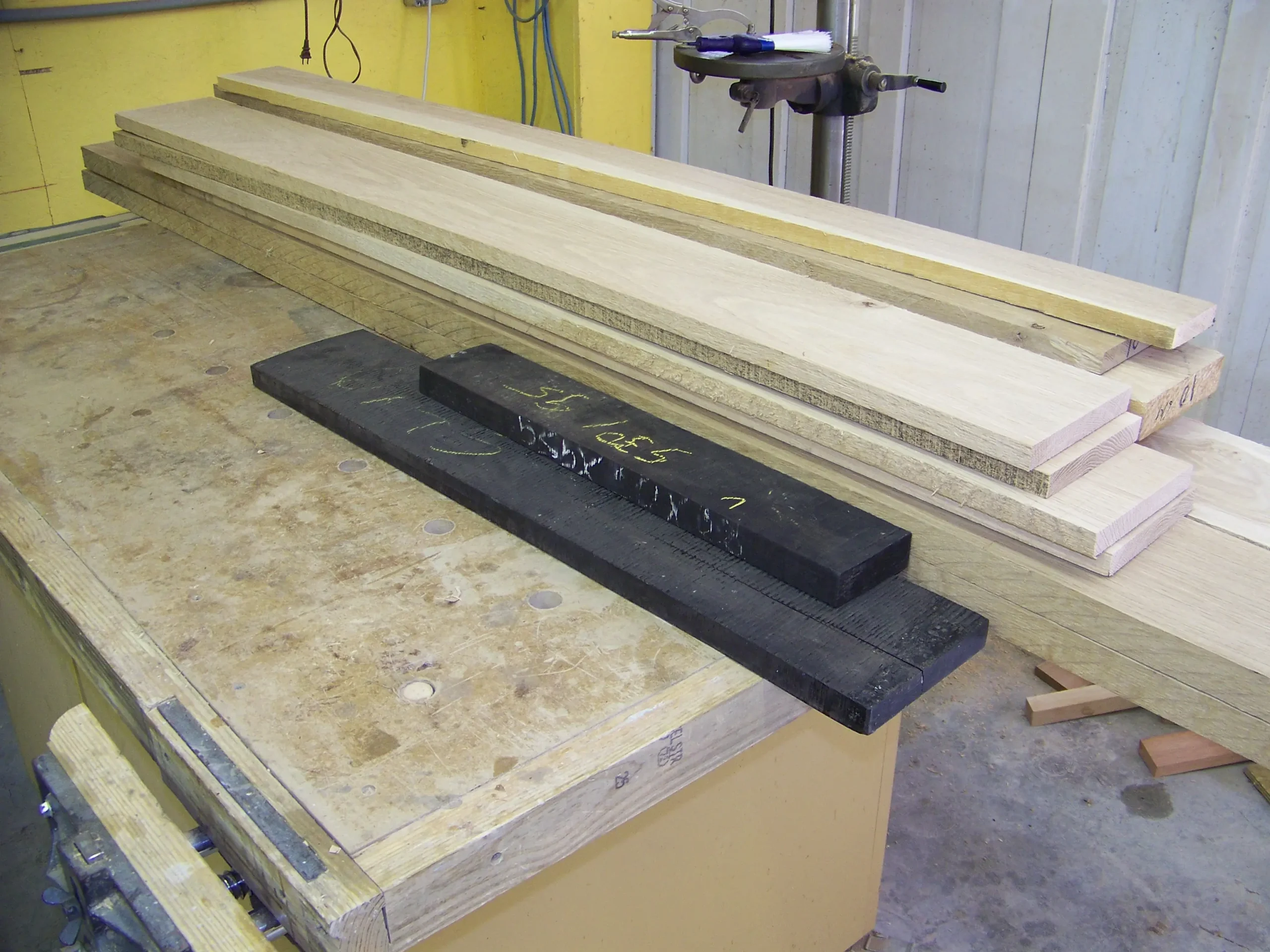
The NHLA hardwood lumber grading rules classify hardwood lumber. They do not grade a finished table, chair or cabinet. A high lumber grade can support a clear, consistent appearance, but poor machining, unsuitable joints or weak assembly can still produce a poor item. Conversely, a lower grade can be appropriate for a design that intentionally uses natural features, if soundness and visual limits are defined.
Check whether long components have suitable grain direction and whether visible faces match the agreed character. For a dining chair, a decorative face is only part of the picture; the selection of stock for legs and rails also matters. For a sideboard, large neighboring doors may make small color differences more obvious than they are on a handheld sample.
If the product brief allows either oak group, compare white oak vs red oak furniture before approving a color and grain range. Species group and cut affect appearance; the finished sample still needs its own acceptance limits.
If a supplier proposes changing the oak group, board selection or panel construction after approval, treat it as a material change. Recheck the affected appearance and performance requirements before accepting the substitution.
Check Moisture Control
Oak remains responsive to humidity after manufacture. The USDA Wood Handbook chapter on moisture relations explains that wood exchanges moisture with surrounding air according to relative humidity, temperature and its current moisture content. This is why a dry-looking sample does not prove that a later production batch is ready for another climate.
Ask how and when moisture is measured, which components are checked, and how the target relates to the intended destination and construction. A reading from one easily reached surface is not a complete record. The buyer may also need to review storage, conditioning and timing between machining, finishing and packing.
The relationship between moisture, density and wood movement is explained in our oak wood properties for furniture guide. For an order, convert those principles into a component-specific measurement plan instead of copying a single number from a general article.
Look for visible warning signs: an opened joint, a cupped panel, a rubbing door or a finish line that has separated at a moving joint. None has a single guaranteed cause. The purpose of inspection is to identify the issue early, document it and investigate before the order ships.
The detailed discussion of oak wood moisture content belongs in our dedicated technical guide. In this quality check, moisture is one control point among several, not a magic number that certifies the entire product.
Examine Construction and Joinery
Inspect the parts that carry load and keep the product square. On a chair, examine the legs, rails and their connections. On a table, look at the frame, attachment of the top and any extension mechanism. On a cabinet, check the case, shelves, back, doors and drawers. A heavy item is not necessarily a well-engineered one.
Ask to see the underside and rear of the sample. Joints should be appropriate to the product, accurately fitted and free of visible gaps, splitting or looseness. A named joint type alone does not establish strength. Its dimensions, wood quality, adhesive, fasteners and execution matter.
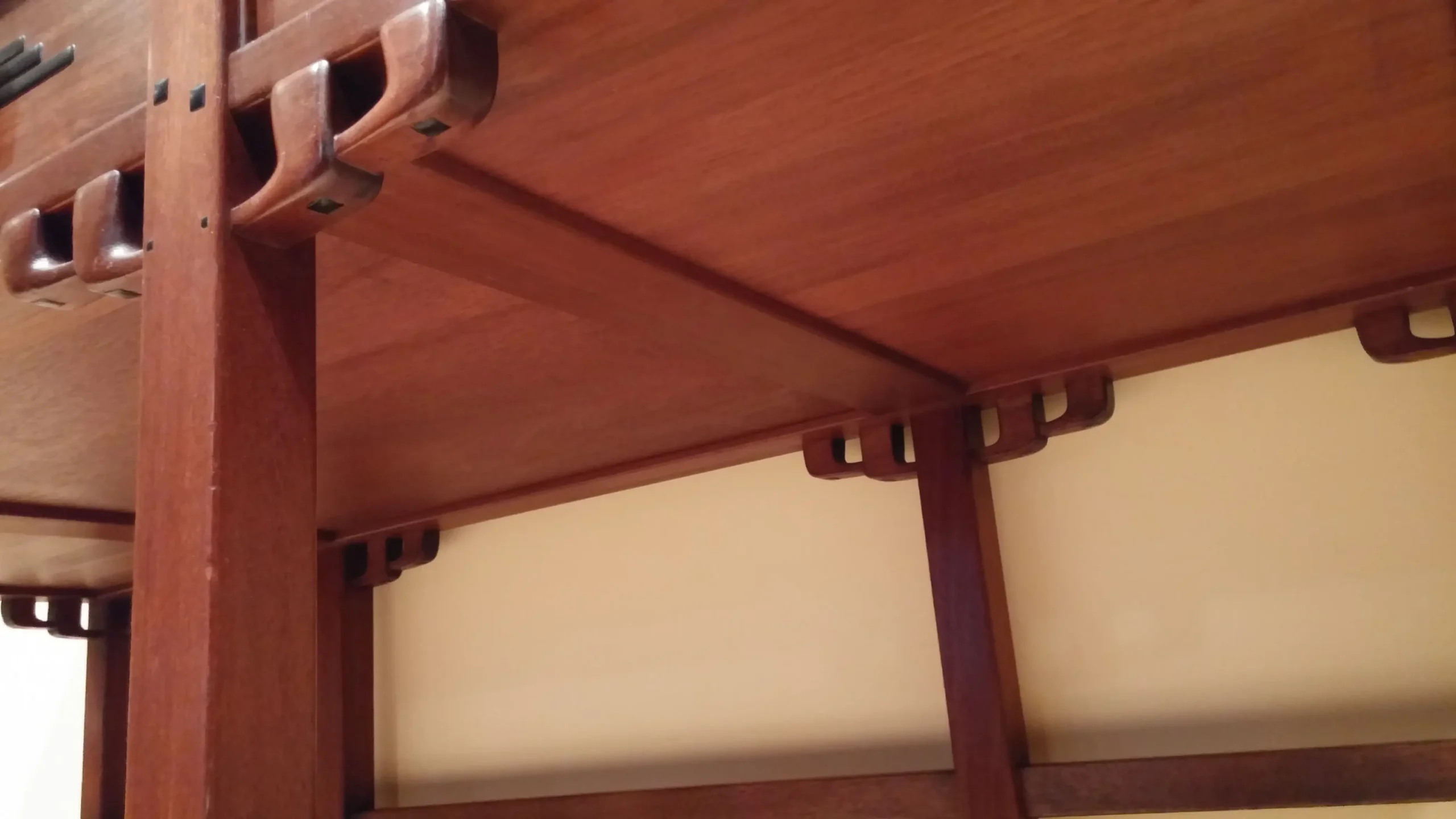
Photo: Sam Wilson, CC BY-SA 2.0, via Wikimedia Commons. Illustrative joinery example; neither its wood species nor any MrsWoods connection is asserted.
Broad solid-wood components need room for movement across the grain. Fixed attachments that restrain a wide top can be a risk when the environment changes. A veneered engineered panel solves some design problems but brings its own requirements for core selection, bonding and edges. The full mechanics are covered in oak furniture construction; for this inspection, focus on whether the actual build follows the approved drawing.
Sit on a chair sample, open every drawer, extend the table and assemble a flat-pack item according to its instructions. Record wobble, binding, unexpected noise or poor alignment. These simple checks reveal issues, but they do not replace a specified durability or stability test when one is required.
Inspect Veneer and Edge Details
Good veneer work should look intentional across the whole piece. Examine large faces under ordinary light, then look closer at corners, cutouts, curved edges and joins between panels. Check whether the grain direction and match follow the approved sample, and whether opposite or neighboring faces are acceptably consistent.
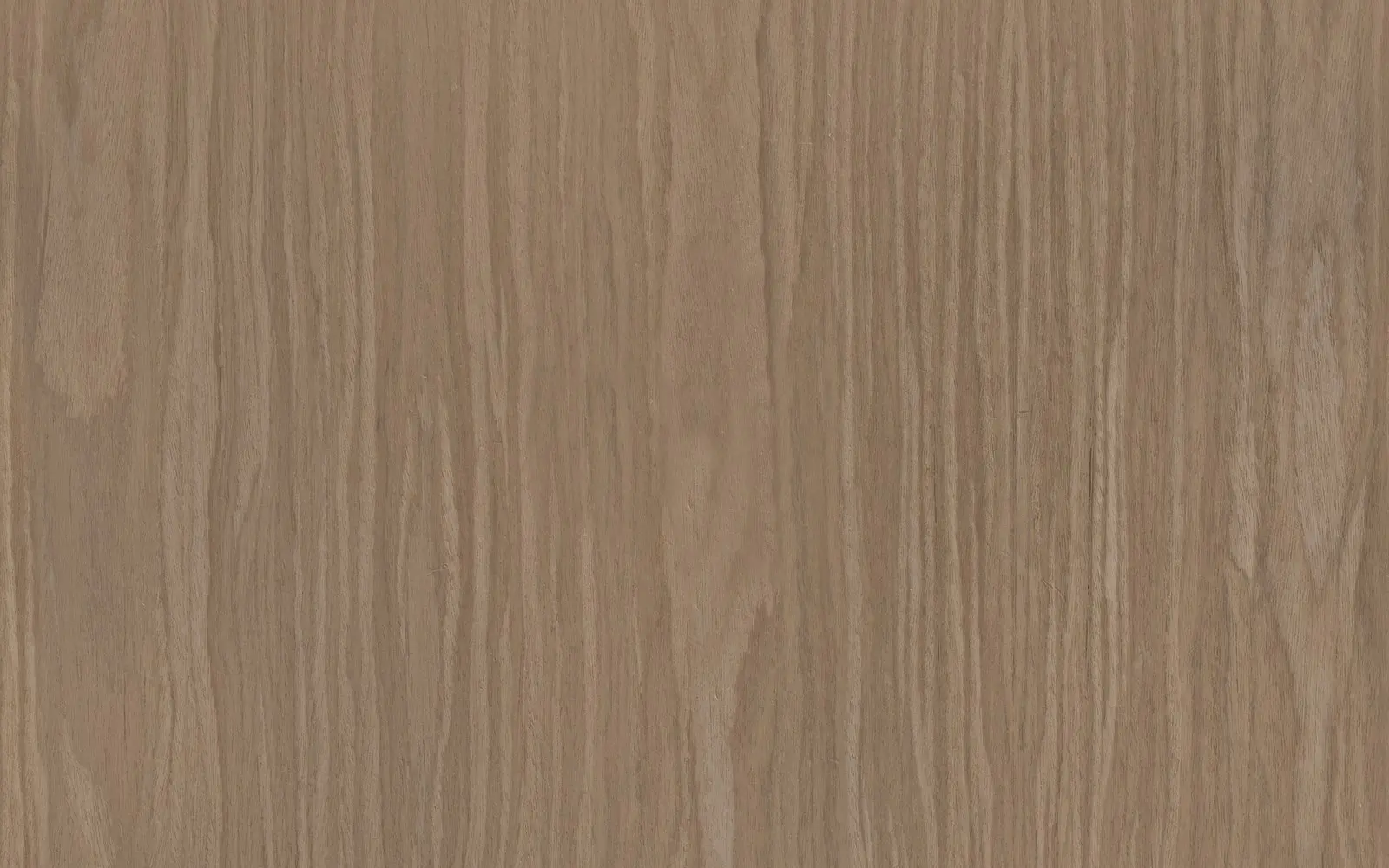
Look for lifted edges, bubbles, open seams, glue marks and sanding-through. Run a hand lightly over the edge to detect abrupt ridges, but do not mistake every natural grain change for a defect. An edge band should cover the substrate cleanly, with a radius and transition that match the design. Inside edges and undersides may have different appearance standards, but those standards should be written down.
An oak veneer furniture manufacturer should be able to explain the face veneer, core, edge treatment and finish proposed for each component. An oak veneer furniture supplier should be able to preserve those approved details through a repeat order. Ask for close-up sample photographs and a physical reference where possible; photographs alone can hide small edge failures.
Our guide to oak veneer furniture quality details explores matching, curved edges and common veneer defects in greater depth. This article uses those details as one part of the finished-product decision.
Evaluate Surface Finish
View the approved sample and production pieces under consistent lighting. Compare color, sheen, texture and grain contrast. Inspect the most visible face, but also look at edges, corners, joints and areas that are easy to miss in a product photograph.
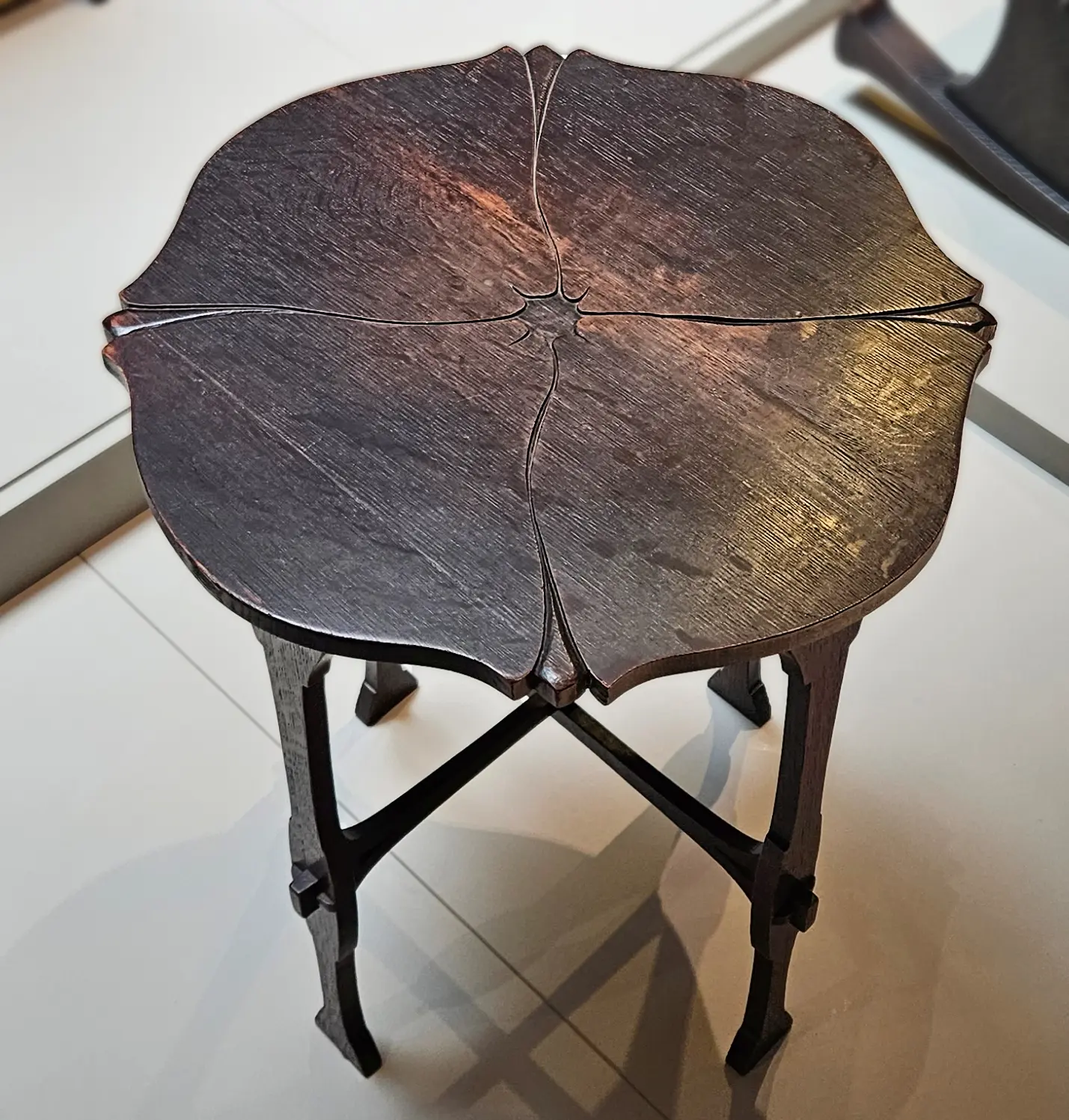
Photo: Eric Polk, CC BY-SA 4.0, via Wikimedia Commons. Historic oak furniture shown as a finish-view example, not a MrsWoods product or an approved finish standard.
The USDA guidance on finishing wood notes that a finish affects appearance and cleanability, while protection requirements vary with use. A beautiful showroom sample may still be the wrong specification for a frequently cleaned restaurant table. Agree on the intended use and the relevant care or performance expectations before selecting a finish system.
Check for missed coating, dust trapped in the surface, uneven staining, runs, roughness and premature damage on handled edges. A small amount of natural color variation may be within an agreed range; a defect is judged against that range, not an unspoken expectation of perfect uniformity.
For repeat orders, retain a signed finish sample or a controlled set showing the allowed range. A screen image is not a dependable color standard. Our separate guide to oak furniture finishes covers sample approval and finish selection in more detail.
Check Hardware and Function
Hardware can determine whether a well-built oak cabinet is pleasant to use. Open and close each door and drawer several times. Check clearances, smooth travel, stops, soft-close action where specified, and whether screws and mounting plates are secure. Identify the hardware model or agreed equivalent in the specification.
For tables, test extension leaves, locking parts and levelling feet. For seating, check that the assembled product sits evenly on a suitable flat surface. For knock-down furniture, perform a trial assembly with the supplied parts and instructions. Note whether tools, spare fittings and protective pads are included where promised.
Do not rely on a smooth first movement as evidence of long-term durability. If the intended market or project requires a formal performance claim, request testing for the finished product and the relevant use category. BIFMA’s standards descriptions distinguish tests for seating, tables and storage. The applicable standard depends on the product and market; a passing report for one model is not blanket approval for a different construction.
What Should Be Inspected Before Shipment?
The pre-shipment check should compare the actual order with the approved reference, not with a general idea of “premium oak.” Start with the order number, model, revision, quantity and finish code. Confirm the inspection approach and sampling method with the buyer or appointed third party before production is complete.
Review dimensions, stability, assembly, visible finish, doors and drawers, veneer edges, hardware and labels. Check the carton and protective packing against the agreed shipment method. For mixed-product containers, confirm that item identification and loading plans allow the buyer to receive the right quantities without unnecessary handling.
Photographs are useful evidence, especially for visible finish, packaging and labels. They cannot capture every functional or hidden defect. An inspection report should record what was checked, what was not checked, the result, and how any nonconformity will be handled. If testing or a compliance claim is required, keep its document separate from an ordinary visual QC report.
MrsWoods describes sample checks, production QC, pre-shipment review and mixed-container coordination in its furniture supply services. Buyers should still confirm the agreed inspection scope for their own order and welcome an appropriately briefed third-party inspector where needed.
Oak Furniture Quality Checklist
Use this checklist at three decision points: supplier quotation, sample approval and pre-shipment review. An item is not “passed” merely because it appears in a photograph. Agree on the evidence and acceptance rule for each line before the order proceeds.
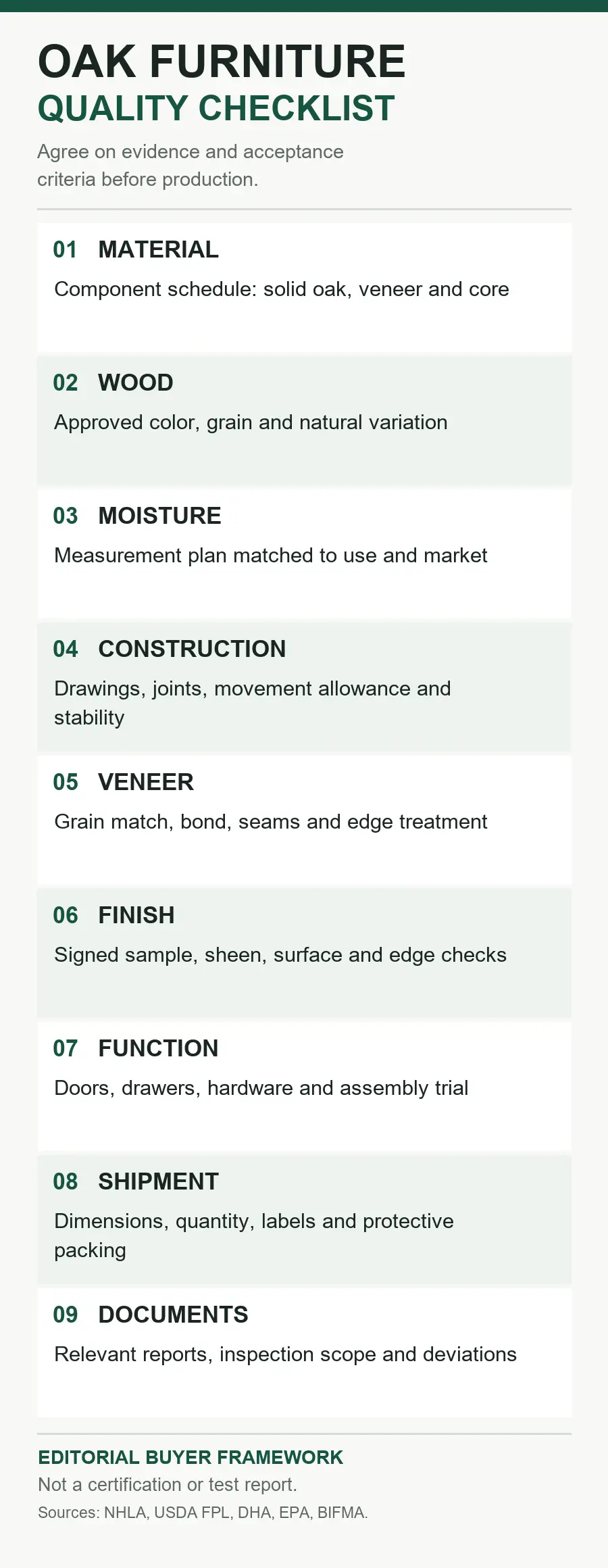
Send the same brief to each candidate oak furniture supplier. Compare responses on the same material schedule, finish, quantity, packaging and inspection terms. A low quotation with an unspecified core, simplified edge or different hardware is not a like-for-like offer.
The questions also help evaluate an oak furniture manufacturer: Can the team explain a change in construction? Can it show a physical sample and record the approved version? Can it identify what will be inspected and how deviations are resolved? Clear answers are more useful than a generic claim of “high quality.”
Frequently Asked Questions
How to tell if oak furniture is good quality?
Use the approved material schedule, drawings and finish sample to inspect the actual piece. Check joints and stability, moisture controls, veneer edges, hardware and packing; a product photograph alone cannot confirm those points.
How can I tell whether oak furniture is solid or veneered?
Check a component material schedule and inspect accessible edges, undersides and cross-sections. Appearance alone is unreliable because a genuine oak veneer can closely resemble a solid face.
Does a higher lumber grade guarantee better furniture?
No. NHLA grades lumber, while finished quality also depends on construction, machining, moisture control, finish, hardware and inspection.
What to look for in oak furniture when comparing suppliers?
Request the material schedule, drawings, finish sample, quantity and packaging terms, sample approval process, inspection criteria and any market-specific documents relevant to the product.
Can an oak veneer cabinet be high quality?
Yes. Its performance depends on the specified core, veneer selection and bonding, edge treatment, construction, finish and intended use. “Veneer” alone is not a quality grade.
Is a pre-shipment photo set enough?
Usually not for complex products. Photos help document visible details, but functional, dimensional, stability and hidden construction checks may require direct inspection or product testing.
How to inspect oak furniture before shipment?
Compare sampled units against the approved model, dimensions, finish, assembly and packaging requirements. Record deviations and the agreed disposition before release. The sampling plan should be set for the specific order.
Conclusion
To identify high quality oak furniture, examine the full product rather than a wood name or a polished image. Confirm the material in each component, approve a realistic appearance range, check moisture and construction, test function, inspect veneer and finish, and compare shipped goods with the approved specification.
MrsWoods works with brands, retailers, wholesalers and project buyers on furniture development, sourcing, manufacturing coordination and QC. To discuss an oak furniture project, send the team your drawings, reference images and product requirements, including target market, materials, finish, expected quantity and inspection needs. The first useful step is a clear brief, followed by a sample and an agreed production standard.
