
The right choice in oak vs ash vs walnut furniture depends on the product, visual direction, target price, construction and supply specification. White oak is generally the heaviest and hardest of the three reference groups, ash combines a light color with strong grain and excellent bending potential, and black walnut provides a naturally dark, premium appearance with lower reference hardness.
None is automatically the best wood for furniture. A well-engineered ash chair may be more appropriate than a heavier oak version, while walnut may create the value expected in a premium cabinet even when oak offers higher hardness. Buyers should compare the complete material specification, not choose from color or one data point alone.
This guide uses American white oak, American ash and American black walnut for a consistent furniture wood comparison. Commercial names can cover multiple species or growing regions, so purchase documents should identify the intended material precisely.
Key Takeaways
- White oak has the highest average weight and hardness in the AHEC reference data used here, but furniture performance also depends on grade, moisture, component size, joints and manufacturing.
- Ash is light in color, strongly grained and particularly useful for bent, turned or visually lightweight furniture components.
- Black walnut is valued for its chocolate-brown heartwood and premium positioning; it should not be specified as if every board were uniformly dark.
- Cost is shaped by grade, dimensions, color selection, yield, construction and availability, not only by the price per cubic meter or board foot.
- B2B buyers should approve physical material and finish samples, define acceptable natural variation and test the finished product rather than selecting a species from a small image.
Oak vs Ash vs Walnut: Quick Comparison
For a quick decision, begin with the role the wood must play:
- Choose white oak when the collection needs a familiar premium hardwood, a hardwearing surface, broad use across tables and cabinets, or a visible ray figure in selected cuts.
- Choose ash when the design needs a pale base, bold growth-ring contrast, turned parts, steam-bent forms or a lower visual weight.
- Choose black walnut when natural dark heartwood and a high-end visual signal are central to the product concept.
The comparison is not a winner-takes-all ranking. The same collection may use one species for solid frames, another as veneer, and metal, stone or upholstery where those materials perform better.
If oak is your starting point, our earlier overview of the advantages and disadvantages of oak wood explains why oak remains widely used while still requiring careful control of weight, movement, grain and cost.
Color and Grain
Color is usually the first visible difference, but approved samples should include grain, cut, feature allowance and finish as well.
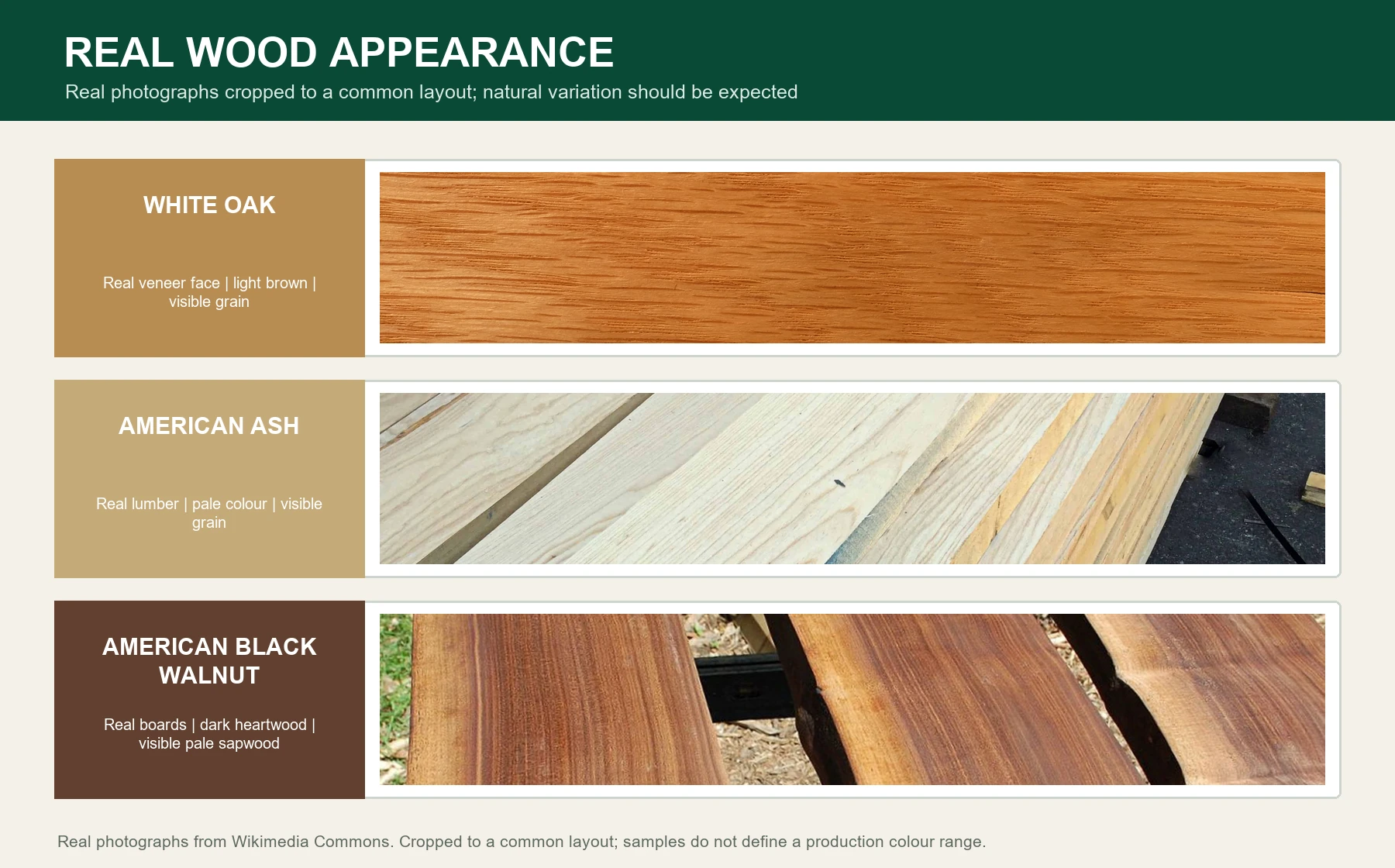
White oak sapwood ranges from whitish to light brown, while heartwood normally ranges from light to darker brown. The grain is commonly straight with a medium-to-coarse texture. Medullary rays can create pronounced figure, especially in quarter-sawn material. This makes oak useful for products that need visible natural character rather than a visually quiet surface.
American ash is generally light colored. Its sapwood may range from white to yellow, while heartwood can be light to dark brown. The grain is usually straight and coarse, with strong contrast between growth rings. Mineral streaks are natural features, so a buyer who expects a uniformly pale surface should specify color selection and feature limits rather than assuming the species name provides them.
American black walnut has creamy sapwood and heartwood that can range from light brown to dark chocolate, sometimes with darker or purplish streaks. Grain is often straight but may be wavy or curly. Sapwood policy matters: allowing it creates natural contrast and may improve yield, while strict dark-heartwood selection can raise waste and cost.
The AHEC American white oak profile, AHEC American ash profile and AHEC American walnut profile provide the species descriptions and comparison data used in this guide.
Density, Hardness and Strength
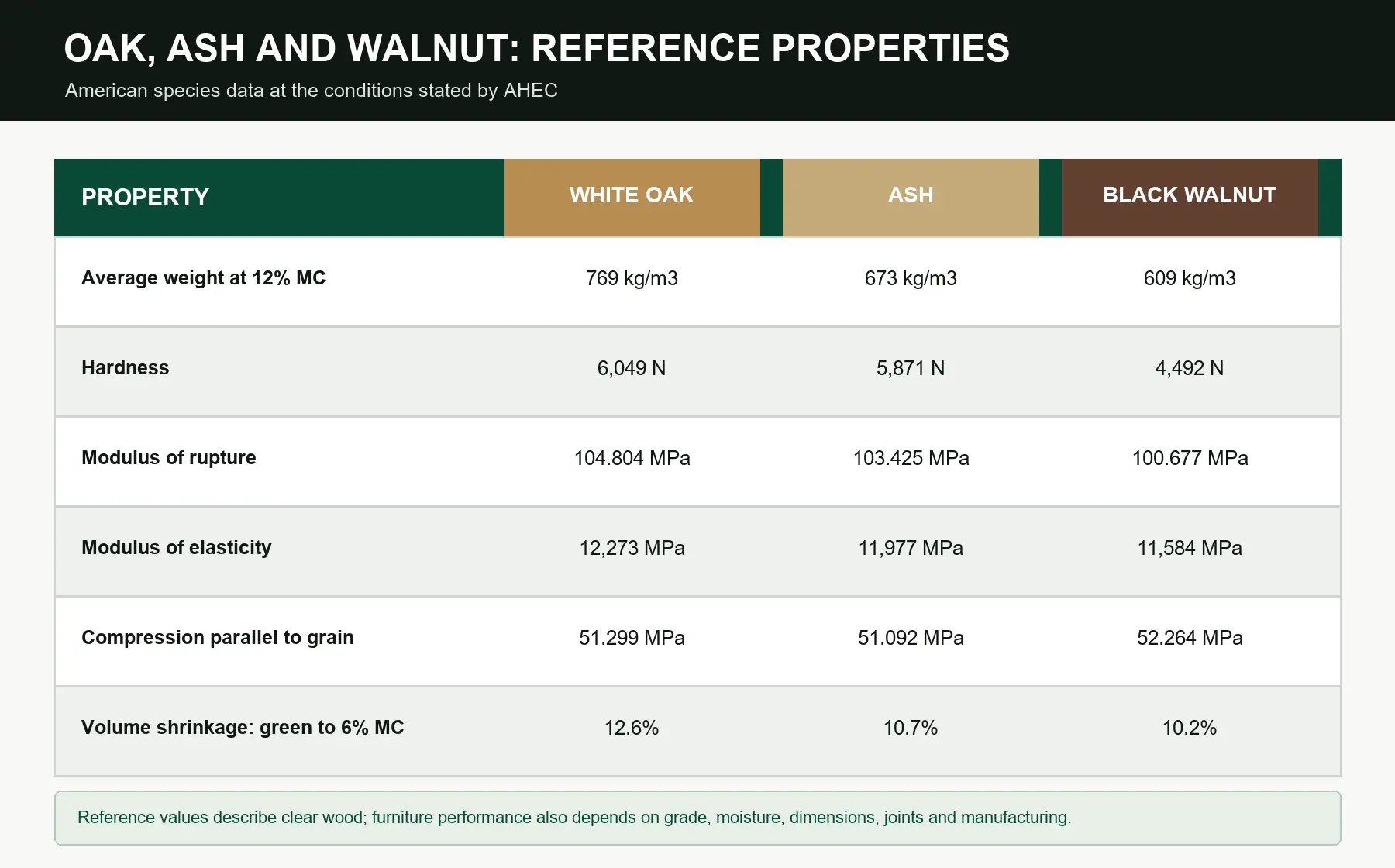
In the AHEC values at 12% moisture content, American white oak averages 769 kg/m3, ash 673 kg/m3 and walnut 609 kg/m3. Their reference hardness values are 6,049 N, 5,871 N and 4,492 N respectively. White oak is therefore heavier and harder in this dataset, while ash remains close in hardness at a lower average weight.
That difference can affect shipping weight, the feel of a product and the dimensions needed for a component. It does not prove that every oak chair is stronger than every ash or walnut chair. Bending strength, stiffness, compression, grain direction, defects, member geometry and joint design answer different questions.
The USDA Wood Handbook chapter on mechanical properties emphasizes that variability is normal even in clear wood and explains how growth features, manufacturing and service conditions influence mechanical behavior. For furniture buyers, this means reference data should guide engineering and sampling, not replace them.
The oak vs ash decision is especially relevant for chair frames. Ash is known for shock resistance and steam bending, while oak offers weight, hardness and a familiar visual language. The correct answer to oak or ash for furniture therefore changes with component shape, target weight, joint design and finish.
For buyers who need definitions of density, hardness, MOR and MOE before comparing species, our oak wood properties for furniture guide explains what each measurement can and cannot tell you.
Moisture and Dimensional Behavior
All three species are hygroscopic: they exchange moisture with surrounding air and change dimension as moisture content changes. Species-level shrinkage data can indicate tendencies, but construction must still allow for movement across the grain.
AHEC reports average volume shrinkage from green to 6% moisture content of 12.6% for white oak, 10.7% for ash and 10.2% for walnut. These are not predictions that a finished tabletop will change by those percentages in normal indoor use. They describe a much larger drying interval and combine movement in multiple directions.
The USDA Wood Handbook chapter on moisture relations explains that moisture exchange depends on relative humidity, temperature and the wood’s current moisture content. Furniture specifications should therefore define a target moisture range appropriate to manufacture and destination, measurement method, conditioning, component design and storage conditions.
Wide solid-wood panels deserve more attention than narrow rails or veneer on a stable core. Tabletop fixing, frame-and-panel construction, grain direction, adhesive choice and mixed-material interfaces should permit expected movement. Walnut’s lower reference shrinkage does not excuse rigid detailing, and oak’s higher value does not make it unsuitable when designed correctly.
Machining and Finishing
All three woods are established furniture materials, but their processing routes differ.
White oak machines, drills, stains and polishes well. Because it is hard and relatively heavy, pre-boring may be appropriate for screws and nails, and drying requires care. Its open visual texture and rays can become part of the finish design rather than something to hide.
Ash machines, nails, screws and glues well, and it can be stained and polished effectively. Its pale base and bold grain make it versatile: natural finishes preserve a light look, while black or colored stains create a different market language without requiring naturally dark wood. Sample control is essential because earlywood and latewood can take color differently.
Walnut works readily with hand and machine tools and is well suited to planing, turning and moulding. It can be polished to an excellent surface, but over-staining may reduce the reason for selecting natural walnut. Clear or lightly toned systems are often used when the heartwood color is the main value signal.
The USDA guidance on finishing wood recommends considering appearance, protection, cleanability, substrate properties and exposure together. A finish sample should therefore use the actual species, cut, sanding schedule, stain, sealer and topcoat proposed for production.
Our guide to oak furniture finishes provides a practical method for approving color, sheen, surface preparation and use conditions. The same sample-based discipline should be applied when specifying ash or walnut.
Cost and Material Yield
There is no permanent global price ranking that applies to every grade, thickness, width, origin and order date. Black walnut is commonly positioned as a premium species, but usable cost must be calculated from the actual specification and manufacturing yield. Ash or oak can also become expensive when a project demands unusual widths, strict color selection, thick stock or long clear components.
The NHLA hardwood lumber grading rules provide a shared system for classifying North American hardwood lumber. Lumber grade is primarily a measure of usable clear cuttings; it is not a finished-furniture beauty grade and does not define the buyer’s acceptable knots, mineral, sapwood, color or grain matching.
Yield depends on how the component list fits available boards and veneers. Narrow rails may use lower-width clear cuttings efficiently; broad, color-matched cabinet fronts may require selective cutting. Curved parts, knots, sapwood policy, grain direction, veneer layup and machining allowance all affect material consumed per sellable item.
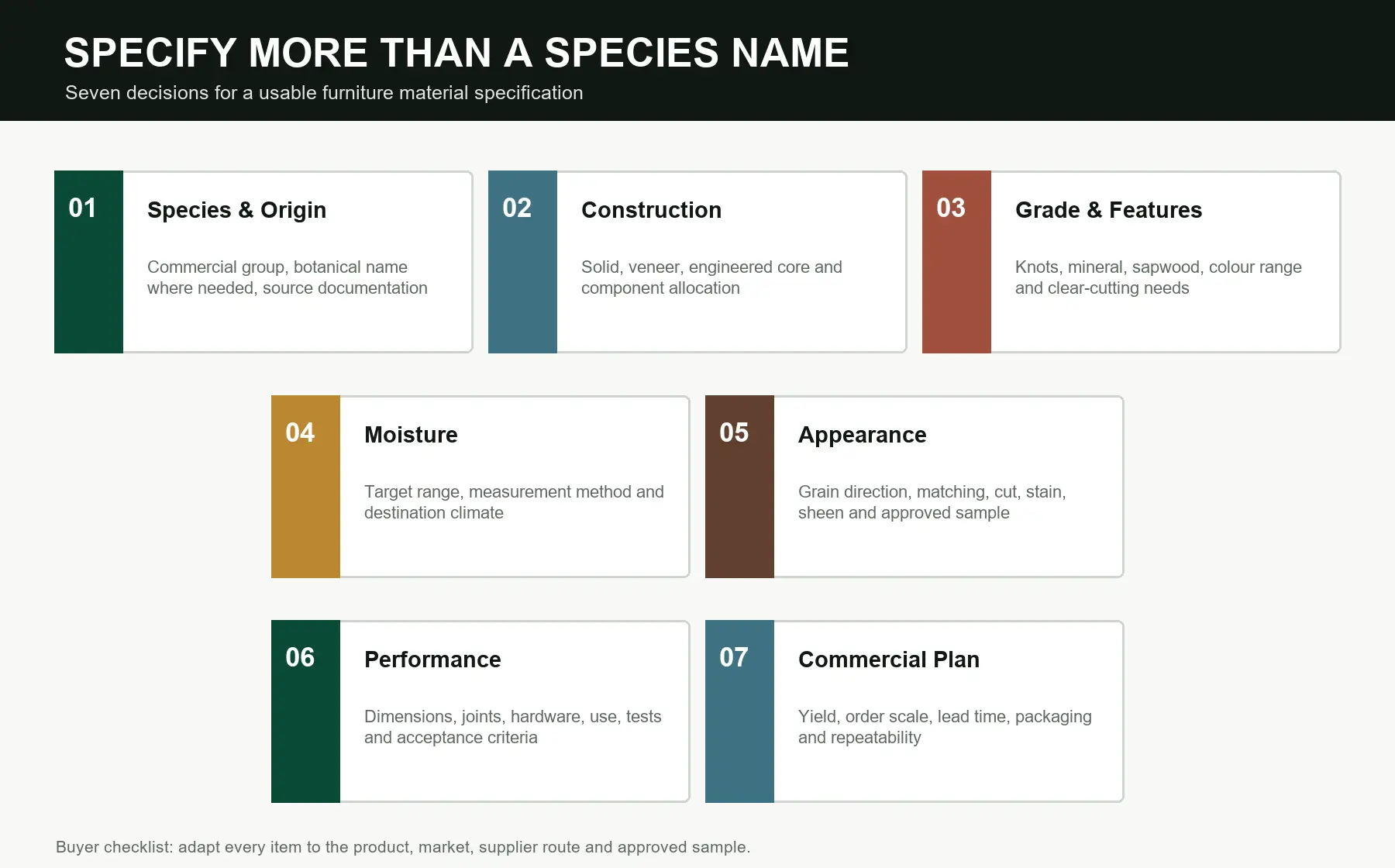
For a realistic quotation, provide component dimensions, construction, visible faces, feature limits, color range, finish, order scale and packaging. A furniture supplier can then compare material routes rather than pricing an undefined species name.
Best Applications
Species choice should follow the product’s highest-value requirements. The guide below shows common directions, not fixed limitations.
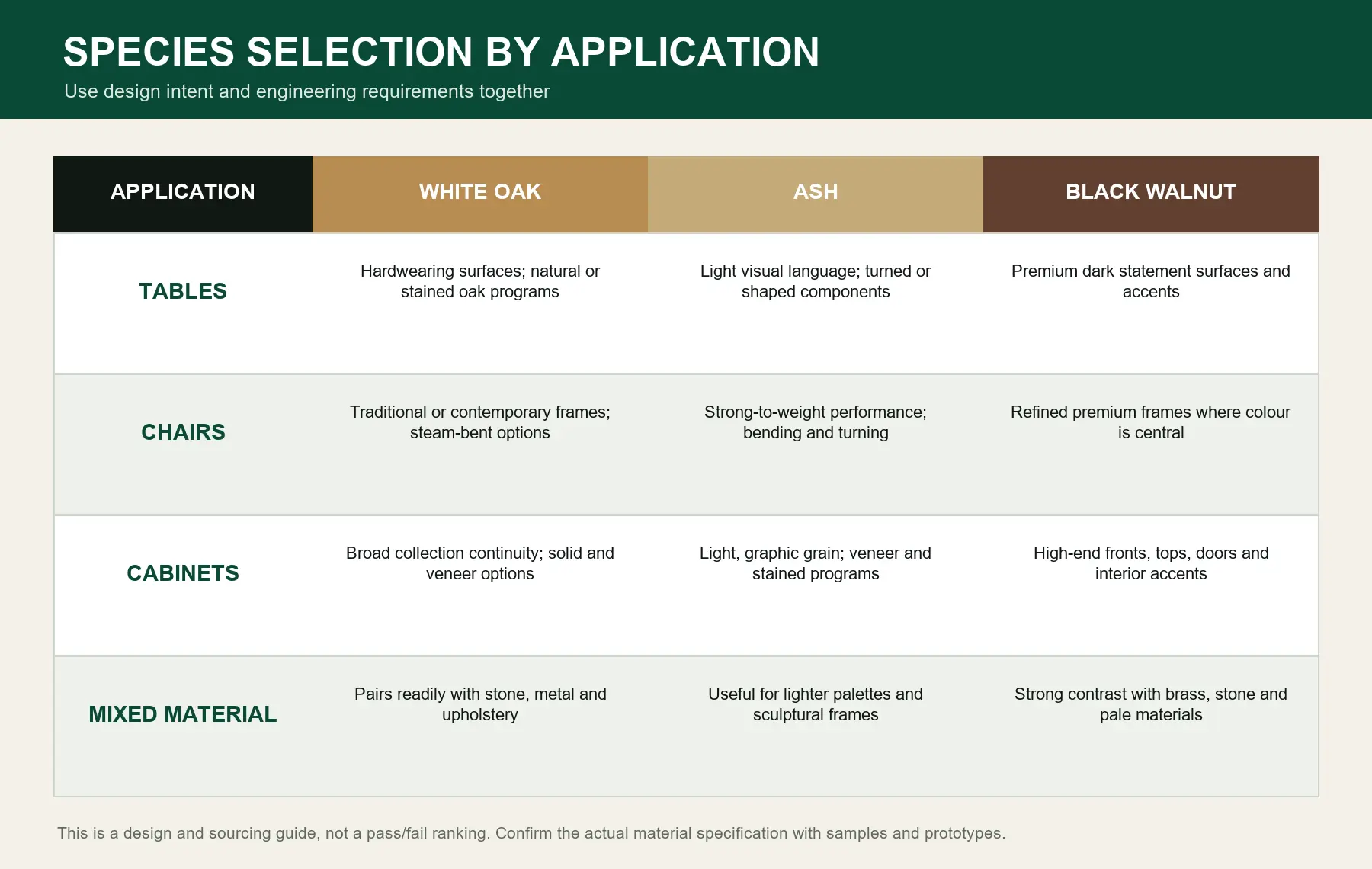
Tables
Oak is a strong default for dining and occasional tables when buyers want a visible hardwood surface and broad collection continuity. Ash can support lighter, more sculptural forms and is suitable for turned or shaped components. Walnut is effective where the tabletop or edge profile must communicate a naturally dark premium material.
For wide tops, decide whether the specification calls for solid wood, veneer over a stable substrate, or a mixed construction. Species alone does not determine flatness, movement or surface durability.
Chairs
Ash is especially relevant to curved and steam-bent forms because of its bending reputation and strength-to-weight relationship. Oak supports both traditional and contemporary frames, while walnut can create refined premium frames where darker color is worth the material investment.
Chair performance depends on geometry and joints. Buyers should validate prototypes through the relevant furniture quality testing and order-specific inspection plan instead of treating species data as a chair test result.
Cabinets
Oak works across cabinets, sideboards and storage ranges in both solid and veneer formats. Ash provides a pale, graphic grain that can remain natural or take strong stains. Walnut is often used for premium doors, drawer fronts, tops and visible interior details; veneer can extend consistent figure across broad surfaces while controlling weight and movement.
Which Wood Fits Different Market Positions?
Market position is a combination of design, material honesty, finish, construction, detail and service, not a species label alone.
White oak suits broad mid-to-premium programs because consumers recognize its grain and it can support natural, smoked, stained or painted directions. An oak furniture manufacturer can also coordinate solid components and oak veneer across multiple categories.
Ash suits contemporary, Scandinavian-influenced and color-led ranges. Its light base helps natural finishes feel bright, while stained ash can produce black, brown or colored programs with visible grain. An ash furniture manufacturer should still define mineral, heartwood and color allowances clearly.
Black walnut naturally supports premium and statement positioning. A walnut furniture manufacturer should identify whether the product uses solid walnut, natural walnut veneer, stained substitute species or a combination. These routes can look similar online but differ in material value, consistency, engineering and cost.
MrsWoods works as a custom furniture manufacturer for brands, retailers, wholesalers and project buyers. Its manufacturing and raw-material resources support flexible order planning, while the design team can develop buyer concepts, modify existing designs and coordinate OEM/ODM details across living, dining, bedroom and study categories. Our furniture sourcing and customization services connect material selection with sampling, production follow-up, quality checks, third-party inspection coordination and mixed-container planning.
The later guides to sustainable oak furniture sourcing, choosing an oak furniture manufacturer and custom oak furniture manufacturing will cover supply-chain documentation, supplier evaluation and OEM/ODM development in greater depth.
Can These Woods Be Combined With Other Materials?
Yes. Oak, ash and walnut can all be combined with metal, stone, glass, upholstery, cane and engineered panels. The design opportunity is large, but interfaces need technical control.
Stone tops add concentrated weight and require suitable support, fixing and packaging. Metal frames can restrain wood movement if slots, clearances or connection details are not designed correctly. Upholstered chair seats change load paths and assembly tolerances. Veneer over an engineered core can create broad, stable surfaces, but edges, balancing construction and adhesive processes must be specified.
Color coordination also matters. Oak pairs readily with warm metals and many stones; pale ash can sharpen a light contemporary palette; walnut creates strong contrast with brass, pale stone and neutral upholstery. These are design tendencies, not rules. Physical finish samples should be reviewed together under agreed lighting.
MrsWoods’ multi-material capability covers wood, veneer, metal, stone and upholstery, allowing one development program to coordinate proportions, interfaces, finishes, packaging and quality requirements. This is useful when a collection needs a consistent language across tables, chairs, cabinets and bedroom pieces rather than isolated products from unrelated suppliers.
Frequently Asked Questions
Is oak, ash or walnut the best wood for furniture?
There is no universal best species. White oak is a strong all-round option for hardwearing surfaces and broad collections; ash is valuable for pale, strongly grained and bent designs; walnut is valuable for naturally dark premium furniture. The best choice fits the product, construction, market position and supply specification.
What is the main difference in oak vs ash furniture?
In the reference data used here, white oak is heavier and slightly harder, while ash is lighter, strongly grained and well regarded for bending and shock resistance. Appearance may be the deciding factor: oak offers rays and a familiar tan-to-brown character, while ash starts from a paler base with high growth-ring contrast.
Which is better in oak vs walnut furniture?
Oak generally offers higher reference hardness and a lighter-to-medium brown palette. Black walnut offers a naturally darker heartwood and stronger premium signal but more visible sapwood contrast. For oak vs walnut, choose according to the intended look, component, yield and price position rather than assuming darker wood is stronger.
Is ash cheaper than oak or walnut?
It can be, but there is no permanent answer. Origin, grade, thickness, width, color selection, order timing and yield can change the result. Compare quotations against the same component list and appearance specification.
What is the best hardwood for furniture manufacturing at scale?
The most scalable choice is the species and construction that can be sourced consistently at the required grade, dimensions, moisture condition and visual range. It must also machine efficiently, meet performance needs and fit the target price. A repeatable oak or ash specification may be more valuable than an under-defined premium species.
Can oak, ash and walnut be used as veneer?
Yes. All are available as veneer. Veneer can improve grain continuity across broad panels and reduce weight or movement when applied to a suitable balanced construction. Buyers should specify veneer type, thickness where relevant, matching, substrate, edge treatment, balancing layer and approved appearance.
Conclusion
The practical answer to oak vs ash vs walnut furniture is to match the species to the job. White oak offers weight, hardness, familiar grain and broad application. Ash offers a pale, expressive grain with strong bending and machining potential. Black walnut offers natural dark color and premium visual value.
A good decision goes beyond the species name. Define construction, grade, natural features, moisture, component dimensions, grain direction, finish, performance, yield and acceptable variation. Then approve samples and prototypes that represent the actual production route.
As a flexible furniture supplier and custom furniture manufacturer, MrsWoods can help buyers compare species and mixed-material alternatives, develop or modify designs, coordinate smaller and larger purchasing programs, follow quality through production, support third-party inspection and organize mixed-container shipments. The final recommendation should always be tied to the buyer’s product, market and order requirements.
To compare material routes for a new collection, contact the MrsWoods team with your reference images or drawings, intended use, target market, preferred finish, estimated quantity and price position.
