

Furniture quality testing checks whether a defined furniture sample meets specified requirements for stability, strength, durability, function, surfaces, dimensions or assembly. The most useful furniture quality tests for buyers identify the product, method, edition, acceptance criteria and sample configuration instead of reporting only that an item was “tested.”
Testing is only one part of quality assurance. Furniture inspection compares materials, workmanship, dimensions, appearance, function, labels and packing with an approved specification. Laboratory testing applies controlled methods and equipment to selected performance questions. Neither activity replaces clear product engineering or production control.
That distinction matters when working with an oak furniture manufacturer or oak furniture supplier. Tables, chairs and cabinets do not share one universal program. Product category, use, market and buyer requirements must be defined before the relevant furniture testing standards are selected.
Key Takeaways
- Furniture QC is a system of specifications, approvals, production controls, inspection and corrective action; a laboratory report is one item of evidence within that system.
- Stability, strength and durability describe different properties. A product can perform well in one area and still require improvement in another.
- Test methods and acceptance requirements are not always contained in the same document. For example, ISO 7170:2021 provides test methods for storage units but does not itself specify acceptance criteria.
- A report should identify the exact sample, configuration, test method, edition, result and limitations. It should not be extended automatically to changed materials, dimensions or hardware.
- Buyers obtain better evidence when they define testing and inspection before sampling and production, rather than requesting a generic “test certificate” shortly before shipment.
Inspection vs Testing: What’s the Difference?
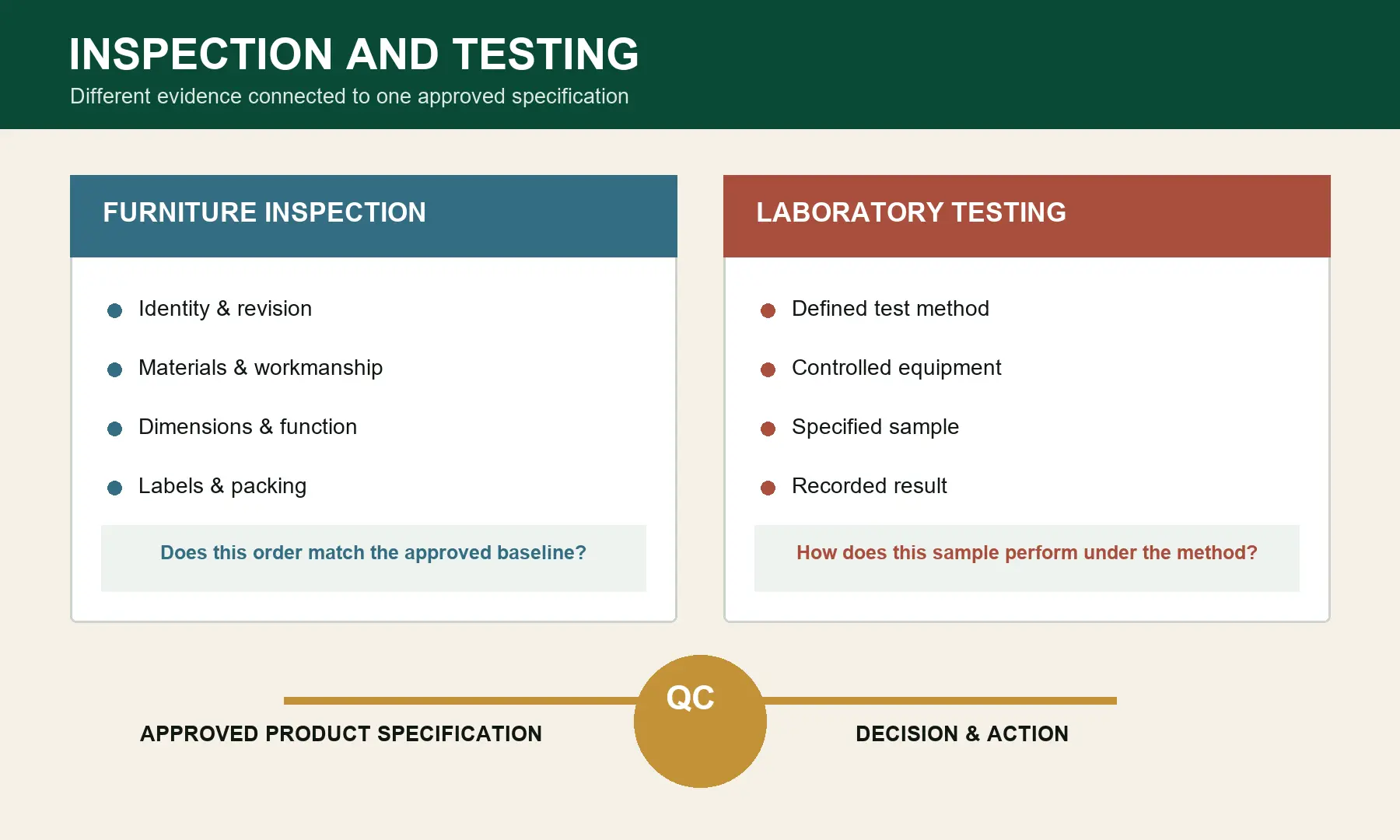
Furniture inspection asks whether the goods match an agreed baseline. An inspector may verify model identity, material callouts, dimensions, color range, hardware, workmanship, operation, labels, carton contents and packing. The work can occur during production, before shipment or at another agreed checkpoint. Its usefulness depends on the approved sample, drawings, bill of materials, finish references, defect definitions and sampling plan available to the inspector.
Testing asks a narrower performance question under a defined method. It may apply forces, cycles, impacts, liquids or heat, then record damage, movement or loss of function. Some checks can be performed with suitable factory equipment; others require a competent laboratory.
Both activities require a clear scope. Furniture inspection can identify assembly errors a laboratory never examines, while visual inspection cannot establish cyclic performance. Buyers should combine evidence according to risk.
Our guide to high-quality oak furniture explains what buyers should examine in materials, structure, finish, consistency and documentation. This article continues from that purchasing view by showing how selected claims can be verified through furniture quality testing.
What Furniture Properties Can Be Tested?
The phrase furniture strength and durability testing combines several properties that should be understood separately. A test plan should state which property matters, how it relates to foreseeable use and what result is required.
Stability
Stability concerns a product’s tendency to overturn under specified conditions. It is influenced by geometry, mass distribution, support points, moving parts, loading and use. A wide cabinet may become less stable when doors or drawers are opened. A table with a visually heavy top may still depend on base dimensions and connection stiffness. Stability testing therefore needs the actual configuration, including relevant extensions, doors, drawers, shelves or adjustable features.
Strength
Strength concerns whether a product and its components withstand specified forces without unacceptable failure, deformation or loss of function. The load path matters: a tabletop transfers force through fasteners, rails, legs and floor contact; a chair transfers force through the seat, back, joints and base. Material quality alone does not prove the strength of the complete item.
Durability
For buyers, furniture durability testing repeats specified actions to assess how a product responds to cumulative use. It may reveal loosening, wear, joint movement or functional decline that is not visible during a single static check. It is not a prediction of an exact service life. The result relates to the method, severity, sample and acceptance criteria used.
Function
Function checks whether moving and adjustable elements operate as intended before and after relevant tests. Doors should open without binding, drawers should travel and stop as specified, extension leaves should align, locks should engage, and knock-down fittings should permit correct assembly. Functional criteria should be measurable wherever possible instead of relying on “works well.”
These properties begin with construction. Our article on oak furniture construction explains how joints, grain direction, movement allowance and hardware affect furniture design. Testing then evaluates a finished configuration rather than approving a joint name in isolation.
Table Testing
Table testing should match the table’s use. Dining tables, office desks, occasional tables, height-adjustable products and extension tables present different configurations and foreseeable actions. The plan may address stability, vertical and horizontal strength, durability, deflection, operation of extensions, hardware retention and the condition of the product after testing.
The official ISO 19682:2023 scope covers test methods for the stability, strength and durability of desks and tables. Its scope also states what it does not cover, including ageing, degradation, flammability and electrical components. This is an important purchasing lesson: naming one standard does not cover every risk associated with a table.
For North American applications, the BIFMA standards descriptions currently list X5.5-2021 for desk and table products and X6.5-2022 for home-office and occasional-use desk, table and storage products. Confirm the intended setting before selecting one.
A report should identify the sample configuration and production hardware. A result for one size should not cover a larger top, different base or changed fitting without a documented technical basis.
Chair and Seating Testing
Seating concentrates dynamic forces at joints and interfaces. Test plans may address seat and back strength, repeated loading, arm performance, leg or base behavior, stability, caster or swivel functions, and the condition of fasteners and joints after testing. Upholstery, electrical functions or ergonomic suitability may fall outside a structural test method and require separate evaluation.
The ISO 7173:2023 seating standard specifies methods for determining the strength and durability of chairs and stools. Its official scope excludes certain products and states that it does not assess ageing, degradation, ergonomics, electrical functions or upholstery durability. ISO also marks this edition as under revision, so buyers should verify the current edition when a project starts rather than copying a version number from an old specification.
BIFMA’s current list separates office, public/lounge, large-occupant and occasional-use seating. This prevents selection by familiarity without checking the use environment and user population.
Before testing, the buyer and OEM furniture manufacturer should freeze the configuration. Changes to geometry, joints, hardware or material thickness can alter performance even when the chair looks similar.
Cabinet and Storage Testing
Storage furniture combines structural loads with moving components and changing stability conditions. A cabinet test plan may address unit strength, shelf behavior, door and drawer durability, stops, locks, hardware retention, stability with elements open, and wall-attachment or restraint instructions where applicable.
The official ISO 7170:2021 scope covers methods for determining the strength, durability and stability of storage units, including fully assembled units and both movable and non-movable parts. The official abstract also makes a critical distinction: the document describes test methods but does not itself specify the acceptance requirements. A buyer should therefore avoid writing only “pass ISO 7170” without identifying the applicable requirement level or separate criteria.
For office storage, BIFMA currently lists ANSI/BIFMA X5.9-2019. Home-office and occasional-use storage may fall under a different category. Products installed in hospitality, retail or residential settings may also be governed by customer programs, local regulations or project specifications that are not replaced by either document.
For U.S.-bound bedroom storage, buyers must also check the CPSC clothing storage unit requirements. CPSC guidance states that 16 CFR part 1261 applies to products within its defined scope and identifies the latest Commission-accepted ASTM F2057 version as mandatory. This legal requirement is distinct from a general storage test method.
Wall-mounted units require particular attention to the complete installation system. Testing a cabinet body does not automatically validate an unspecified wall, anchor, installer method or substrate. The product specification and instructions should state what is included and what conditions must be provided on site.
Finish and Surface Checks
Oak furniture surfaces can be checked for color range, sheen, texture, sanding marks, contamination, adhesion-related defects, edge coverage and consistency between components. These production checks are different from controlled tests for resistance to liquids, heat, abrasion, scratching or impact.
The current ISO furniture surface standards catalogue lists the ISO 4211 series for several surface-finish properties. For example, ISO 4211-1:2025 addresses resistance to cold liquids, while ISO 4211-2:2013 addresses wet heat. A buyer should select only the exposures relevant to expected use and define the required rating or acceptance condition; “tested surface” is too vague to guide development.
Finish performance depends on the complete system: substrate preparation, stain, sealer, topcoat, cure and maintenance instructions. Our guide to oak furniture finishes helps buyers define color, sheen and use conditions before selecting the relevant surface checks.
Dimensional and Assembly Checks
Dimensional checks confirm that critical features meet approved drawings and tolerances. Overall width and height matter, but interface dimensions often matter more: hole spacing, drawer clearances, door gaps, tabletop alignment, hardware positions, interchangeable parts and carton fit can determine whether products assemble and function consistently.

Equipment should suit the tolerance and feature being checked. A tape may suit carton dimensions but not a small hardware interface. Tools should be identified and maintained; readings have little value when the method is inconsistent.
Assembly checks should use production hardware and customer-facing instructions. Record the sequence, parts, fastener access, alignment and final stability. Trial assembly is especially useful for flat-pack and mixed-material products.
When Are Laboratory Tests Necessary?
Laboratory testing is most useful when a contractual requirement, regulation, product claim, retailer protocol, project specification or identified safety/performance risk requires controlled evidence. It may also be appropriate after a major structural change, for a new product category, when factory equipment cannot perform the specified method or when an independent result is needed to resolve uncertainty.
Not every variation needs a full new program, but any extension of an existing report should have a documented technical basis. Changes in dimensions, materials, thickness, joints, hardware, base geometry, moving parts or intended use may affect whether earlier evidence remains relevant. The buyer, manufacturer, laboratory and, where necessary, compliance specialist should make that decision before production.
When selecting a laboratory, check both competence and scope. ISO/IEC 17025:2017 sets requirements for the competence, impartiality and consistent operation of testing and calibration laboratories. Accreditation bodies use it to assess laboratories, but the buyer should still confirm that the chosen laboratory’s accredited scope covers the required furniture method. Accreditation to the general standard is not a claim that every possible test is included.
A laboratory request should identify the model, sample, use, assembly state, standard edition, acceptance criteria and report format. The report should record method deviations and the sample’s condition after testing.
Which Standard Applies to Which Market?
The destination country is only the first filter. Selection also depends on product category, use setting, users, installation, buyer program and product claims. A familiar regional standard may be voluntary, contractual or unsuitable for another use.
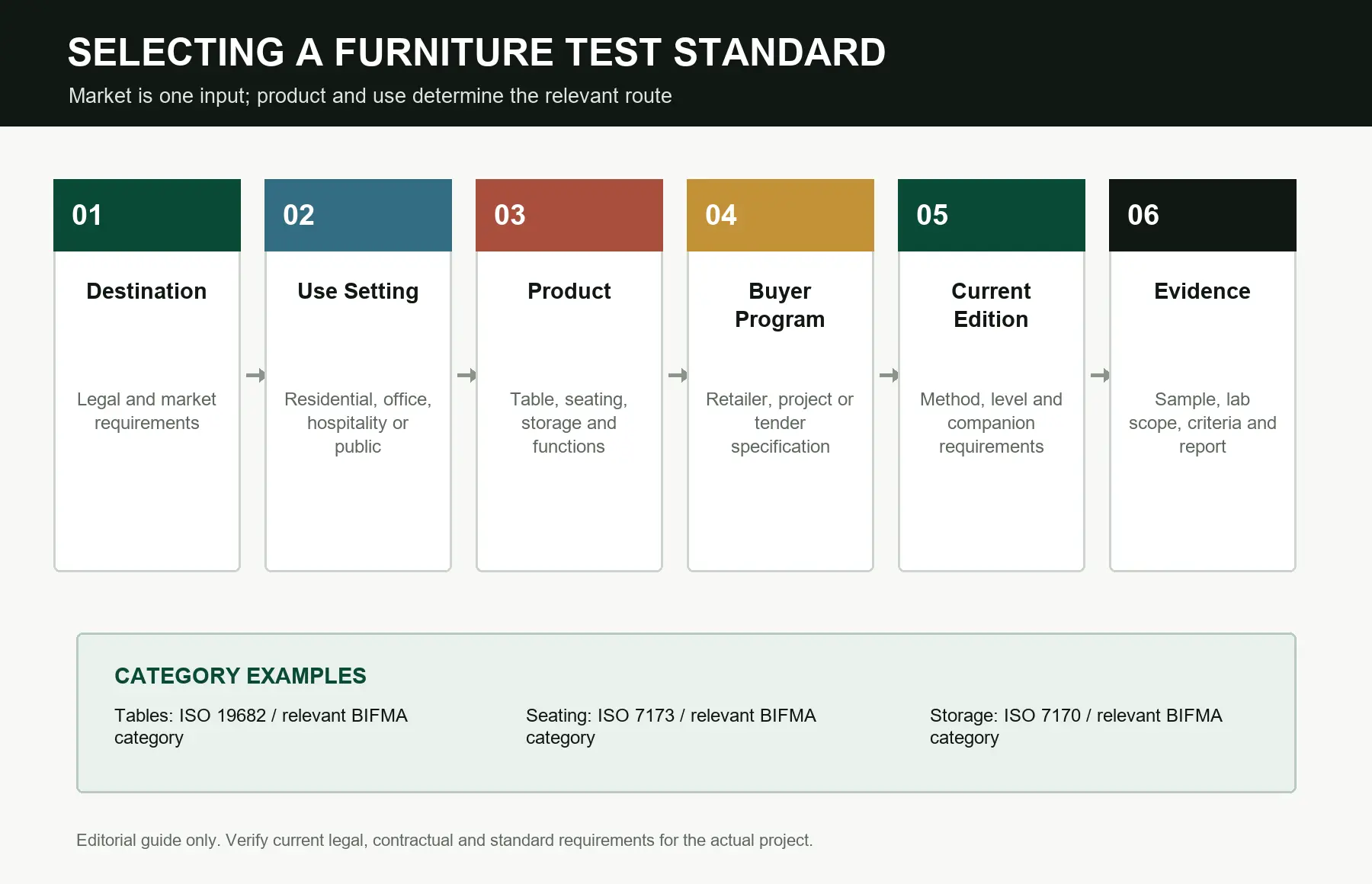
Use this sequence:
- Define the destination market and check applicable legal requirements.
- Define the use environment: residential, office, hospitality, retail, educational, public or another setting.
- Identify the precise product category and all relevant functions.
- Check the buyer, retailer, project or tender specification.
- Select the current standard edition and any required level, option or companion requirement document.
- Confirm sample configuration, laboratory scope, acceptance criteria and report wording.
Do not write “European standard,” “BIFMA certified” or “ISO approved” as a substitute for this work. BIFMA and ISO publish multiple documents with specific scopes. Product certification, laboratory accreditation, legal compliance and a single test result are different concepts.
Our later guide to furniture compliance for destination markets will address regulatory and market-entry documents separately. Testing in this article concerns defined product properties; it does not establish every labeling, chemical, electrical, fire, packaging or legal requirement that may apply.
Building a QC Specification Before Production
The strongest furniture QC plan begins before the purchase order is released. It turns the design intent into a controlled baseline that the custom oak furniture manufacturer, buyer, inspector and laboratory can all use.
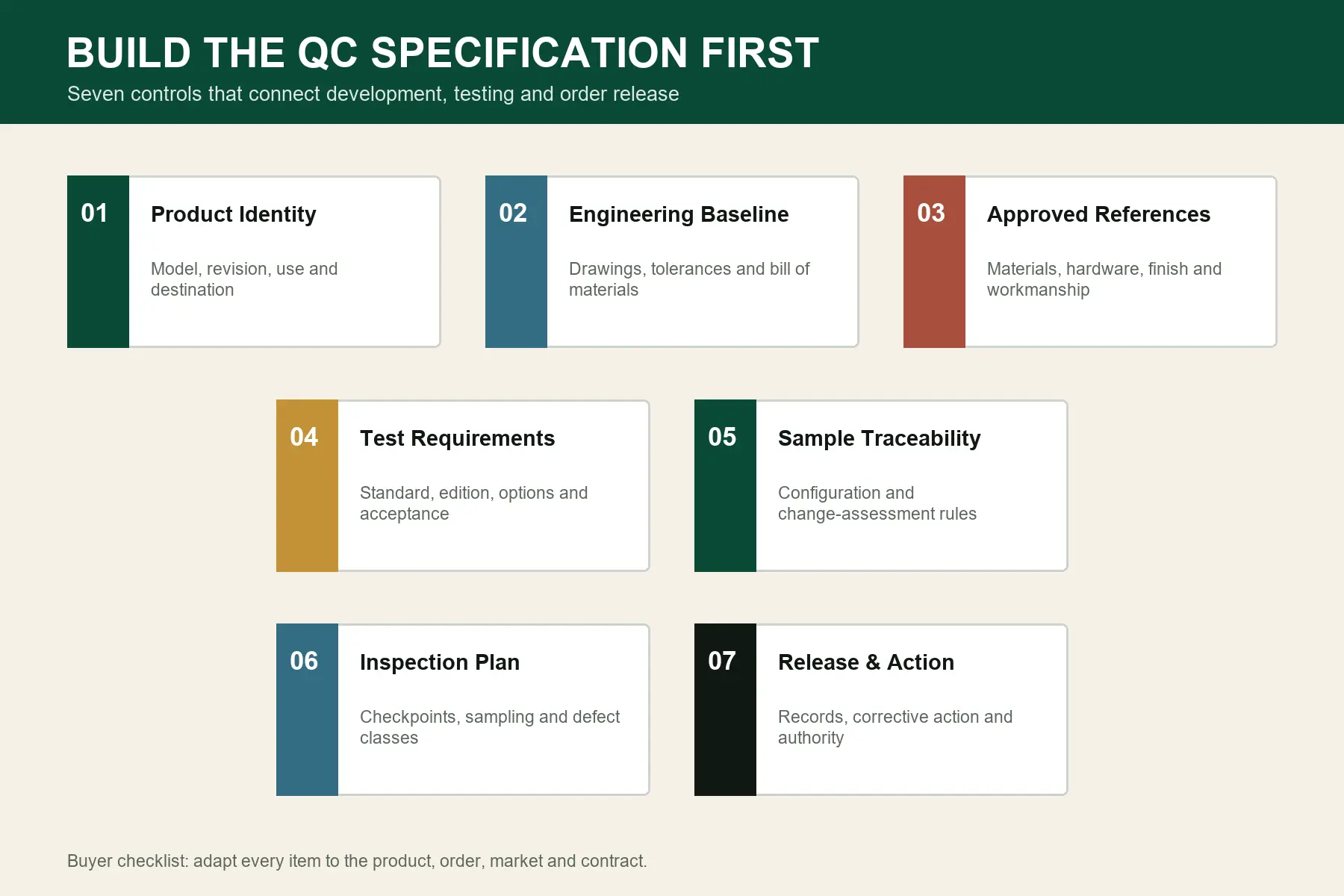
A practical specification should include:
- Product identity, revision, intended use and destination.
- Approved drawings, dimensions, tolerances and bill of materials.
- Approved material, hardware, finish, color and workmanship references.
- Applicable furniture testing standards, editions, options and acceptance criteria.
- Sample identity and rules for assessing later material or design changes.
- Production checkpoints, furniture inspection scope, sampling and defect classification.
- Required records, report format, corrective-action process and release authority.
The oak furniture manufacturing process shows where material approval, first-off checks, assembly control, finish approval and pre-shipment inspection fit into production. Linking the test plan to those stages allows problems to be addressed before finished goods accumulate.
MrsWoods supports brands, retailers, wholesalers and project buyers with product development, OEM/ODM coordination, mixed-material furniture, production follow-up, quality inspection and shipment planning. Our furniture sourcing and quality-control services can help translate drawings and product goals into approval points, inspection criteria and order-specific documentation. Independent laboratory testing or third-party inspection can be included when the product, market or buyer program requires it.
For sourcing decisions beyond laboratory evidence, sustainable oak furniture sourcing and supplier quality management require separate documentation and review. They will be addressed in later cluster articles rather than compressed into a single testing claim.
Frequently Asked Questions
What is the difference between furniture inspection and furniture quality testing?
Inspection compares goods with approved product and order requirements, often covering appearance, dimensions, function, labeling and packing. Testing applies a defined method to a selected property such as stability, strength, durability or surface resistance. A complete quality plan may need both.
Does every furniture sample need laboratory testing?
No. The need depends on applicable law, buyer requirements, project specifications, product risk, performance claims and available evidence. Routine visual and dimensional checks can be performed through furniture QC, while controlled performance claims may require a qualified laboratory.
Can one test report cover several furniture models?
Only when there is a documented basis for doing so. Different dimensions, materials, joints, hardware, functions or use environments may change performance. The report and any technical assessment should identify exactly which configurations are covered.
Which furniture testing standards for tables and storage should a buyer request?
Start with destination requirements, intended setting and exact product category. ISO 19682 addresses desk and table test methods; ISO 7170 addresses storage-unit test methods; BIFMA lists category-specific North American business and institutional furniture standards. The correct document, edition and acceptance level must be confirmed for the actual project.
Do BIFMA or ISO standards certify a furniture factory?
Not by themselves. A product may be tested to a method, a certification program may evaluate defined requirements, and a laboratory may be accredited for a particular scope. These are different claims. Buyers should read the report or certificate and verify its issuer, scope, model, standard and validity.
What should a buyer send an oak furniture manufacturer before testing?
Send the current drawings, product revision, bill of materials, intended use, destination, assembly configuration, selected standard and edition, acceptance criteria, sample identification and required report format. Open technical questions should be resolved before the sample is submitted.
Conclusion
Effective furniture quality testing begins with a defined product and a precise question. It separates stability, strength, durability, function, surface performance, dimensions and assembly; then selects methods and acceptance criteria that fit the category, market and intended use.
For B2B buyers, the most valuable evidence is traceable. A report should connect to the approved sample and production configuration, while furniture inspection and process controls confirm that shipped goods remain aligned with that baseline. A single generic certificate cannot replace this chain of information.
As a flexible oak furniture supplier and custom oak furniture manufacturer with its own manufacturing and raw-material resources, MrsWoods can support both smaller and larger purchasing programs, product development from buyer concepts, OEM/ODM execution, broad furniture categories, multi-material construction, full-process quality follow-up, third-party inspection coordination and mixed-container shipment planning. Requirements should still be defined for each order rather than assumed from a company-level claim.
To discuss a new collection or prepare order-specific quality documents, contact the MrsWoods team with your product drawings, target market, intended use and testing expectations.
