
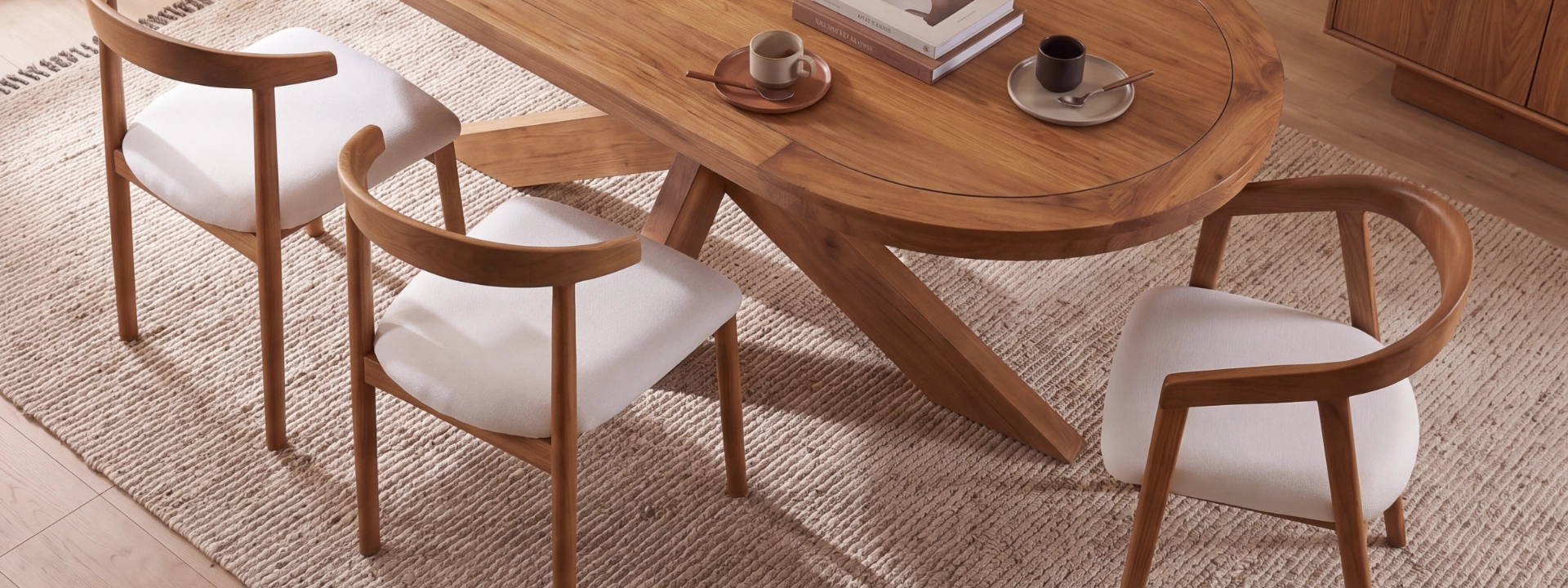

The oak furniture manufacturing process turns selected lumber, veneers and supporting materials into a finished product through controlled drying, machining, joinery, sanding, finishing, inspection and packing. Each stage affects the next, so an attractive final surface cannot compensate for unstable material, inaccurate components or poorly planned construction.
For a buyer, understanding how furniture is made is useful for more than factory tours. It helps define a product brief, approve a sample, identify meaningful inspection points and compare an oak furniture manufacturer with an oak furniture supplier that may coordinate several specialist facilities.
There is no single production route for every table, chair or cabinet. Solid oak frames, veneered panels, curved parts, metal details and knock-down fittings require different operations. The practical goal is to establish a controlled route for the approved design and keep its materials, dimensions, appearance and function consistent through repeat production.
Key Takeaways
- Oak furniture production begins with a component-level material specification, not with the general word “oak.”
- Drying is only the first moisture-control step; storage, machining, assembly and packing conditions also matter.
- Accurate machining and appropriate joint design work together. A precise part can still fail if the construction does not allow for load or wood movement.
- Veneering and solid-wood construction are different production routes, and many products use both where each is most suitable.
- Effective quality control uses approved drawings, samples and acceptance criteria at planned checkpoints instead of relying only on a final visual inspection.
How Is Oak Furniture Made?
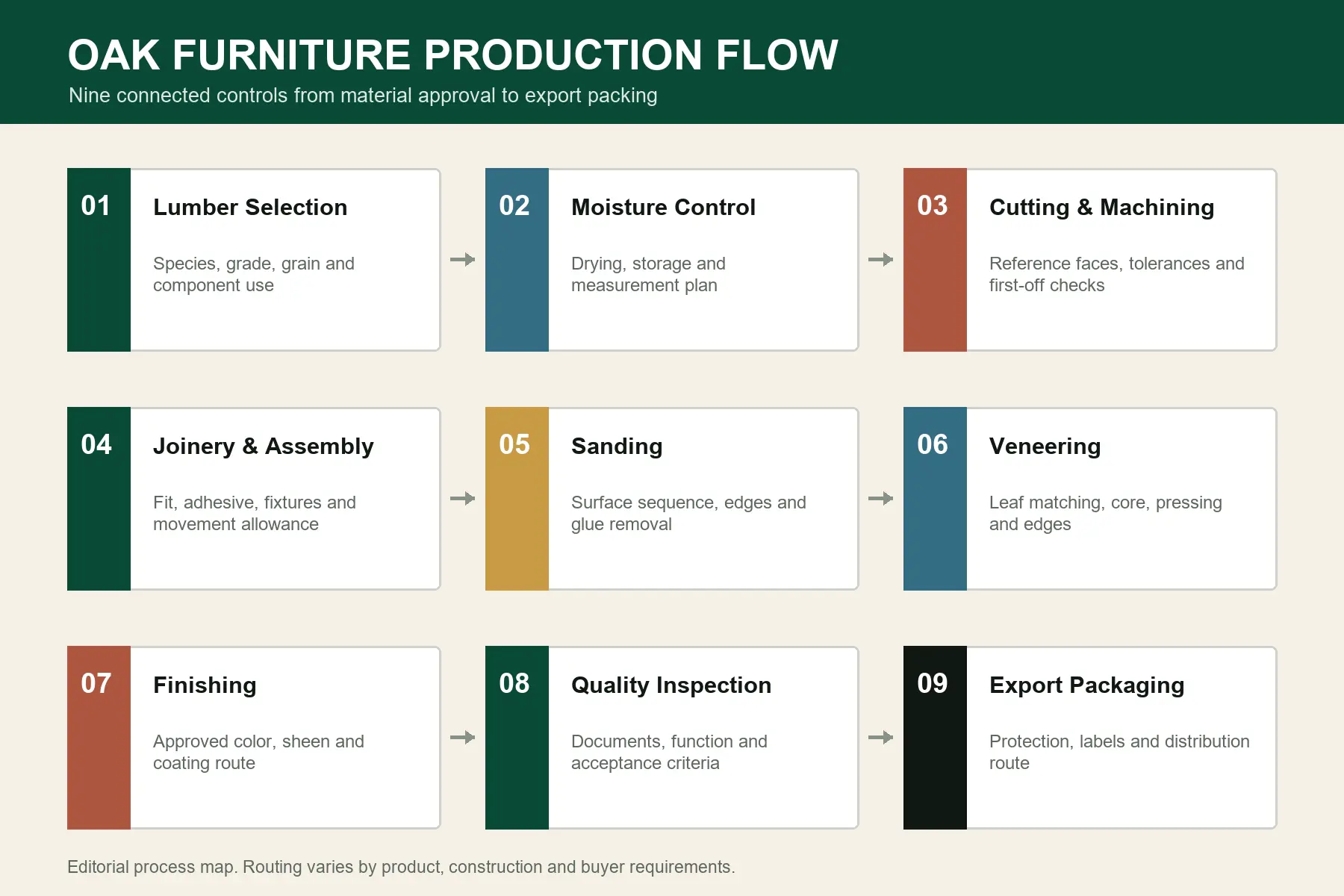
In a typical furniture manufacturing project, the supplier first converts an approved design into production information: drawings, dimensions, a bill of materials, finish references, hardware details, packing requirements and inspection points. Lumber and panel components are then selected and conditioned before they are cut, machined and assembled. Sanding prepares the surface, while veneering and finishing follow the construction specified for each component. The product is inspected, protected and packed for its distribution route.
The sequence sounds linear, but production often includes feedback loops. A prototype may reveal that a joint needs more clearance, a veneer radius is too tight, a color is difficult to repeat or a carton does not protect a vulnerable edge. Good development resolves these issues before volume production and records the approved solution.
Buyers should therefore ask for more than a list of machines. They need to know what is approved before production, what is checked during production, what records are kept and how deviations are handled. That evidence is more useful than an unsupported claim that a factory follows “strict QC.”
Step 1 – Lumber Selection
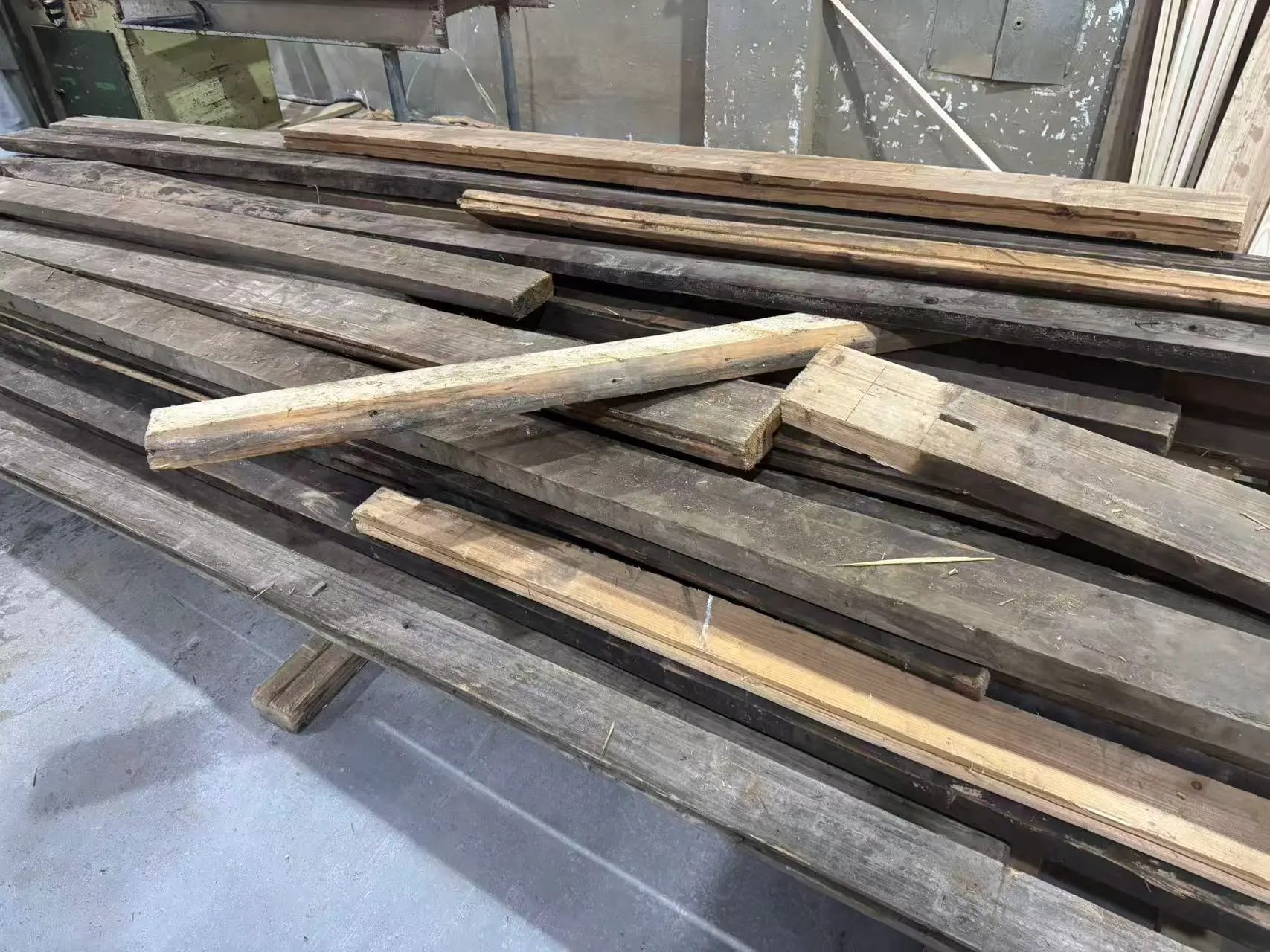
The process starts by defining what each component must do. Legs and rails require sound stock and suitable grain orientation. Wide visible surfaces may prioritize color and grain arrangement. Hidden blocks may have different appearance limits while still needing adequate strength and moisture condition.
Species, Grade, Grain and Defects
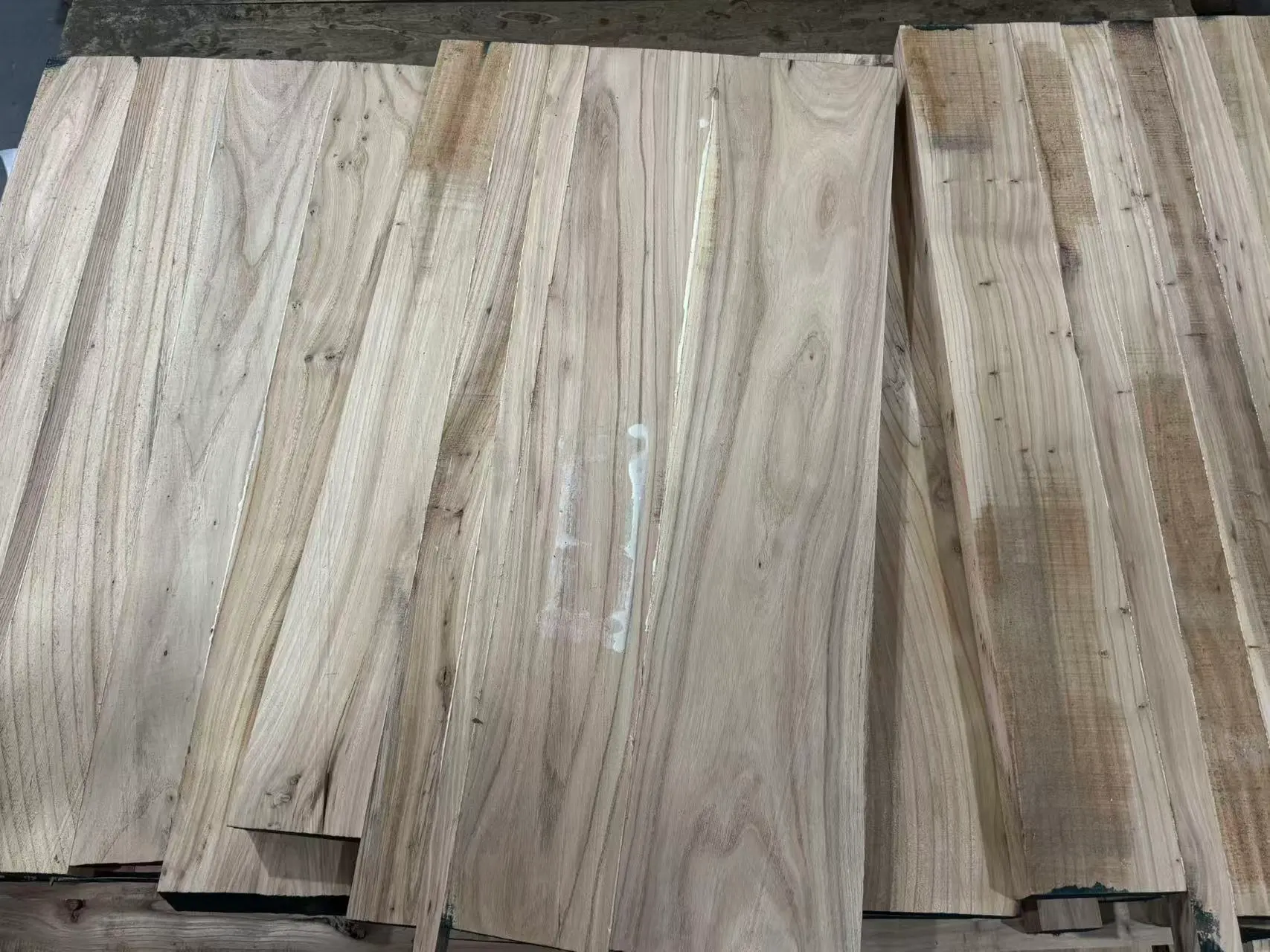
“Oak” should be narrowed to the agreed species or commercial group where that distinction matters. The specification should also state where solid oak, oak veneer and any engineered core are used. For visible parts, define acceptable sapwood, knots, mineral streaks, color variation, filled features and grain direction rather than expecting every natural board to look identical.
The NHLA hardwood lumber grading rules provide an established system for classifying North American hardwood lumber. They grade boards according to the rules’ yield-based framework; they do not certify the quality of a finished chair, table or cabinet. A solid wood furniture manufacturer still needs to allocate boards to components, remove unacceptable defects and respect the approved appearance range.
Before cutting begins, the production team should confirm material identity, dimensions, visible-face requirements and defect limits against the approved specification. This prevents high-value clear material from being used where it adds little benefit and unsuitable pieces from reaching structurally or visually critical locations.
Step 2 – Drying and Moisture Control
Oak lumber is normally dried before furniture machining, but “kiln-dried” is not a complete production specification. Moisture condition must be appropriate for the construction and intended environment, and it can change again during storage or transit.
The USDA Wood Handbook chapter on drying and moisture control explains that correct drying, handling and storage help limit later moisture changes and dimensional problems. It also describes moisture determination, drying methods and design factors rather than prescribing one universal number for every product and destination.
A useful production control states which components are measured, where readings are taken, which meter settings are used and how results are recorded. Thick parts, newly exposed surfaces and material from different stacks may not behave identically. Storage between drying and machining also matters: poorly protected lumber can regain moisture before it reaches the machine.
Our guide to oak wood moisture content explains how destination climate, equilibrium moisture content and construction should inform the control plan. In production, the important point is traceability: readings should relate to a defined batch and stage, not a single convenient board photographed for a report.
Step 3 – Cutting and Machining
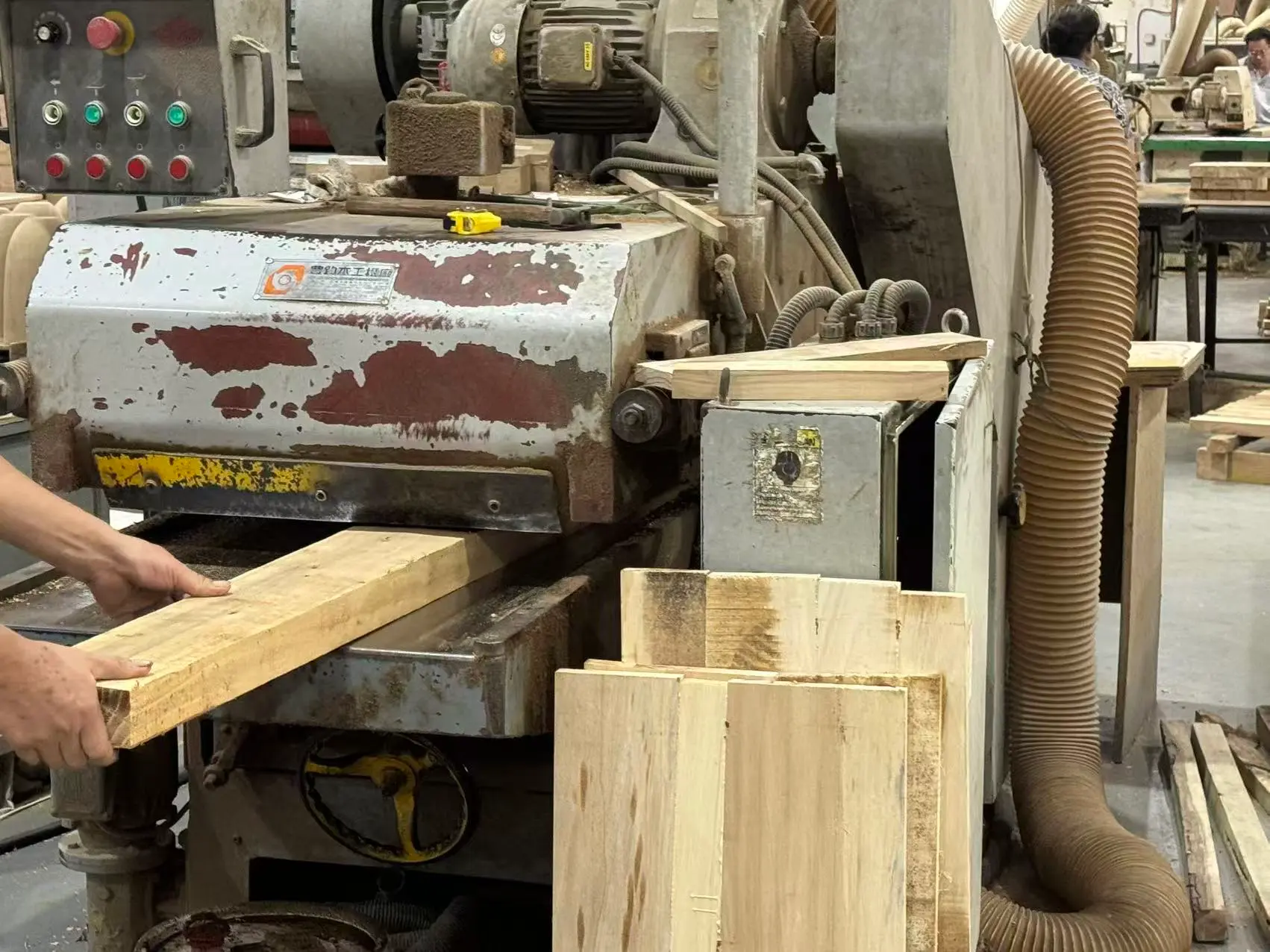
Once the material is approved, rough cutting breaks boards or panels into workable blanks. Parts may rest or be rechecked before final sizing if removing material releases internal stress. Final machining then establishes the surfaces, holes, profiles, grooves, tenons, mortises and other features required for assembly.
This stage translates drawings into physical accuracy. The team needs controlled reference faces, sharp tooling, suitable feed direction and allowances for later sanding or finishing. Oak’s open pores and pronounced grain can expose torn fibers or machining marks, especially around changing grain direction and profiled edges.
For repeat oak furniture production, a component is not “correct” merely because it resembles the sample. Critical dimensions and interfaces should have defined tolerances. Templates, jigs, CNC programs or gauges can improve repeatability, but each still depends on correct setup and verification. First-off parts should be checked before an entire batch is machined.
A buyer does not need every machine parameter. More useful questions are: Which dimensions affect fit and stability? How is left/right orientation controlled? What prevents mixed revisions? When is the first production piece compared with the approved drawing?
Step 4 – Joinery and Assembly
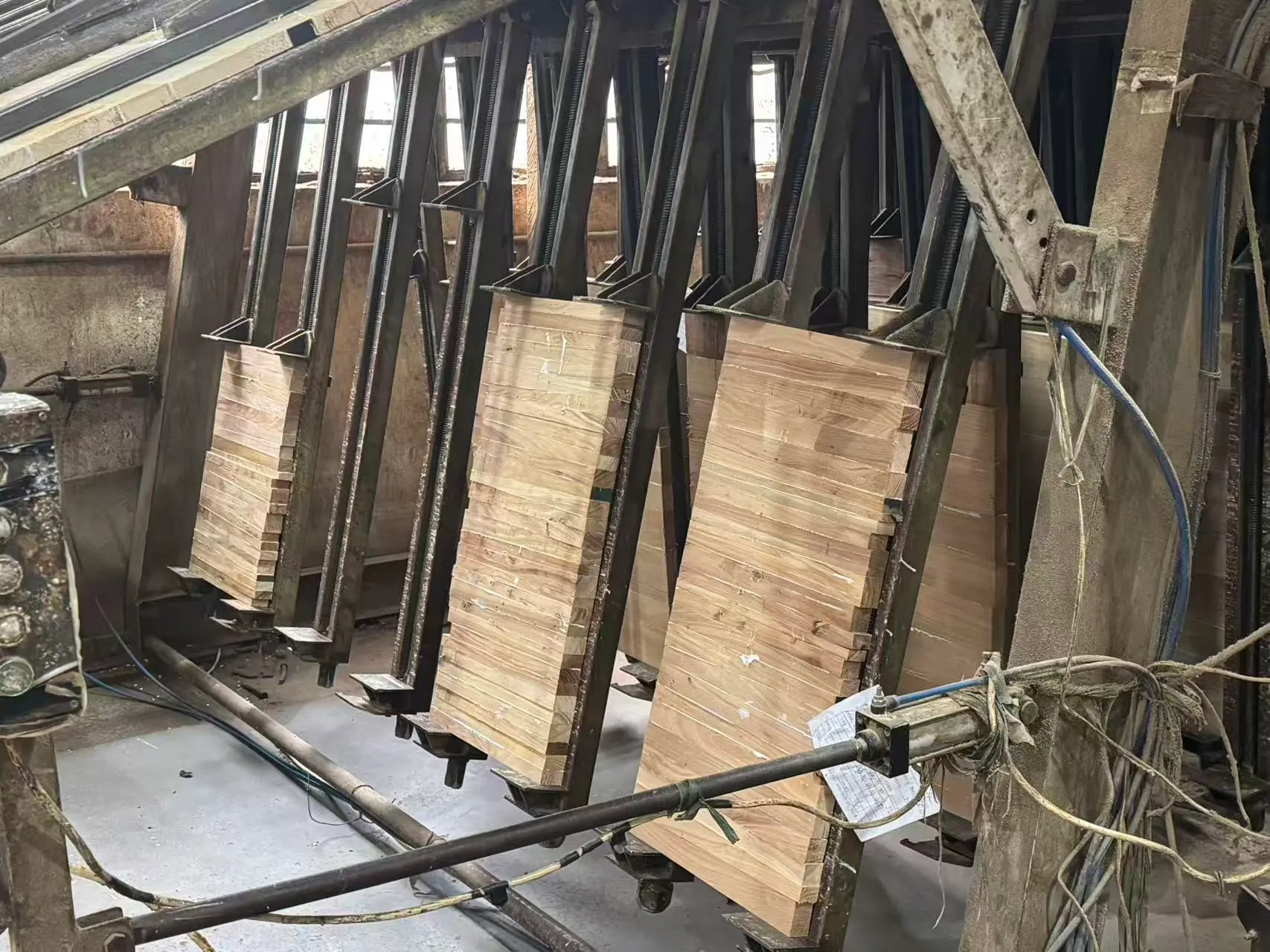
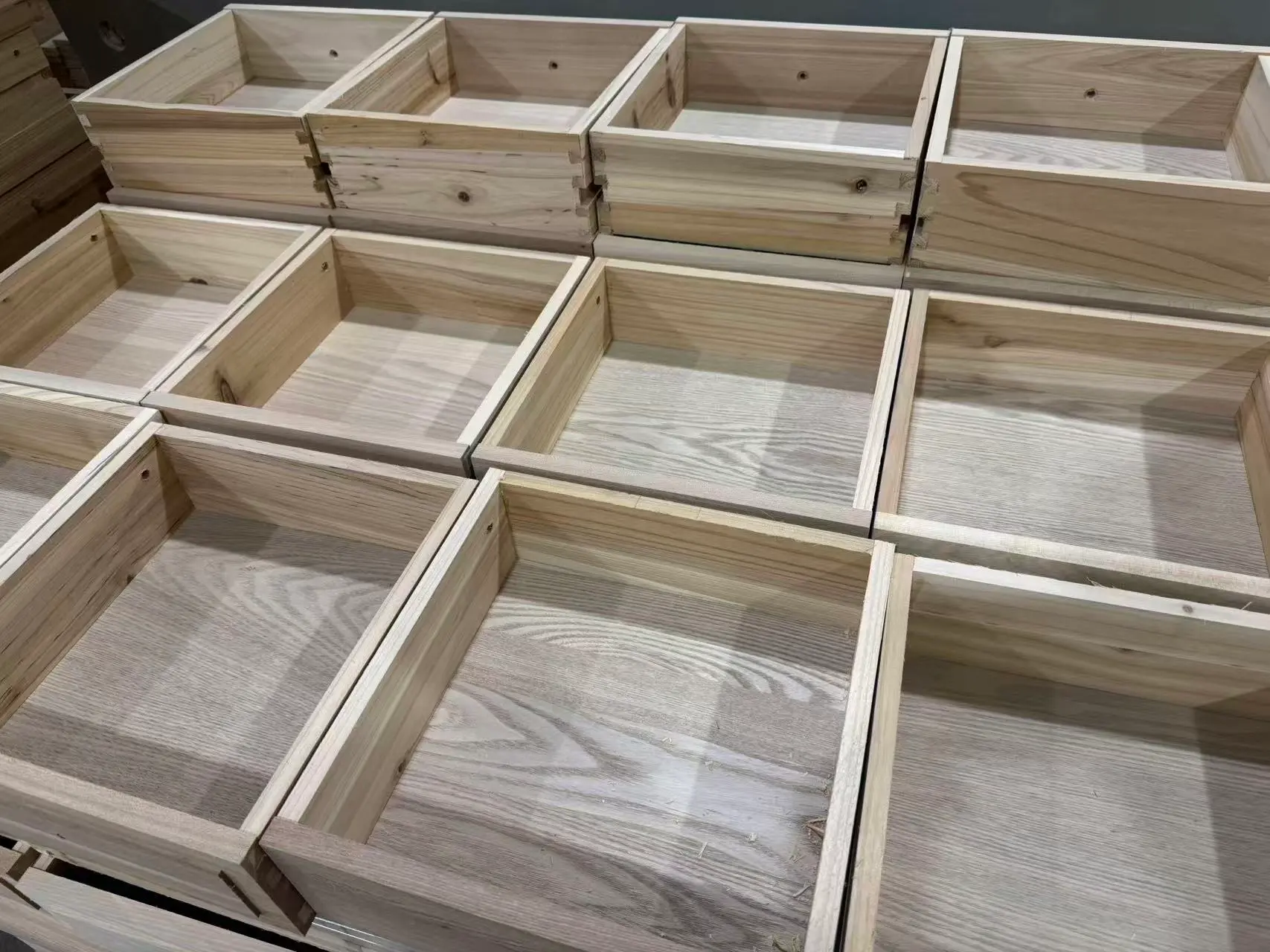
Machined parts become subassemblies and finished structures through joints, adhesives, fasteners and hardware. The joint must suit the load, grain direction, component thickness, product use and production method. A named joint is not automatically strong; fit, glue coverage, clamping, curing and surrounding wood all affect the result.
In solid wood furniture manufacturing, oak also moves mainly across the grain as its moisture condition changes. Wide tops, doors and side panels therefore need construction details that provide support without unnecessarily restraining movement. Hardware positions, elongated holes, panel grooves and clearances should follow the approved engineering solution.
The design principles behind these choices are covered in oak furniture construction. During assembly, the production concern is execution: parts should be square where required, joints should close correctly, adhesive should be controlled and assemblies should remain in the fixture or clamp for the necessary process time.
For knock-down furniture, trial assembly is especially valuable. It can reveal inaccessible fasteners, ambiguous instructions, misaligned inserts or a sequence that works at a factory bench but frustrates the end user.
Step 5 – Sanding
Sanding removes machining marks, blends joints and prepares a consistent surface for finishing. It is a staged operation: jumping directly to a very fine abrasive does not reliably remove deeper defects, while excessive sanding can soften profiles, change dimensions or reduce the clarity of a designed edge.
On oak, scratches may become more obvious after stain or a low-sheen clear coat is applied. Cross-grain marks, glue residue and uneven pressure can produce color differences even when the coating itself is correct. Edges, corners, end grain and repaired areas need attention because they absorb finish differently or are easy to over-sand.
A finish sample should therefore be made on the actual or representative substrate using the intended preparation sequence. Approving only a color chip separates the color from the surface that creates it.
Step 6 – Veneering Where Required
Many well-engineered products combine solid oak with oak-veneered panels. Veneer can provide broad, stable surfaces and controlled grain layouts, while solid wood remains useful for edges, legs, rails or other shaped and load-bearing parts. The material schedule should identify the construction of each component rather than describing the whole product simply as oak.
Veneer production includes selecting and arranging leaves, preparing the substrate, applying adhesive, pressing, trimming and treating edges. Grain direction, book matching or slip matching, veneer sequence and color range should be approved before a production batch is laid up. Curved work requires a substrate and pressing method suited to the radius.
For goods entering the United States, certain hardwood plywood, MDF and particleboard products are covered by the U.S. EPA composite wood requirements. The EPA’s current stakeholder guidance also addresses regulated laminated products. Applicability depends on the panel, adhesive route, exemptions and role in the supply chain; natural oak veneer alone does not establish compliance.
The practical production details behind matching, curved edges and common defects are explained in oak veneer furniture. A capable OEM oak furniture manufacturer should document the approved veneer, core, edge treatment and visible matching standard, not silently substitute a different construction after sampling.
Step 7 – Finishing
Finishing establishes color, sheen, texture, cleanability and a level of surface protection appropriate to the product. The process may include final surface preparation, color application, sealer or build coats, controlled drying or curing, de-nibbing and a final topcoat. The exact system depends on appearance, use, substrate and market requirements.
The USDA guidance on finishing wood advises considering appearance, protection, cleanability, wood properties and expected service when selecting a finish. This is why a coating should not be approved only because it looks good in one photograph.
Production controls may include viscosity, mix ratio, application amount, drying conditions and time between coats, but buyers usually need the approved outcome and relevant performance requirement rather than proprietary process settings. Color should be compared with a signed physical standard or agreed range under consistent lighting. A screen image is not a dependable color reference.
Our guide to oak furniture finishes explains how sheen, stain, grain filling and sample approval influence the result. For repeat orders, keep the approved finish reference connected to the material and sanding route used to produce it.
Step 8 – Quality Inspection
Inspection should begin before the finished item reaches the packing line. Incoming-material checks, first-off component approval, assembly checks and finish comparisons catch different problems at the stage where they can still be corrected efficiently.
Final inspection should compare the order with current approved documents: drawings, material schedule, finish sample, hardware list, labels, assembly instructions and packaging specification. Depending on the product, checks may cover overall dimensions, visual workmanship, stability, moving parts, assembly, specified loads and carton contents. Sampling level and acceptance criteria should be agreed rather than implied.
The buyer framework in how to tell if oak furniture is good quality helps convert general expectations into material, construction, finish, function and pre-shipment checks. A custom oak furniture manufacturer should also show how revisions are controlled so inspectors do not compare production with an obsolete drawing.
Inspection is not the same as formal product testing. When a buyer requires a performance claim, select a method for the product and end-use category. BIFMA’s standards descriptions distinguish standards for office chairs, public seating, tables, storage and other furniture categories. A report for one model or configuration should not be presented as blanket evidence for another.
Future guidance on furniture testing and quality standards will address test selection, sample identity and report interpretation separately. In this manufacturing guide, testing is one possible project requirement, not a substitute for day-to-day process control.
Step 9 – Packaging for Export
Packaging is part of product engineering, especially for furniture that will travel through ports, warehouses, distribution centers and last-mile handling. The pack must protect finished surfaces and vulnerable corners while remaining practical to load, open, assemble and dispose of in the destination market.
Start with the real distribution route. A fully assembled cabinet in a container, a knock-down table delivered through parcel networks and event furniture repeatedly loaded into vehicles face different hazards. Carton strength, cushioning, abrasion protection, moisture protection, hardware packs, palletization and loading plans should respond to those conditions.
The International Safe Transit Association test procedures separate screening, partial-simulation and general-simulation approaches and include Procedure 2C for individual packaged furniture transported in a container. The appropriate procedure depends on the package and distribution system; mentioning ISTA does not prove that a package has been tested.
Before shipment, verify product identity, carton marks, quantities, hardware, instructions and protective materials. Mixed-container orders add another planning layer: carton dimensions, weights, loading sequence and compatibility between product categories need coordination so an efficient container plan does not create avoidable damage risk.
How Custom Furniture Changes the Process
Custom work adds decisions before the factory repeats operations. The buyer may begin with a reference image, drawing, target price, existing sample or performance problem. The supplier then has to convert that input into an unambiguous specification and resolve conflicts between appearance, construction, material availability, tooling, quantity and schedule.
For MrsWoods, custom furniture manufacturing services can connect sourcing, product development, sample approval, production follow-up, inspection and export coordination. This is particularly useful for brands, retailers, wholesalers and project buyers developing collections across solid wood, veneer, metal, stone and upholstered categories.
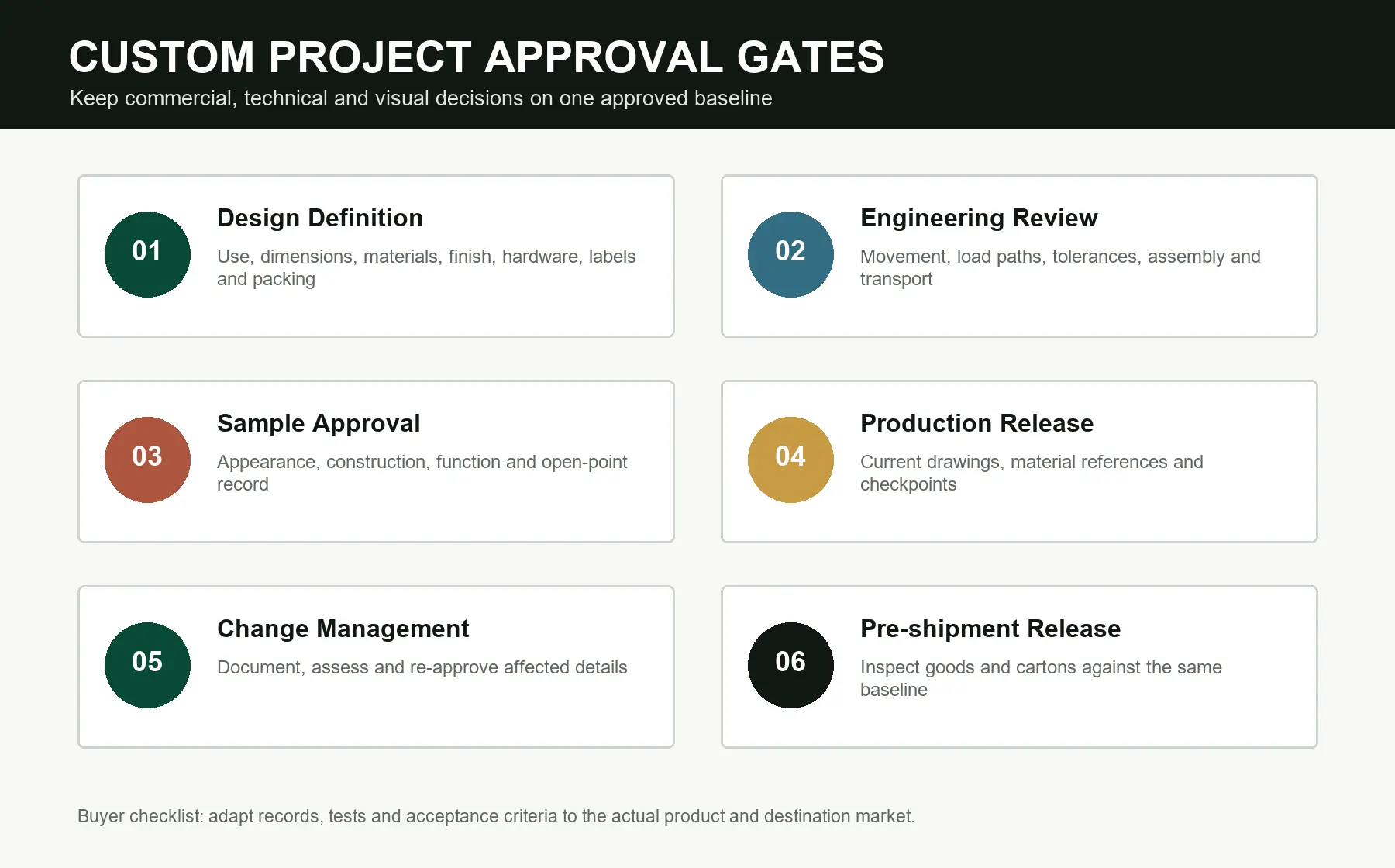
A practical custom workflow uses approval gates:
- Design definition: intended market, dimensions, materials, construction, finish, hardware, labels and packaging.
- Engineering review: movement, load paths, interfaces, tolerances, assembly and transport constraints.
- Sample approval: appearance, function, construction and packaging are confirmed together, with open points recorded.
- Production release: the approved revision is converted into controlled drawings, material references and checkpoints.
- Change management: substitutions or revisions are documented, reviewed and re-approved where they affect the product.
- Pre-shipment release: goods and packaging are checked against the same approved baseline.
The advantage of an experienced oak furniture supplier is not simply access to a workshop. It is the ability to keep design, sourcing, manufacturing, quality and logistics decisions connected. A capable solid wood furniture manufacturer should explain limitations early; a capable development partner should also coordinate other materials and specialist processes when the collection extends beyond oak.
Flexible order planning does not mean every quantity suits every design or production method. Tooling, material yield, finish setup, packaging and component purchasing can change the workable minimum. Buyers should share the expected quantity, launch schedule and repeat-order outlook so the production route can be evaluated honestly.
Frequently Asked Questions
How long does the oak furniture manufacturing process take?
There is no reliable universal lead time. Development time depends on design maturity, sample revisions, material availability, finish approval, testing and packaging. Production time then depends on quantity, construction, factory loading and curing or conditioning stages. Ask for a milestone schedule that separates sample development, approval, material preparation, production, inspection and shipping.
Is all oak furniture made from solid oak?
No. A product may use solid oak, oak veneer over a specified core, or a combination. The best route depends on component shape, dimensions, movement, appearance, weight, cost and intended use. Require a component-level material schedule so the construction is clear.
Why is moisture checked before machining and assembly?
Wood changes dimensions as it gains or loses moisture. Checking moisture condition helps the manufacturer judge whether material is ready for the planned construction and destination. One reading does not prove that the whole batch is suitable, so the measurement plan should identify the stage, sample locations, meter settings and acceptance criteria.
What should a buyer approve before mass production?
At minimum, approve the current drawing, material schedule, construction, finish reference, hardware, labels, assembly method and packaging. Record permitted natural variation and critical dimensions. If formal testing or market documentation is required, define that before production rather than after goods are complete.
Can buyers request third-party inspection?
Yes. The inspection scope should refer to the approved specification and state the sampling method, checks and acceptance criteria. Third-party inspection can provide independent order evidence, but it does not replace the manufacturer’s own process control or product-specific laboratory testing where required.
What information should I send an oak furniture manufacturer for a quotation?
Send drawings or reference images, dimensions, intended use, destination market, preferred materials and finish, estimated quantity, target timing, packaging route and any required tests or documents. Identify which details are fixed and which can be optimized. Clear inputs allow an OEM oak furniture manufacturer to propose a realistic construction and approval plan.
From Production Process to a Reliable Supply Program
Understanding how solid oak furniture is manufactured makes supplier evaluation more concrete. A transparent oak furniture manufacturing process lets buyers review how materials are specified, when moisture and dimensions are checked, how samples control production, and whether inspection and packing refer to the same approved product instead of relying on a general promise of “good quality.”
MrsWoods supports furniture brands, retailers, wholesalers and project buyers with product development, multi-category sourcing, production follow-up, QC coordination, third-party inspection cooperation, mixed-container planning and export support. The most useful starting point is a clear brief rather than a generic request for the lowest price.
To discuss a new collection or repeat-order program, contact the MrsWoods team with your drawings or reference images, materials, finish direction, estimated quantity, target market, packaging needs and required testing. We can then review the feasible production route, sample plan and commercial next steps.
