
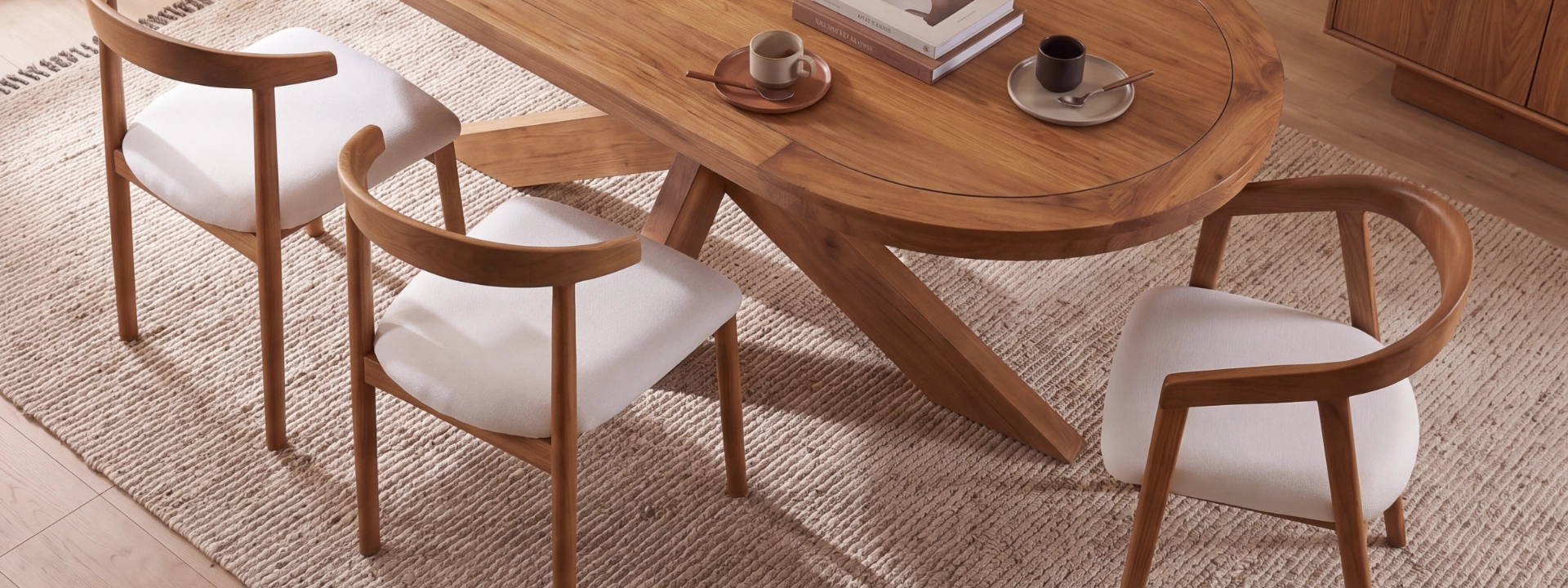

Oak furniture construction determines how a product handles loads, changing humidity and repeated use. A strong wood species cannot rescue a poorly located joint or a tabletop fixed so rigidly that it cannot move. The right construction begins with the intended product, then matches component dimensions, grain direction, joints and hardware to that use.
This guide focuses on design decisions rather than a step-by-step factory tour. It helps buyers read a drawing, question a sample and identify which details should be checked before production.
Key Takeaways
- Wood grain direction and moisture movement affect the way solid-oak components should be joined.
- Joint names alone do not prove strength; dimensions, fit, adhesive, fasteners and workmanship matter.
- A tabletop, cabinet door and chair frame need different movement and load decisions.
- Veneered panels and solid-oak frames can work together when their connection and edge details are specified.
- Buyers should review representative drawings, samples and any required finished-product tests, not infer durability from oak’s published material values.
Why Construction Matters in Oak Furniture
Oak can provide a useful combination of strength, workability and visible grain, but a finished piece behaves as an assembly. A chair transfers load through legs, rails and joints. A tabletop expands and contracts across the grain. A cabinet depends on panel construction, door gaps, hinges and alignment. Each product has a different path from material property to customer experience.
Published values for clear wood do not rate a finished chair or table. The USDA Wood Handbook’s mechanical-properties chapter describes how wood properties vary with moisture, grain and natural features. The buyer’s task is to verify that the proposed construction uses the material appropriately and that the complete item is checked for its intended use.
Ask the supplier for a component drawing, material schedule and representative sample. These show where oak is solid, where panels are veneered, how joints are formed and what can be inspected after assembly. A polished photograph of the outside can hide a weak connection or an unsuitable panel fixing.
Designing for Natural Wood Movement
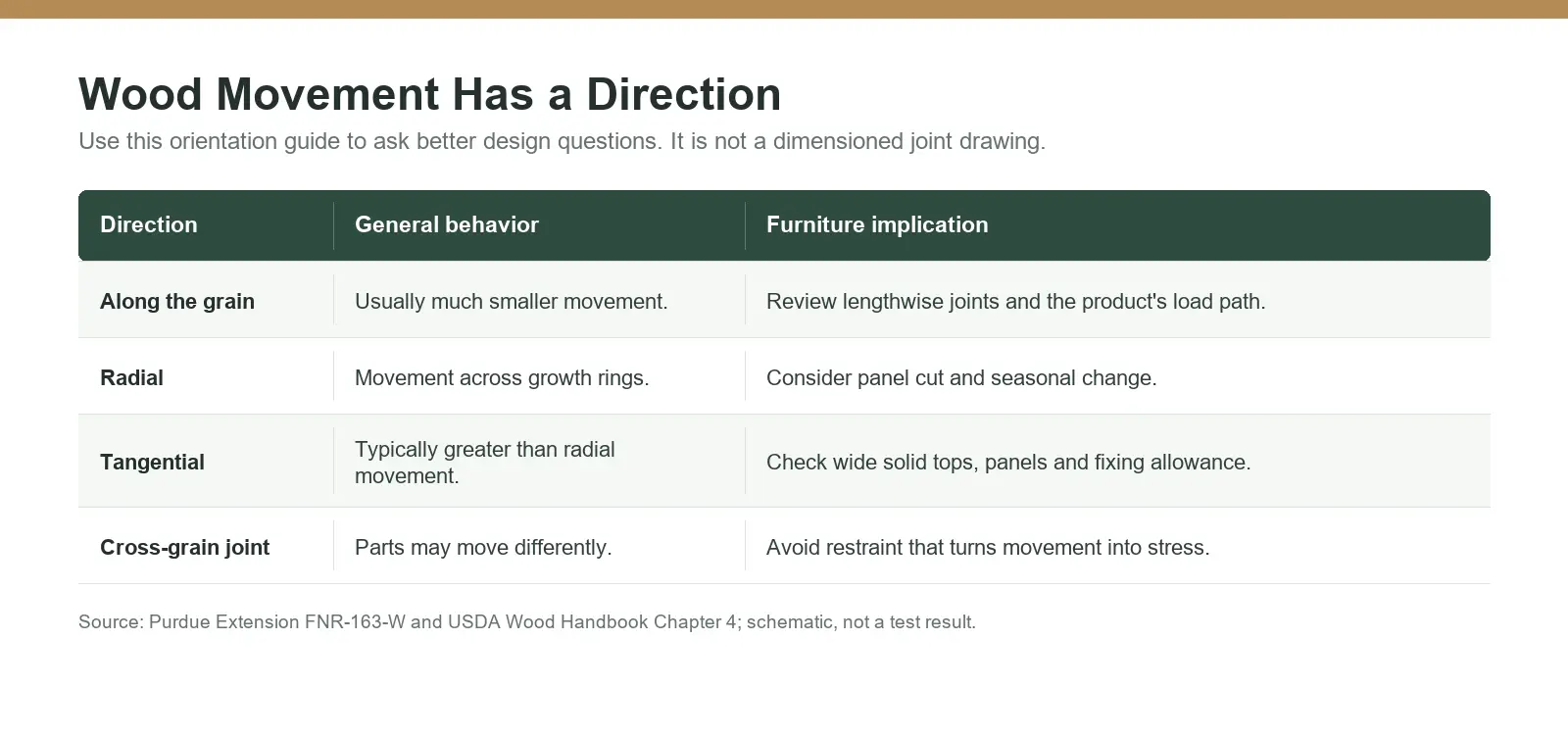
Solid wood changes dimension as it exchanges moisture with the air. Movement across the grain is more important to many furniture details than movement along the board. Purdue University’s study of wood shrinkage and swelling in furniture explains why changing humidity can create both visual and structural problems. Drying and coating do not remove the need to design for movement.
A broad top, panel or door may need room to change width without forcing the surrounding structure apart. The exact solution depends on grain direction, product dimensions and joint design. A cross-grain connection should be reviewed for the movement it permits. A fastener that holds a narrow rail well may not be the right way to restrain a wide top.
Oak wood moisture content belongs in the same design conversation. If stock enters assembly in unsuitable condition, even a thoughtful movement detail may be tested beyond its intended range. Conversely, good moisture records cannot make a rigid cross-grain joint flexible. Material control and design need to support one another.
Common Joinery Used in Oak Furniture
Mortise-and-tenon joints, dowels, mechanical connectors, screws and engineered joints can all have a place in furniture. None is automatically the best choice for every product. A joint that performs well in a chair rail may be unnecessarily complex for a removable cabinet component, while a connection suited to flat-pack assembly may need different inspection points.
The USDA Fastenings chapter explains that connection performance depends on wood grain direction, dimensional change and the fastening design. The USDA Wood Adhesives chapter adds the bonding conditions that matter to glued assemblies. These references provide principles, not a ready-made test certificate for an individual MrsWoods product.
For a mortise-and-tenon joint, examine member size, grain continuity, shoulder fit, glue surfaces and the load it will carry. For dowels, examine alignment, spacing, penetration and assembly consistency. For screws or bolts, consider edge distance, grain direction, access for maintenance and whether the fixing must allow a panel to move.
Ask what the supplier will inspect in production. A joint may have the correct name on a drawing while being badly machined or assembled. A sectioned development sample or controlled production photo can be more informative than a generic claim about craftsmanship.
Tabletop Construction
Tabletops make material decisions visible. A broad solid top may be assembled from several boards; the grain layout, board selection, adhesive joints and support connection all influence the result. A veneered top uses a different panel structure and edge detail. The two should be compared against the same appearance and service brief.
For a solid top, ask how the base connects to the top and where cross-grain movement can occur. Check whether a design uses rigid fixing across the full width. Examine the proposed edge profile, end grain exposure and any extension leaves or inserts. The way a table is cleaned and moved also affects the choice of finish and hardware.
Solid oak vs oak veneer furniture is therefore partly a construction question, not simply a label on a quotation. For product context, the MrsWoods dining collection shows the kinds of tables and seating that can be developed to a buyer’s specification. Confirm the actual component materials and connections for the specific product being ordered.
Cabinet and Door Construction
Cabinets combine panels, frames, doors, shelves, drawers and hardware. A large visible door may benefit from a controlled veneer layout, while solid oak can be used where an exposed rail, edge or shaped member calls for it. The exact allocation should follow the design and performance requirements.
Look closely at door gaps and the way doors hang. A cabinet that looks aligned on the sample day may need enough tolerance for production variation and service conditions. Examine hinge positions, fastening into the proposed substrate, edge finishing and how adjacent faces are matched.
If a solid panel is held inside a frame, check whether its connection accounts for expected movement. If a veneered panel is used, inspect the core, balance, bond and edge. The choice of panel cannot be evaluated from the face alone. A drawing should state both the visible material and the hidden construction that supports it.
Chair Frames and Load Paths
A chair experiences repeated loads, not only a static weight placed at its center. The forces travel through the seat, rails, joints and legs, and the geometry changes the demands on each connection. A small difference in published oak hardness says little about how a finished chair handles rocking, racking or repeated use.
Review grain direction in legs and rails, joint location, member dimensions and the support beneath an upholstered or wooden seat. Ask how the sample will be checked and whether the required market calls for a specific test. ISO 7173:2023 provides methods for assessing chair and stool structure; it does not mean every chair cited in an article has been tested or meets a particular requirement.
For event or rental seating, add handling and repeat-use conditions to the brief. Transport, setup and cleaning can expose weaknesses that a short showroom inspection misses. If stacking or knock-down assembly is proposed, evaluate those features as part of the product rather than assuming they are automatically suitable for all oak chairs.
Fasteners, Adhesives and Mixed Materials
Many furniture pieces combine oak with plywood, veneer, metal, stone, upholstery or engineered cores. Each combination introduces a connection detail. A metal bracket can restrain wood movement if placed without allowance. A heavy stone surface needs a base designed for its load and handling conditions. A veneer face depends on a sound bond to its substrate.
The bond or fastening system should be chosen for the materials, loads and expected environment. The USDA wood-bonding reference explains that surface condition and bonding process affect performance. Buyers need not prescribe a proprietary adhesive formula, but they should require a suitable material specification and sample evidence for critical details.
MrsWoods’ furniture development services support projects that combine materials and need drawings, samples and production follow-up. A good brief identifies which details are aesthetic, which are structural and which will be inspected or tested. That makes it easier to develop a product without confusing a visual preference with a performance requirement.
Common Construction Failures
Warning signs include an opening glue line, visible splitting at a fastener, a rocking chair, a table that twists on an even floor, misaligned cabinet doors or a shelf that deflects more than expected under its intended load. These symptoms deserve investigation, but a photograph alone may not establish their cause.
Look for patterns across several units. One damaged item may result from transport, while repeated joint movement may indicate a design or production issue. Check approved drawings, material records, assembly procedure and the conditions in which the defect appeared. Avoid assuming that the oak species alone explains every failure.
Corrective action should address the cause. Changing a finish cannot fix an undersized joint; adding a screw may not solve a panel held against its natural movement. Oak furniture quality testing and inspection should be selected for the actual product and defect risk, not as a generic badge on every furniture category.
What B2B Buyers Should Inspect
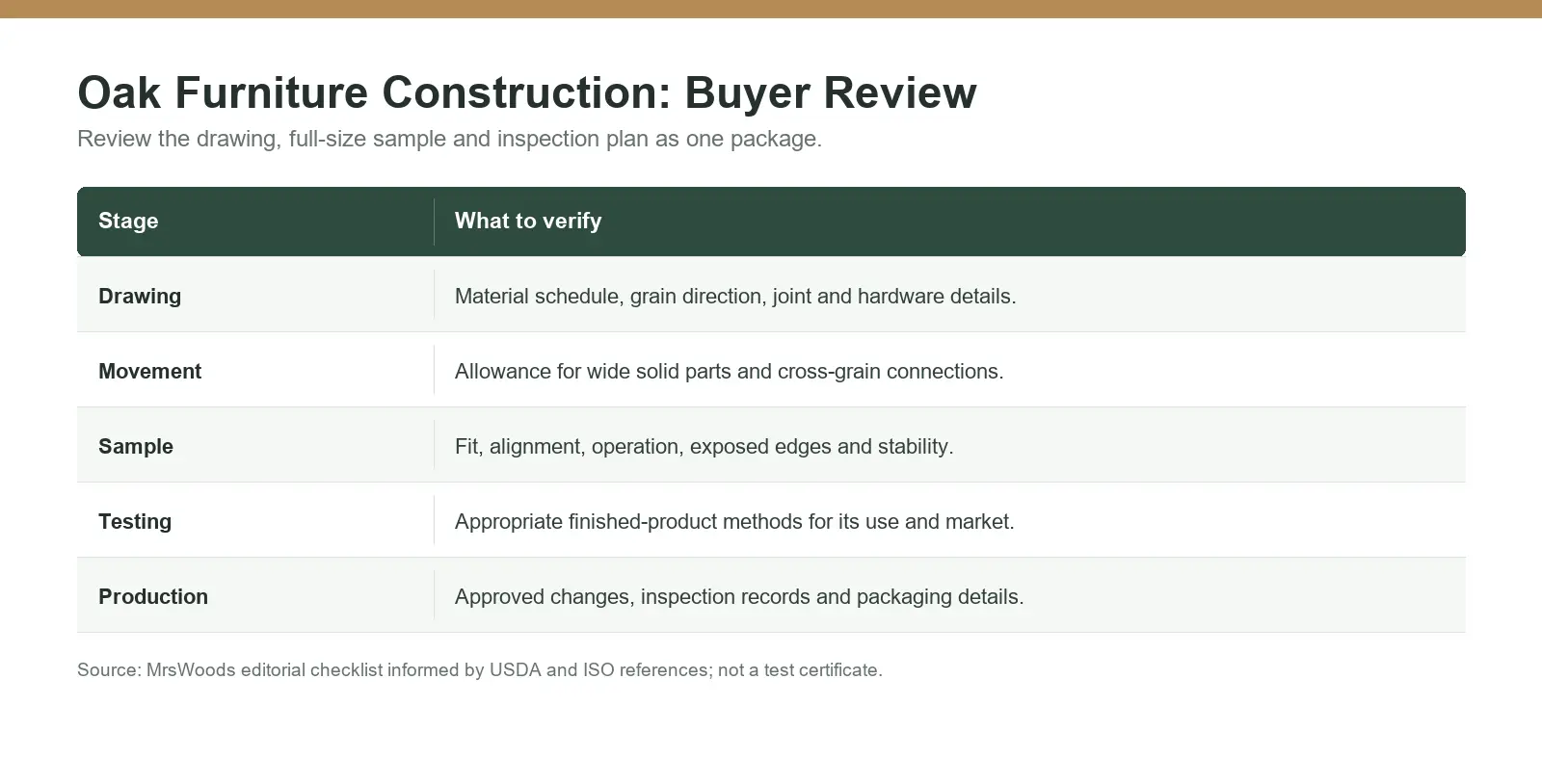
Begin at the drawing stage. Identify the material of each component, visible and hidden connections, expected movement, hardware and assembly method. Ask which dimensions and tolerances are critical. A supplier should explain the proposed construction in terms a buyer can approve.
At sample approval, inspect joints from more than one angle, open doors and drawers, check the product on a level surface and compare the finish across components. Where the design is new or the use demanding, agree on the relevant finished-product tests before mass production. Keep a signed reference sample and a change-control rule for substitute materials or revised connections.
For an OEM or ODM discussion, share MrsWoods your drawings, reference product, target dimensions, materials, use environment, quantity and destination market. The development conversation can then test whether the proposed structure is appropriate before tooling and production decisions become costly to change.
Frequently Asked Questions
What is the strongest joint for oak furniture?
There is no single joint that is strongest in every design. Performance depends on the members, grain direction, dimensions, load, machining and assembly quality.
Does a solid-oak top need room to move?
Generally, yes. A broad solid top can change width with humidity. Its connection to the base should be reviewed for the expected movement.
Can a cabinet combine solid oak and veneered panels?
Yes. The construction should identify each component, including the veneer core and edge, and use connections suited to those materials.
Does using oak mean a chair does not need testing?
No. Oak material values do not verify the complete chair. Apply the tests appropriate to its design, use and target market.
Conclusion
Good oak furniture construction makes the wood’s strengths useful while accounting for its movement and the loads placed on the product. The name of a joint or species is only the beginning; dimensions, connections, workmanship and finished-product checks complete the picture.
Buyers should approve component drawings, inspect a representative sample and define any required tests before production. Those steps help turn an attractive oak design into a product that can be made consistently and evaluated fairly.
