
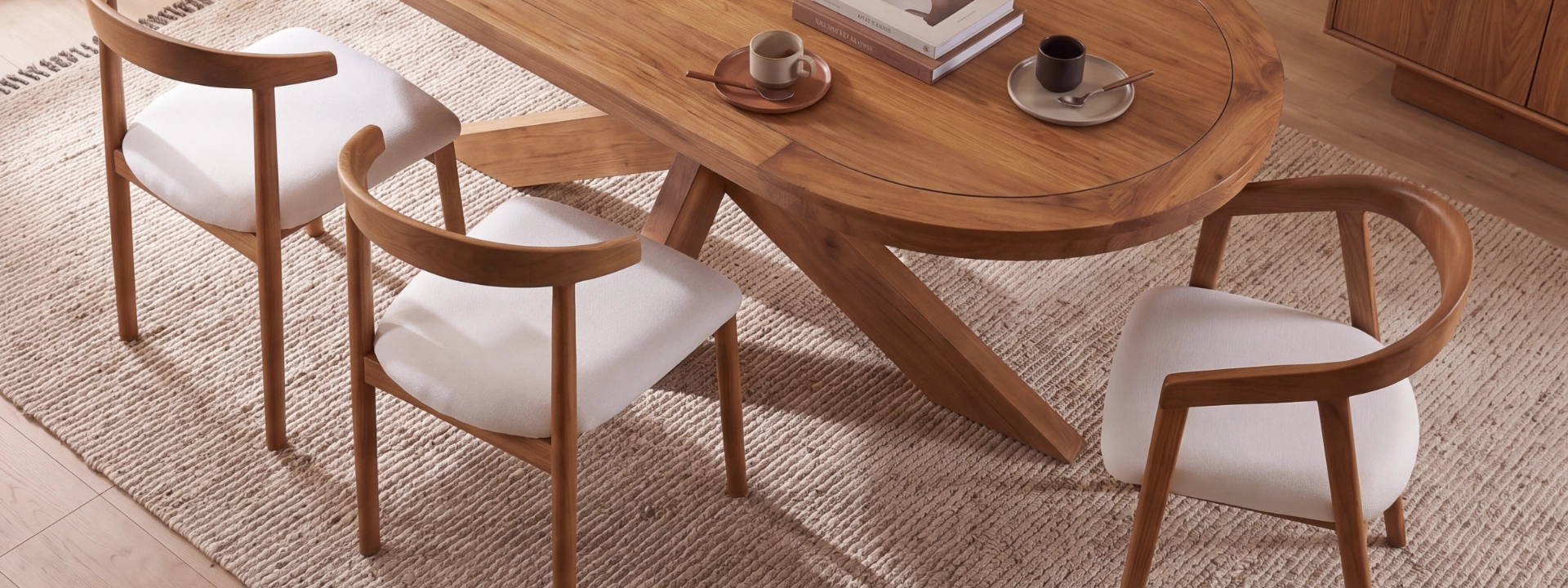

The most important oak wood properties for furniture include density, strength, hardness, stiffness, grain structure, moisture response, machining behavior, and finishing performance. Together, these characteristics explain why oak can work well for tables, chairs, cabinets, shelving, bed frames, and many other furniture categories.
However, oak is a natural material, not a standardized industrial material with identical properties from one board to another. Species, growing conditions, grain direction, moisture content, board selection, and natural features can all influence how the wood behaves.
For furniture buyers, understanding these properties is more useful than simply specifying “oak.” It helps explain why one construction works well while another may create unnecessary weight, movement, manufacturing difficulty, visual inconsistency, or cost.
This article expands on our earlier guide to the advantages and disadvantages of oak wood by looking more closely at oak from a wood-science and furniture-manufacturing perspective.
Key Takeaways
- Oak is a hardwood with vessels, fibers, rays, and growth-ring structures that influence both appearance and performance.
- Density, hardness, strength, and stiffness describe different material properties. No single number determines furniture quality.
- Oak is hygroscopic, so its dimensions change as moisture conditions change.
- Grain direction and board selection affect strength, machining, appearance, and dimensional movement.
- Good oak furniture depends on matching the material properties with suitable construction, moisture control, finishing, and quality standards.
What Makes Oak Different From Other Furniture Woods?
Oak is distinctive because of the combination of its wood anatomy, relatively high density, visible grain, vessels, rays, and growth-ring structure.
These characteristics are not simply aesthetic. The internal structure of wood affects how it carries loads, absorbs moisture, machines, accepts finish, and changes dimension.
Hardwood Anatomy
The term “hardwood” is botanical rather than a guarantee of physical hardness.
Hardwoods come from angiosperm trees and contain vessel elements, also called pores when viewed in cross-section. Softwoods generally rely on a different cellular structure. The USDA Wood Handbook: Structure and Function of Wood explains that the physical, mechanical, chemical, biological, and technological properties of wood are fundamentally connected to the fact that wood is formed as a biological structure.
For furniture buyers, this distinction matters because hardness is only one material property.
A wood can be hard but still require careful moisture control. Another material may have lower hardness but perform well in a specific construction. Density, stiffness, strength, grain direction, moisture behavior, and structural design therefore need to be considered together.
Ring-Porous Structure
Temperate oaks are commonly associated with a ring-porous structure.
In a ring-porous hardwood, large vessels are concentrated in the earlywood portion of the growth ring, while the later part of the ring contains smaller vessels and denser fibrous tissue. USDA uses northern red oak (Quercus rubra) as an example of this ring-porous structure.
This structure helps explain why oak can show stronger growth-ring patterns than many diffuse-porous woods.
It also explains why the surface appearance of oak is closely related to how a board is cut. ring-porous wood structure is therefore not only a botanical feature. It contributes directly to the grain that furniture designers and buyers see on the finished surface.
Growth Rings and Rays
Growth rings are only one part of oak’s visual character.
Rays are cells extending through the wood in the radial direction. In oak, these rays can be particularly noticeable. Depending on sawing orientation, they can form distinctive figures on the finished surface.
This is especially visible in quarter-sawn oak.
The result is important for furniture because the same species can present very different surfaces depending on board orientation, sawing method, grain selection, component dimensions, and finish.
Furniture buyers who require visual consistency should therefore specify more than the species name. Natural grain direction and board selection can become part of the product specification.
Density and Mechanical Properties of Oak
Terms such as density, hardness, strength, and stiffness are often used interchangeably in furniture marketing.
Technically, they describe different properties.
USDA Wood Handbook: Mechanical Properties of Wood also emphasizes that variability is common in wood because it is a natural material. Moisture, growing conditions, grain direction, knots, slope of grain, manufacturing environment, and service environment can all affect performance.
That means published values should be used to understand and compare materials, not as a guarantee that every finished furniture component will achieve exactly the same result.
Oak Property Data: American Red Oak vs American White Oak
The following image uses published values from the 2024 second edition of the American Hardwood Export Council Species Guide.
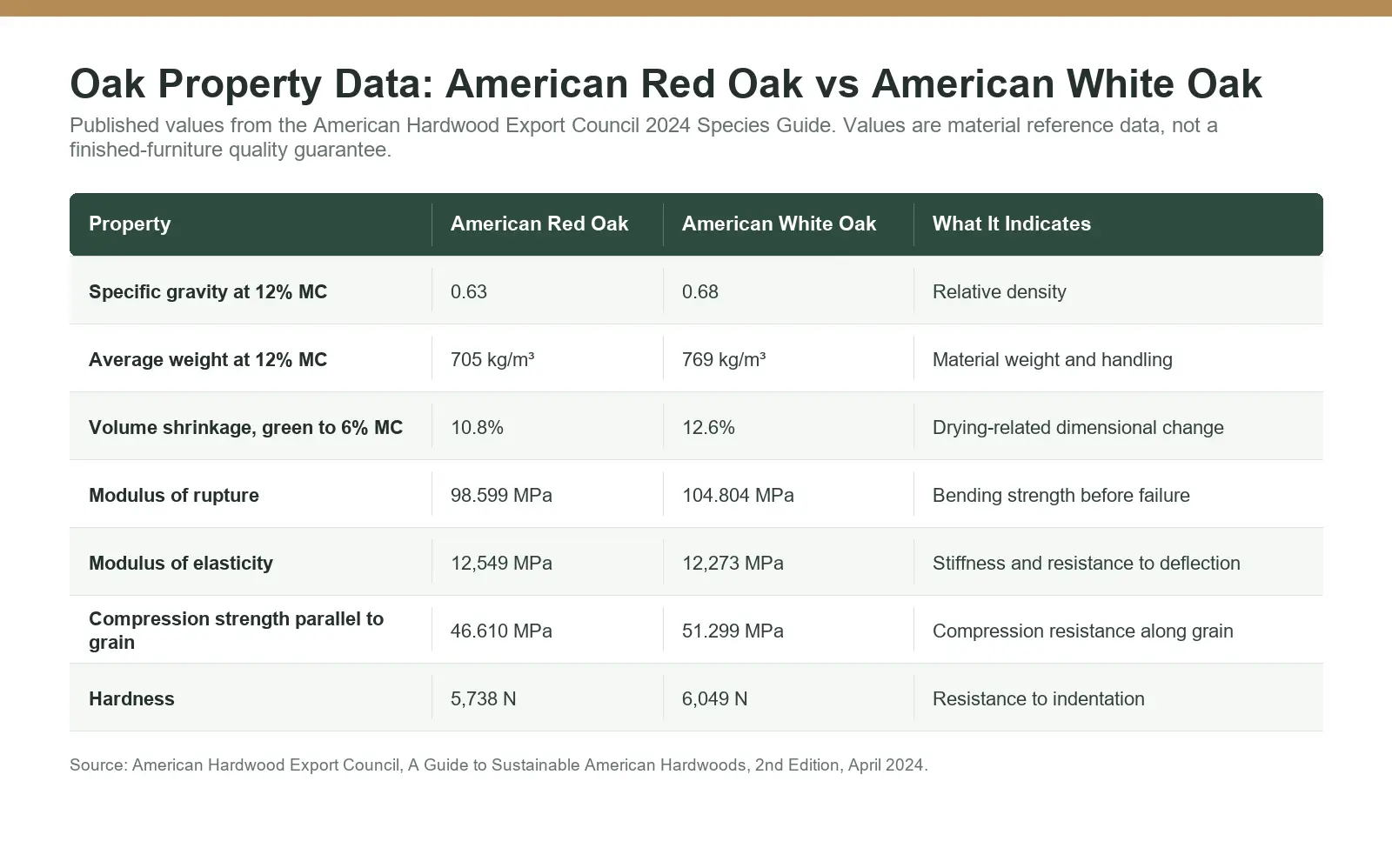
These values reveal an important point: wood performance cannot be reduced to one ranking.
White oak in this dataset is heavier and harder, with slightly higher bending and compression values. Northern American red oak has a slightly higher modulus of elasticity in the same dataset.
That does not mean one species is universally better. The correct choice depends on what the furniture component needs to do.
Density and Weight
Density affects more than how strong a piece of timber feels.
In furniture, a higher-density material can influence finished product weight, factory handling, packaging design, container loading, installation, and final-mile delivery.
For a large dining table or sideboard, greater weight may reinforce a substantial product feel. For furniture that must be moved frequently, lower weight may be commercially useful.
Material selection therefore needs to consider logistics as well as appearance and structure.
Hardness
Hardness describes resistance to indentation.
It can be relevant to furniture surfaces exposed to repeated contact, such as tabletops, desks, chair components, cabinet surfaces, and drawer fronts.
However, hardness is not the same as furniture durability.
A harder board can still perform badly if moisture is poorly controlled, construction is weak, or joints concentrate stress in the wrong direction. Furniture quality is always the result of a material working together with a construction.
Strength and Stiffness
Strength and stiffness also describe different behaviors.
Modulus of rupture (MOR) relates to bending strength before failure.
Modulus of elasticity (MOE) indicates stiffness, or how strongly a material resists bending deformation under load.
This distinction is useful in furniture.
For a shelf, stiffness can matter because excessive deflection may occur long before the material actually breaks. For a chair rail, table frame, or bed structure, load-bearing strength and joint design may become more important.
The appropriate choice depends on the component, dimensions, load, joinery, and product category.
Grain, Texture and Pore Structure
The visible oak wood characteristics that buyers notice are closely connected to the underlying anatomy.
AHEC describes American white oak as mainly straight-grained with medium-to-coarse texture. It also notes that the medullary rays in white oak are longer than those in red oak, producing a more pronounced figure. American red oak is also generally straight-grained and coarse textured, with a porous character that is easily identified from the end grain.
These differences can influence how furniture looks after sanding, staining, oiling, or coating.
Why Pore Structure Matters
The pores in oak influence both its appearance and how the surface interacts with finishing systems.
Red oak has a notably open, porous structure and absorbs treatments readily. White oak heartwood differs anatomically, including vessel characteristics that make it less open than red oak.
This means two pieces sold simply as “oak” should not automatically be expected to react identically to staining, pore filling, coloring, surface preparation, or coating.
For a furniture brand, this becomes important when developing a finish that needs to remain consistent across repeat orders.
Why Grain Matching Matters in Furniture
Natural variation may be attractive on a one-off table.
A commercial furniture program creates a different challenge.
A retailer or furniture brand may need dozens or hundreds of pieces to remain visually coherent. A sideboard may have several adjacent doors. A dining collection may contain a table, chairs, cabinet, and sideboard that need to read as one range.
That can require control over grain direction, board selection, color range, sapwood allowance, knot acceptance, veneer matching, and approved finish samples.
This is why furniture specifications often need to define what level of natural variation is acceptable.
A article on white oak vs red oak furniture will examine the species differences in greater depth, including appearance, pore structure, mechanical properties, and finishing.
How Does Oak Respond to Moisture?
Moisture behavior is one of the most important oak wood properties in furniture manufacturing.
Wood remains hygroscopic after drying. It exchanges moisture with the surrounding air, and this exchange depends on relative humidity, temperature, and the current moisture content of the wood.
USDA research on moisture relations and physical properties of wood provides the scientific foundation for understanding this behavior.
This matters because changing moisture content can change both dimensions and mechanical behavior.
Shrinkage and Swelling Are Directional
Wood does not expand and contract equally in every direction.
Its properties differ along the longitudinal, radial, and tangential directions. Dimensional change along the grain is usually much smaller than movement across the grain. USDA notes that tangential shrinkage is about twice as great as radial shrinkage, while longitudinal shrinkage in normal wood is generally much smaller.
This directional behavior is one reason broad solid-wood surfaces require more careful construction than a small component.
Changes across the grain are particularly important in furniture design. A wide tabletop, cabinet door, solid panel, or frame-and-panel construction therefore needs to accommodate natural wood movement rather than trying to eliminate it completely.
Moisture Control and Furniture Design Must Work Together
The AHEC data used earlier reports average volume shrinkage from green to 6% moisture content of 10.8% for northern American red oak and 12.6% for American white oak.
These figures should not be interpreted as the amount a finished table will move in normal indoor use.
They describe a much larger drying range. The more important point for furniture buyers is that oak responds to moisture, so material preparation and product construction must work together.
Correct drying, handling, storage, machining, packaging, and moisture control reduce the risk of major dimensional problems after production.
International furniture supply adds another variable: destination climate.
Furniture manufactured in one environment may eventually be stored and used under very different temperature and humidity conditions. That is why a responsible furniture specification should not rely on one universal moisture number without considering the market and end-use environment.
The dedicated guide to oak wood moisture content will examine EMC, drying, measuring methods, target conditions, destination climate, and common moisture-related failures in greater detail.
How Does Oak Machine and Finish?
Oak is widely used in furniture partly because it performs well through many common woodworking operations.
AHEC reports that both American white oak and American red oak machine well, perform well in nailing and screwing when handled properly, and can be stained and polished to a very good finish. Pre-boring may be recommended in relevant applications.
This does not mean production requires no control.
Machining and Grain Direction
Sawing, routing, drilling, shaping, sanding, and edge work interact with grain direction.
Areas where grain changes direction can behave differently from straight-grained material. Tool condition, cutting direction, feed rate, component geometry, and material selection can therefore influence the final surface.
For mass production, machining consistency becomes especially important.
A sample that looks good once is not enough. Components must fit and finish consistently across an entire order.
Sanding and Surface Preparation
A finish cannot fully hide poor preparation underneath it.
Inconsistent sanding, scratches, glue contamination, torn grain, uneven veneer preparation, or poor edge work can remain visible after staining or coating.
The USDA guide to finishing wood explains that finish selection and performance depend partly on the wood substrate itself. Finishes provide appearance, protection, and a cleanable surface, so the wood and coating system need to be considered together.
Staining and Finish Consistency
Oak’s pores and grain allow finishes to emphasize its natural surface character.
But for B2B buyers, the important question is not simply: “Can oak be stained?”
The more useful question is: Can the approved finish be reproduced consistently across production batches and future repeat orders?
A professional finish specification may need to define reference samples, color tolerance, sheen level, grain visibility, texture, edge treatment, acceptable natural variation, packaging protection, and inspection lighting.
The guide to oak furniture finishes will look more deeply at finish systems, oil, lacquer, stain, color control, surface preparation, and approval standards.
Which Oak Properties Matter Most in Furniture?
Not every furniture category needs the same combination of material properties.
The image below translates the technical principles discussed above into practical furniture-development decisions.
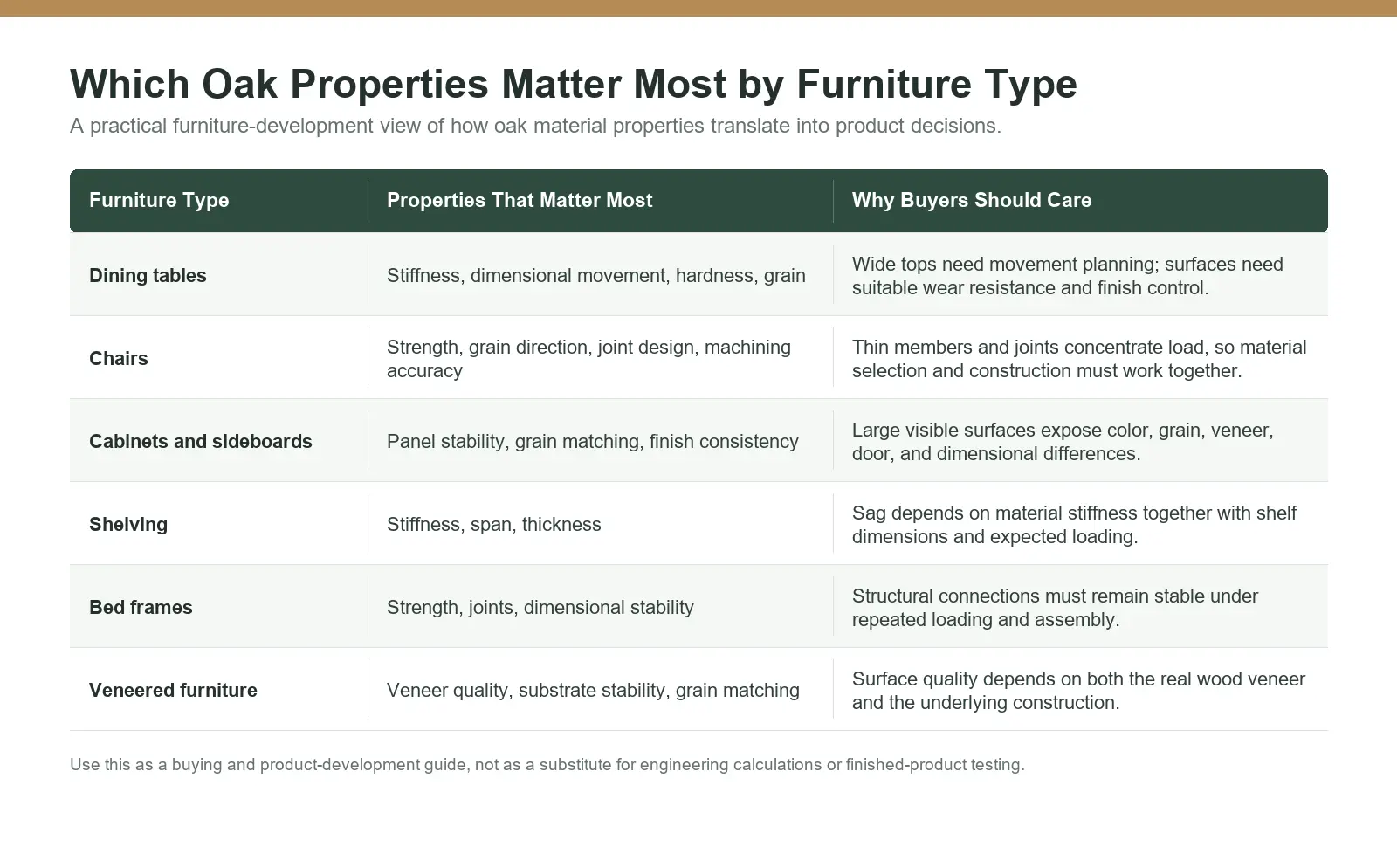
This is not a substitute for engineering calculations or finished-product testing. It shows why oak for furniture should be specified according to the component and end use rather than treated as a single generic material.
For example, the most important question for a chair rail may be grain direction and joint strength.
For a wide cabinet front, dimensional stability and appearance may matter more.
For a tabletop, the buyer may care about hardness, finish, moisture response, and how the construction allows wood movement.
That is why material selection and furniture engineering need to happen together.
This is also where solid oak vs oak veneer furniture becomes important. Solid wood and veneer are not simply “good” and “bad” choices. They behave differently, solve different design problems, and suit different price positions.
Article on oak furniture construction will examine joinery, wood movement, rails, panels, frames, fasteners, and design methods in more detail.
What Do These Properties Mean for Furniture Buyers?
For B2B buyers, the value of wood-science data is not memorizing numbers.
It is knowing which questions to ask before a product enters mass production.
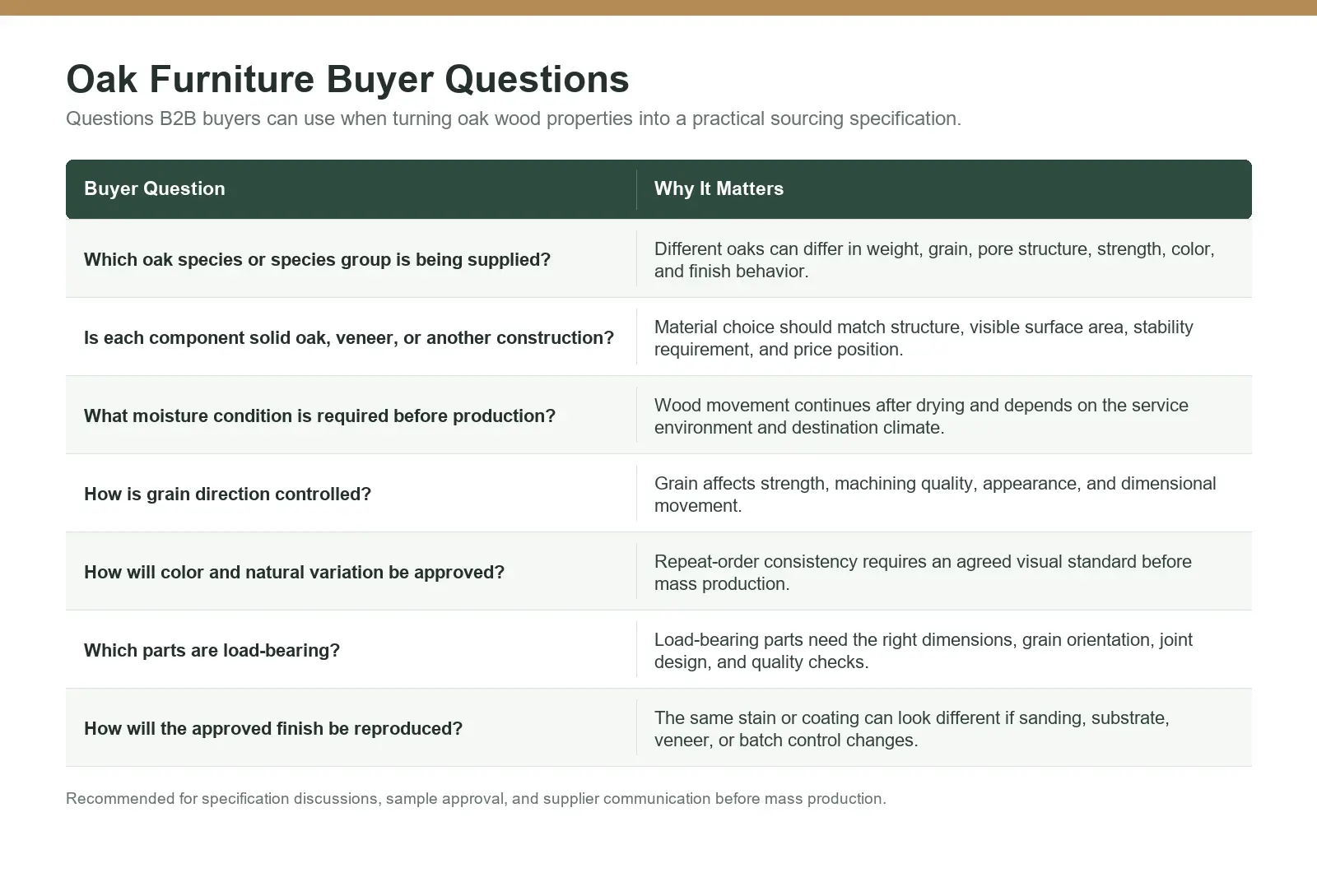
These questions help buyers move from a simple material label to a working specification.
For example, “oak dining table” is not enough information for a serious sourcing conversation. A better specification may need to define species group, solid wood or veneer construction, moisture condition, tabletop structure, edge detail, finish sample, packaging, testing requirements, and acceptable natural variation.
This is where supplier capability becomes important.
An experienced furniture supplier should be able to explain how oak material properties are managed during sourcing, drying, machining, construction, finishing, inspection, packaging, and shipment.
For buyers who want to evaluate finished products more deeply, the guide on how to tell if oak furniture is high quality will connect material knowledge with inspection, construction, finish, packaging, and long-term use.
For custom projects, ODM/OEM collections, repeat orders, or retailer programs, MrsWoods can support furniture buyers from product development to sourcing, sampling, production coordination, quality control, and export delivery.
If you are developing oak furniture for a brand, retail program, hospitality project, or event-rental collection, you can contact MrsWoods with drawings, reference images, target dimensions, material preferences, quantity, budget position, and destination market.
Our team can help review the practical implications of material choice, construction, finish, packaging, and production control before mass production begins.
FAQ
Is oak a hardwood?
Yes. Oak is a hardwood in the botanical sense because it comes from angiosperm trees and contains vessels or pores. However, “hardwood” does not automatically mean every hardwood is physically harder than every softwood.
Is oak strong enough for furniture?
Yes, oak can be strong enough for many furniture applications, including tables, chairs, cabinets, shelving, and bed frames. But strength alone is not enough. The final performance also depends on moisture control, grain direction, component dimensions, joinery, construction, and finish.
Is white oak stronger than red oak?
In the AHEC 2024 dataset used in this article, American white oak has higher reported hardness, modulus of rupture, and compression strength than northern American red oak, while northern American red oak has a slightly higher modulus of elasticity. This does not make one species universally better. The best choice depends on product function, appearance, budget, availability, and production requirements.
Does oak expand and contract?
Yes. Oak, like other wood, is hygroscopic. It exchanges moisture with surrounding air, so its dimensions can change as moisture conditions change. This movement is directional and is much more important across the grain than along the grain.
Why does oak have such a visible grain?
Oak’s visible grain is related to its ring-porous anatomy, growth rings, vessels, and rays. The way a board is cut also affects how the grain appears on the finished surface.
What should buyers check when sourcing oak furniture?
Buyers should check the oak species or species group, whether components are solid oak or veneer, moisture condition, grain direction, load-bearing parts, finish approval, natural variation standard, packaging, and quality-control process
Conclusion
Oak is valued in furniture because its density, mechanical properties, grain structure, moisture behavior, machining performance, and finishing response can create strong and visually distinctive products.
But these benefits are not automatic.
Oak works best when its material properties are understood and managed through suitable drying, board selection, construction, machining, surface preparation, finishing, inspection, packaging, and destination-market planning.
For furniture buyers, the key lesson is simple: do not stop at the word “oak.” Ask which oak, which construction, which moisture condition, which finish standard, and which quality-control process will be used.
That is how oak changes from a material label into a reliable furniture specification.
