
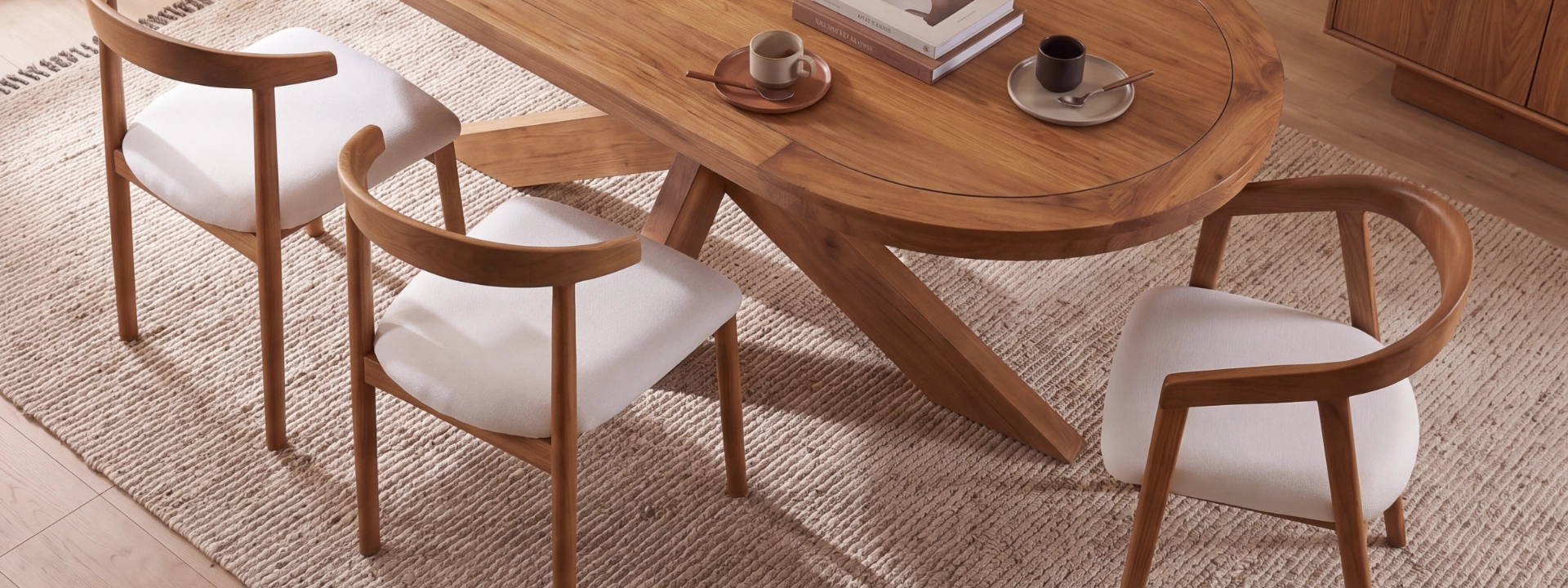

Oak wood moisture content matters because wood continues to exchange water vapor with the air after furniture is made. If the material, workshop and destination environment are poorly matched, solid components can swell or shrink, and visible joints or panels may change. A number on one meter reading is not a complete quality guarantee.
For furniture brands and project buyers, moisture control is a chain of decisions: drying, storage, measurement, construction, finishing, packing and the conditions in which the furniture will be used. The aim is not to promise that oak will never move. It is to reduce avoidable problems and design for the movement that remains.
Key Takeaways
- Moisture content is the mass of water in wood expressed relative to the mass of the wood after oven drying. It is not the relative humidity of the room.
- Oak responds to its surrounding environment even after kiln drying. Transport and storage conditions can change a board before it enters production.
- There is no single moisture-content target suitable for every market, furniture design and service environment.
- Wide solid panels, cross-grain joints and poorly conditioned components deserve particular attention.
- Buyers should request a measurement method, sampling plan, records and an approved construction, not just a supplier’s verbal assurance.
What Is Wood Moisture Content?
Wood moisture content, or MC, describes how much water a piece of wood contains. It is commonly expressed as a percentage of the wood’s oven-dry weight. This is different from relative humidity, which describes the surrounding air. The two are connected, but they are not the same measurement.
The USDA Forest Products Laboratory’s moisture chapter explains wood’s relationship with water and its effect on physical properties. A freshly cut board can contain substantial water. Drying removes much of it, but does not make the board permanently moisture-free.
A specification should say what material is being measured and when. A reading taken from rough lumber at receipt is not equivalent to a reading from a machined component before assembly. A veneer face, solid leg and composite core also require different interpretation. Record the measurement alongside the component and stage of production.
Why Does Oak Exchange Moisture With the Air?
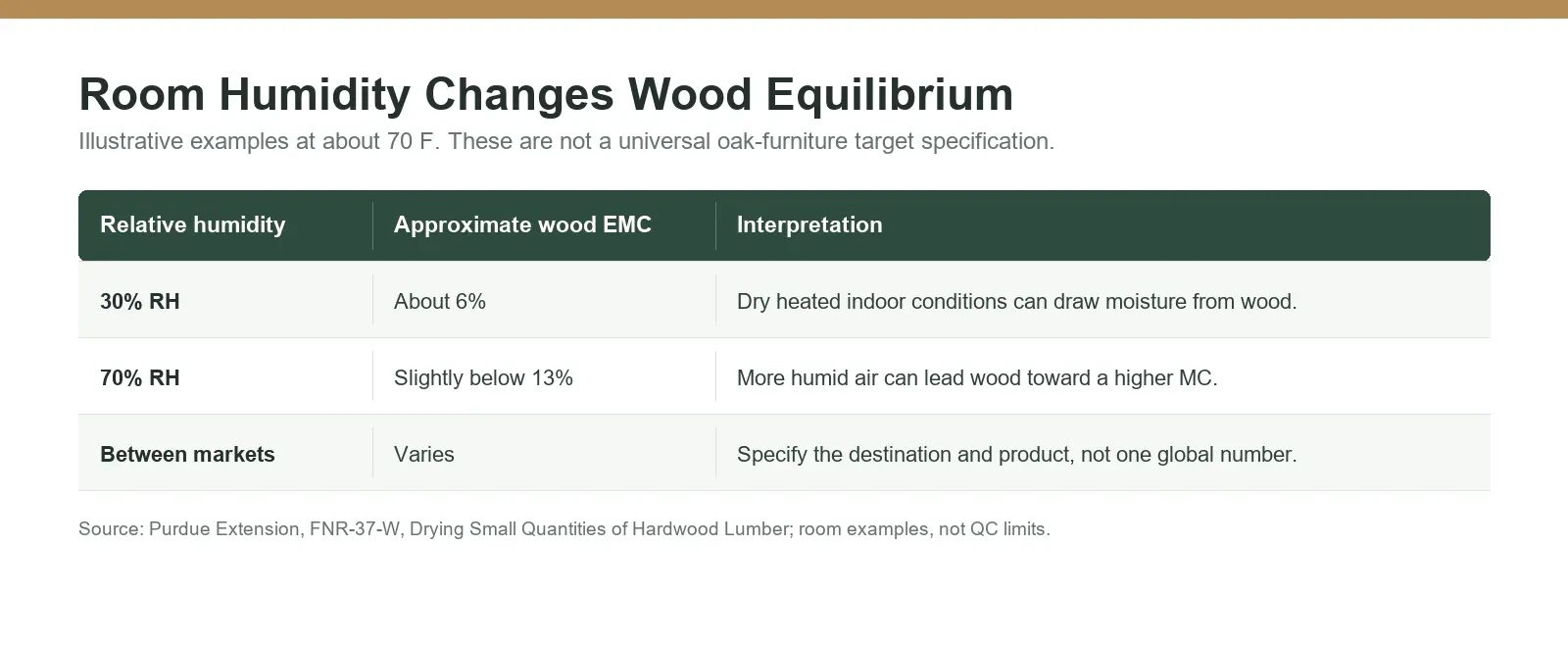
Oak is hygroscopic: it takes up moisture from humid air and releases it when the air is drier. Temperature and relative humidity influence this exchange. After enough time in relatively stable conditions, wood approaches an equilibrium moisture content, or EMC, for that environment.
The environment is rarely stable throughout a furniture supply chain. Kiln-dried wood may wait in a warehouse, move into a production area, travel in a container and arrive in a climate unlike the one where it was assembled. Each stage can expose it to a different temperature and humidity pattern.
Purdue University’s furniture-focused study, The Shrinking and Swelling of Wood and Its Effect on Furniture, explains that kiln drying does not prevent later moisture exchange. A finish may slow that exchange, but generally does not stop it. This is why a shipping destination matters to product planning, not only to logistics.
How Moisture Changes Oak Dimensions
When wood loses or gains bound water, it changes dimension. The amount of movement differs by grain direction. Movement along the length of a board is usually much smaller than movement across its width. Radial and tangential directions also differ, so the way a board is cut and oriented matters.
The USDA moisture and physical-properties reference distinguishes these directions and the conditions under which published shrinkage values are measured. A figure describing drying from green wood to a specified MC must not be presented as the seasonal movement of a finished tabletop. A buyer needs the dimensions, grain orientation and expected humidity range to discuss a real component.
For a wide solid-oak door or top, small changes across each board can accumulate. For a narrow rail, the absolute change may be less visible. This does not mean one component needs no allowance; it means the design must respond to its geometry. The structure that holds a top or panel can either accommodate movement or constrain it in a damaging way.
What Happens When Moisture Is Poorly Controlled?
Poor moisture management can appear as gaps, cupping, warping, a raised joint, sticking doors, a cracked panel or a finish line at an opening joint. None of these symptoms has only one possible cause. Machining, grain selection, assembly, hardware and use conditions also need examination.
Consider a tabletop assembled from boards that have not reached suitable production conditions. If the top later loses moisture, its width can decrease. If it is rigidly fixed across the grain, the connection may add stress rather than allow the top to move. Conversely, a component that takes up moisture in a humid room may press against a tight frame or change a door gap.
The USDA chapter on drying and dimensional-change control addresses drying, storage and moisture control during transit. For a buyer, the practical lesson is to inspect the entire process. A kiln certificate alone does not prove that boards stayed in condition between drying and assembly.
What Moisture Content Should Furniture Have?
There is no single global number that every oak furniture order should meet. A suitable target depends on the expected indoor environment, component design, material construction and agreed tolerance. A dry, heated interior and a humid coastal interior may place different demands on the same product.
Purdue’s hardwood drying guidance provides U.S. examples of moisture content selected with the expected service environment in mind. Those examples help explain the principle; they should not be copied into a worldwide contract as a universal oak standard. Ask the supplier to propose a target and tolerance for the destination and describe the basis for them.
Specify the stage at which the target applies. An agreed reading for solid parts before assembly may not match a later surface reading on a fully finished item. If the product combines solid oak with veneered panels, identify which materials are covered by each requirement. This is more useful than placing “8% MC” on a purchase order without saying where, when or how it will be checked.
Kiln Drying and Conditioning
Kiln drying brings lumber toward a controlled moisture range more predictably than simply leaving it outdoors. Drying schedules also need to manage defects such as checking, internal stress and distortion. The USDA drying chapter explains why drying and subsequent handling must be considered together.
After drying, boards should be stored and conditioned for the environment in which they will be machined and assembled. Mixing fresh arrivals with stock held under different conditions can create variation within one production batch. Buyers do not need to prescribe the supplier’s entire kiln schedule, but they should know the material acceptance process and how out-of-range stock is handled.
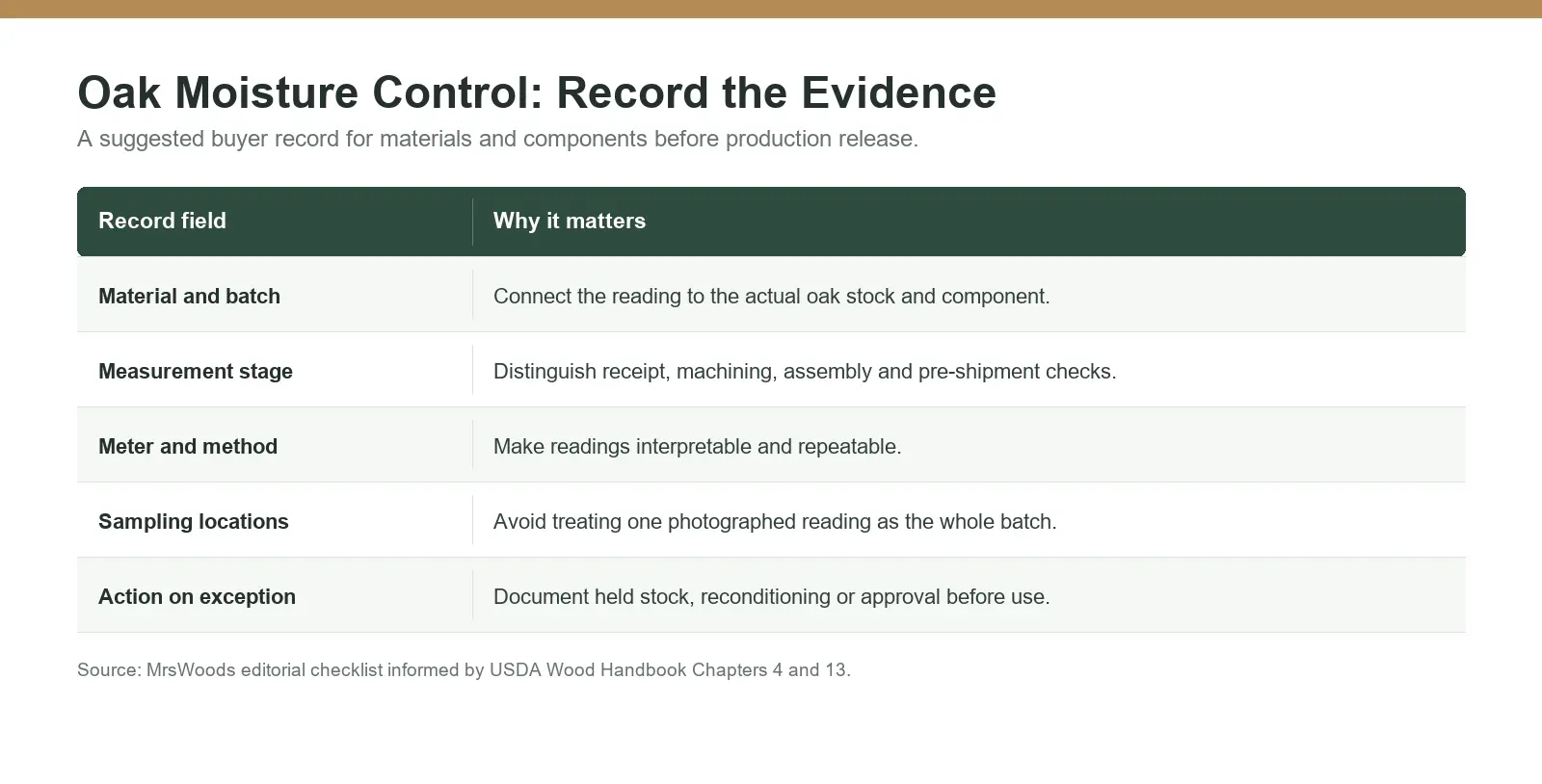
Ask whether moisture readings are made at receipt, before machining and before critical assembly steps. A record is more valuable when it identifies the batch, species group, meter, measurement date and sampled components. If a wide panel is assembled from several boards, a few readings on unrelated stock provide limited assurance.
Measuring Moisture Before Production
Handheld meters can help screen wood in production, but a displayed number has to be interpreted. Instruments may use different measurement principles, and the correct procedure depends on the meter and material. Readings can be affected by measurement depth, temperature, species settings or an unsuitable contact point.
The USDA drying and control reference covers moisture-content determination. In a sourcing specification, request the agreed meter method, any necessary correction, sampling locations, acceptance range and escalation process. Do not rely on a single photograph of a meter pressed against one board as evidence for an entire order.
For critical components, keep traceable records. A simple inspection record can show the material batch, component, reading, date, inspector and action taken. If the reading is outside the approved range, the supplier should identify the affected stock and resolve it before it is hidden inside a finished item.
Export Markets and Climate Differences
Export furniture may pass through several climates before it reaches its final room. A container, warehouse and showroom are not the same as the intended service environment. Packing can protect a product from handling damage, but it cannot erase a mismatch between material condition and product design.
For repeat orders, discuss the destination market early. A brand distributing to several regions may need to check whether one construction and acceptance range suits all of them. Broad solid panels, combined materials and tight-fitting doors deserve special review. Oak furniture construction should make sensible allowance for expected movement; moisture control alone cannot solve a rigid cross-grain connection.
At MrsWoods, furniture sourcing and development services can connect material selection, samples, inspection criteria, packaging and export planning. Buyers should still agree on the conditions and evidence required for their particular product and market. The most useful conversation starts before mass production, when the drawing can still be adjusted.
What Buyers Should Ask Suppliers
A buyer does not need to operate the kiln to ask good questions. Start with the proposed oak species or group, component construction, drying source and destination environment. Ask when the supplier measures MC, what instrument and sampling method it uses, and what happens when stock is outside the agreed range.
Then examine the finished product. Are wide panels fixed in a way that allows movement? Are visible doors and tops approved under the intended finish? Is the sample representative of production stock? How will the supplier document changes in a repeat order? These questions connect moisture science to the product being purchased.
For a new collection, send MrsWoods drawings or reference images, dimensions, material preferences, expected quantity and destination markets. That gives the development team a basis for proposing materials, samples and an inspection plan rather than offering an unsupported universal MC number.
Frequently Asked Questions
Does kiln-dried oak stop expanding and contracting?
No. Kiln drying reduces moisture content, but oak can still exchange moisture with the air after manufacturing. Construction and service conditions remain important.
Is 8% the correct moisture content for every oak table?
No. An appropriate target depends on destination conditions, component design, timing and measurement method. Agree on a justified range for the specific order.
Can a finish prevent oak from moving?
No. A finish can slow moisture exchange, but it does not make solid wood dimensionally inert. Design wide panels with expected movement in mind.
Is one meter reading enough to approve a furniture batch?
No. Use a documented sampling plan that identifies the material and components checked, the method, results and any corrective action.
Conclusion
Managing oak wood moisture content means more than reaching a number at the kiln. Drying, storage, measurement, construction and the destination environment all influence what happens after assembly. A responsible supplier should be able to explain how those steps fit together for the proposed product.
For buyers, the strongest specification states what is measured, when it is measured, the agreed range and how exceptions are handled. Pair those records with a movement-conscious design and a representative approved sample. That is a more credible route to consistent furniture than promising that oak will never change.
